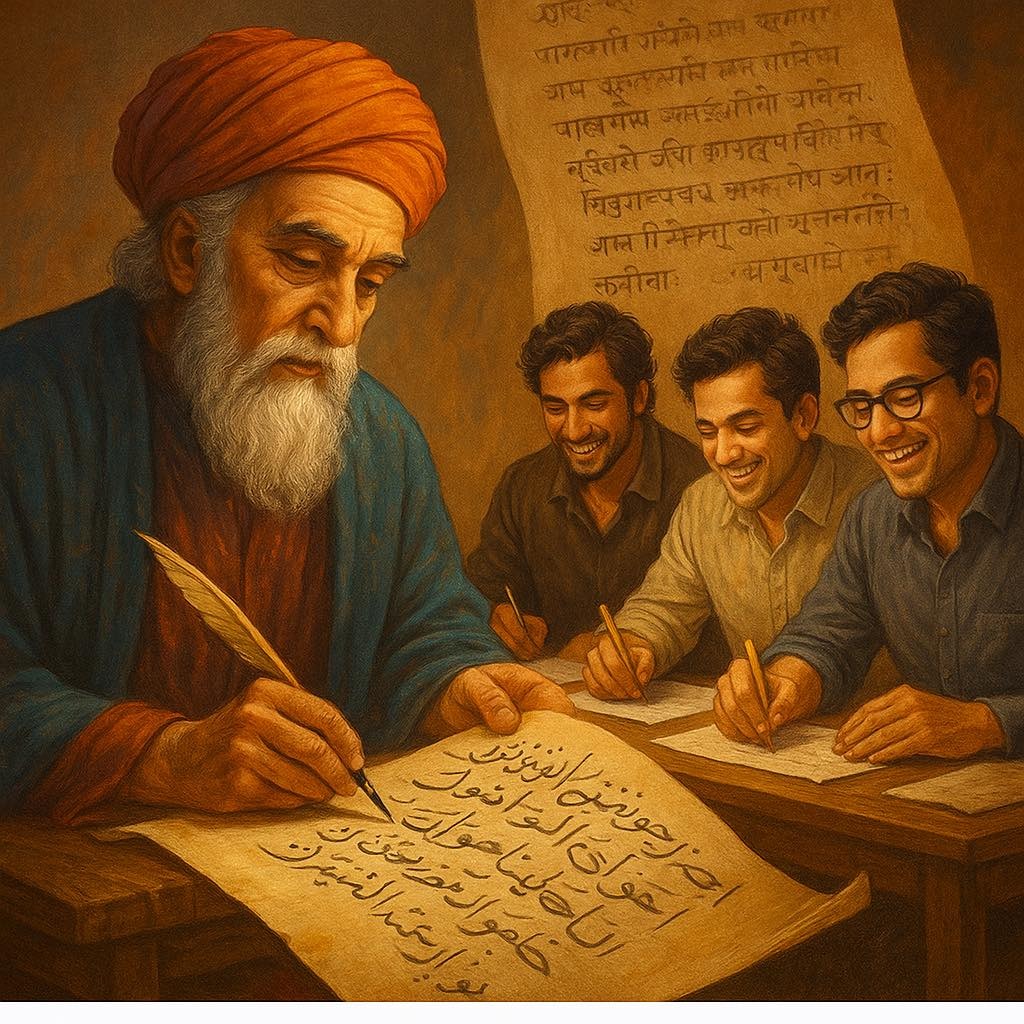
“Zaban-e-Urdu hai jiska naam,
Woh Hindustan ki jaan hai.”
The language called Urdu is the life of Hindustan.
Prologue: A Flight, a Word, a Realization
It was while flying over the Black Sea that I noticed a town on the Turkish coast—Ordu.
The name struck me. It echoed something deeper in my memory. Urdu. Could there be a connection? I looked it up. Indeed, Ordu in Turkish means army camp, derived from Orda, the root of the Mongol horde—and Persian Urdu. From that moment in the air, my curiosity took flight too.
I realized this wasn’t just a coincidence of syllables. This was the origin of a language—a name carried across continents, across empires, into the heart of Delhi, and into the soul of Hindustan.
What we call Urdu today was once literally the language of the camp—a fusion of tongues, cultures, and histories that converged not by conquest alone, but by the human necessity to speak, to connect, to create common meaning.
I. The Language of Fusion, Not Faith
Let us be very clear: Urdu is not a religious language. It is not “Islamic.” It is Hindustani in the truest sense.
It is the product of centuries of fusion, of encounter, of shared songs, marketplaces, mehfils, and shrines. It emerged when Persian-speaking administrators, Turkish soldiers, Arabic theologians, and Indic poets all found themselves camped in Delhi—needing to understand each other, to trade, to rule, to write poetry, to love.
Urdu is not a foreign implant. It is what happened when Hindustan absorbed the world and made something beautiful of it.
II. Amir Khusrau and the Dawn of a Common Tongue
The 13th-century poet Amir Khusrau, born of a Turkish father and Indian mother, wrote in Persian and a vernacular he proudly called Hindavi. His lines are unmistakably local, playful, and profoundly Indic:
“Chaap tilak sab chheeni re mose naina milaike…”
“You’ve stolen all my adornments with just a glance.”
Or:
“Mera piya ghar aaya, Ramzan ki raat…”
“My beloved has returned home, on the night of Ramzan.”
In these verses, one finds no walls of religion, only human longing, spiritual depth, and artistic freedom.
III. From Bazaar to Bait: Delhi as the Heart
As the Mughal Empire grew, Delhi became the melting pot of the subcontinent. Traders, soldiers, poets, saints, and musicians—each brought their language.
This is why Delhi became the crucible where Urdu was cooked.
Not imposed. Not legislated. Emerged. Like steam from boiling rice.
The spoken dialect of Delhi—Khariboli—blended with Persian idiom, Arabic vocabulary, Turkish honorifics, and Indic rhythm to form a common linguistic currency.
By the 17th century, poets in Delhi called their verse Rekhta (meaning “scattered” or “mixed”), celebrating its hybrid form. It wasn’t until Ghulam Hamadani Mushafi around 1780 that the language was called plainly, “Urdu.”
IV. Urdu’s Literary Bloom: Mir to Ghalib
Urdu quickly became the language of expression, of grief, longing, satire, resistance, and love.
Poets like Mir Taqi Mir, Mirza Ghalib, and Nazeer Akbarabadi turned it into a full-fledged literary vehicle—rich in metaphor, cosmopolitan in scope, deeply human in soul.
Mir writes:
“Ibtidaa-e-ishq hai rotaa hai kya…”
“It’s the beginning of love, why are you already crying?”
Only a language this textured could hold such paradox.
V. Bollywood: The Echo Chamber of Hindustani
Today, Urdu is the language of Bollywood—and of every Indian and Pakistani who watches a Shah Rukh Khan movie, sings a Lata Mangeshkar song, or reads a script by Salim-Javed.
What we casually call “Hindi films” are, in truth, Urdu scripts written in Devanagari script, with dialogues like:
“Kabhi kabhi mere dil mein khayal aata hai…”
“Sometimes, a thought arises in my heart…”
Try writing that in Sanskritized Hindi—it loses all its softness.
This is the everyman’s Urdu—not elite, not foreign, not Muslim—Hindustani.
VI. Misconceptions and Myopia: Urdu ≠ Pakistan, Urdu ≠ Islam
Today, some claim Urdu is not Indian, that it is a “Muslim” tongue, or a colonial remnant. But this is intellectual vandalism.
The truth is: Urdu is the only language in the subcontinent that was not born in a temple or court alone, but in streets, tents, sufi shrines, qawwalis, and folk ballads.
When a Bengali in London speaks to a Balochi in Paris,
they speak not English.
They speak this Urdu.
The language of Shahrukh, of Faiz, of Mehdi Hassan, of Begum Akhtar.
The language that wraps grief in ghazals and joy in jugalbandi.
VII. A Language that Belongs to All of Us
This is not Pakistan’s language.
It is not India’s alone.
It is not about religion.
It is about belonging.
From Khusrau to Kaifi Azmi, from Bulleh Shah to Bollywood, Urdu has held Hindustan’s contradictions together.
VIII. Final Word: A River Called Urdu
Languages, like rivers, don’t obey borders. They flow where they are needed.
Urdu flowed from Ordu, the Turkish camp, into the camps of Delhi, and into the hearts of millions. It brought with it the dust of journeys, the hush of longing, the fire of rebellion, and the fragrance of love.
“Zaban-e-Urdu hai jiska naam,
Woh Hindustan ki jaan hai.”
“The language called Urdu is the soul of Hindustan.”
Let no one steal this truth.
https://www.facebook.com/share/p/1YwXi5G6K5/?mibextid=wwXIfr