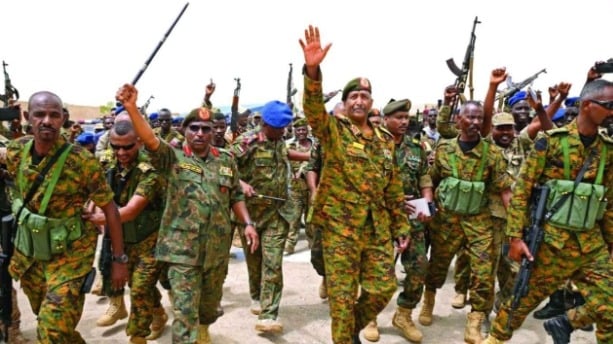
The Liberal website obtained an official secret document that reveals the features of a political project led by the leadership of the Sudanese Armed Forces to reshape the political and constitutional scene in the country during the next phase.
The document, which includes direct instructions from the Chairman of the Sovereignty Council, Lieutenant General Abdel Fattah al-Burhan, reveals a plan based on managing Sudan through a military authority that extends for five years, with a rearrangement of decision-making centers, limiting international initiatives, and relying on regional alliances to provide political and diplomatic cover for the project.
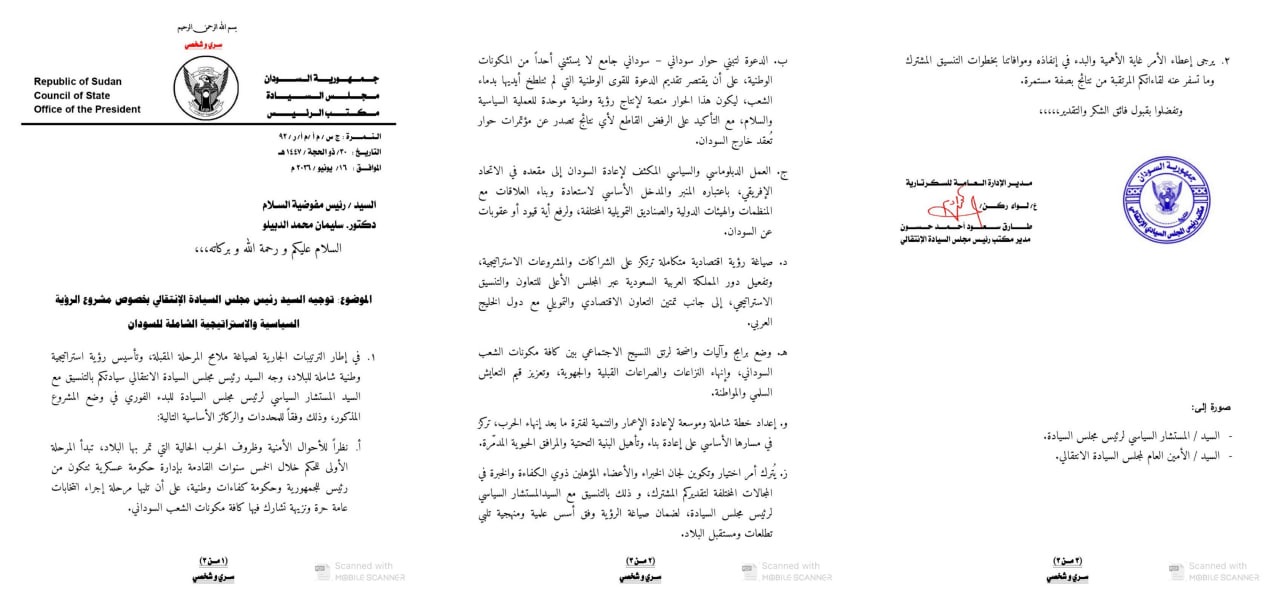
The document, issued by the Office of the Chairman of the Sovereignty Council dated June 16, 2026, includes direct instructions from Burhan to begin preparing “the comprehensive political and strategic vision for Sudan.” The plan stipulates managing the country through a military government that includes a President of the Republic and a government of national competencies for five years, followed by general elections, reflecting a direction towards consolidating the role of the military institution in leading the next phase.
The document included a call for a “Sudanese-Sudanese” dialogue in which national forces that “have not stained their hands with the blood of the people” participate, with the rejection of any results issued by conferences or initiatives held outside Sudan. Analysts see this direction as an attempt to circumvent international and regional pressures aimed at launching a comprehensive political process, and confining the settlement path within a framework controlled by the military authority.
The document also outlined the features of the economic and diplomatic vision of the project, through strengthening cooperation with the Kingdom of Saudi Arabia through the Supreme Council for Strategic Cooperation and Coordination, in addition to expanding economic partnerships with Gulf countries, and working to restore Sudan’s membership in the African Union in a way that contributes to alleviating isolation and international restrictions. This coincided with drawing up a vision for the post-war phase that focuses on the reconstruction of infrastructure and vital facilities, as one of the basic pillars for restoring stability.
These orientations explain the noticeable decline in the role of the Peace Commission, which was established after 2019 to handle negotiations with armed movements and oversee the implementation of the Juba Peace Agreement.
Recent developments indicate a gradual transfer of the peace file from civilian institutions to sovereign and military bodies in Port Sudan, which reflects the army leadership’s desire to tighten control over this file and manage it away from the frameworks produced by the transitional phase.
At the same time, analysts see that the condition of excluding those “whose hands are stained with the blood of the Sudanese” carries political connotations that go beyond being a criterion for participation in the dialogue, as it may be used to present the military institution and its leadership as the protector of the state, distancing it from accusations related to human rights violations and war crimes, which grants it broader space to lead the next phase and reshape the political scene.
On the regional level, Burhan seeks to secure political support for his project by strengthening relations with the Kingdom of Saudi Arabia, as one of the most prominent regional actors capable of providing political and economic cover for the new authority, in addition to expanding cooperation with Gulf countries. Political estimates also indicate that Burhan presented the features of his project during his recent visit to Turkey, in an attempt to obtain additional political and military support from Ankara, which would strengthen the chances of success of his internal arrangements.
Experts on Sudanese affairs agree that the project aims to achieve three main objectives; the first is to consolidate the survival of Burhan and the military institution in leading the state, while re-presenting the army as the only legitimate authority capable of managing the country during the next phase.
The second is to circumvent international and UN initiatives calling for the resumption of the civilian transition path, by rejecting external platforms and confining the dialogue inside Sudan. As for the third objective, it is represented in maintaining the cohesion of military alliances, especially with armed movements in Darfur, and preventing them from adopting independent positions that may affect the arrangements of the next phase or weaken the influence of the Port Sudan authority.
Experts conclude that the project reflects a clear direction to re-engineer the Sudanese political system on bases that grant the military institution a pivotal role in managing the state during the coming years, relying on regional support that provides political and diplomatic legitimacy for the new rule.
On the other hand, experts warn that these steps may increase the complexity of opportunities to reach a comprehensive political settlement, and lead to prolonging the conflict, in light of the continued internal division and the faltering of international efforts aimed at ending the war and returning Sudan to the path of political transition.