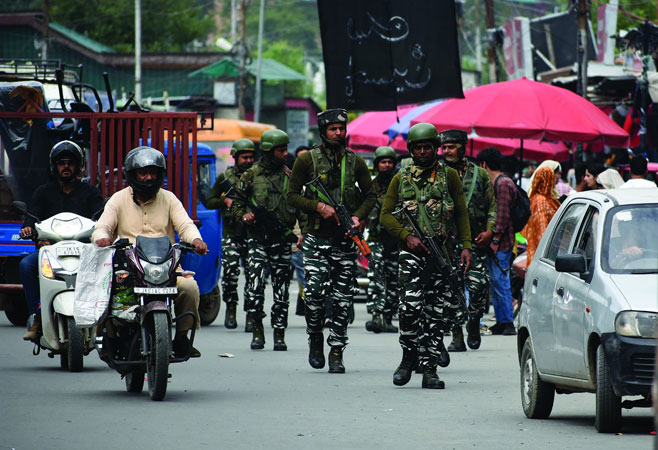
 Kashmiri leaders Sunday strongly condemned India’s repressive measures in Indian-occupied Jammu and Kashmir (IIOJK), accusing the Indian government of using these tactics to silence the local population while diverting attention from its growing international decline.
While in a fresh conversation with PTV news channel, they argued that India’s heavy-handed approach, particularly ahead of the Amarnath Yatra, was an attempt to mask its faltering global influence and shift focus away from its deteriorating international image.
Syed Manzoor Ahmad, senior leader of the All Parties Hurriyat Conference (APHC), expressed that India’s increased deployment of security forces in IIOJK is a deliberate tactic to cover up its failures after being outmanoeuvred by Pakistan.
He stated that the move is a desperate attempt to distract from India’s international setbacks and project an image of control, all while further oppressing the Kashmiri people.
He also highlighted that India has deployed 180 companies of Central Armed Police Forces (CAPF) in IIOJK, adding, Kashmiris have always been hospitable and have consistently cared for their guests.
He criticized the move as unnecessary and unjust, especially given the region’s long-standing tradition of warmth and hospitality and accused India of using force as a cover-up for its international failures.
Another senior Kashmiri leader and analyst, Abdul Hameed Lone, also strongly criticized the Indian government for its increasing military and police presence in Srinagar and other parts of IIOJK ahead of the Amarnath Yatra.
He argued that this heightened security is nothing but a ploy to further militarize the region and intimidate the local population.
Lone condemned the move as an unjustified action aimed at stifling the voices of Kashmiris, who have long resisted foreign occupation.
He further pointed out that the Indian government’s focus on security forces, rather than addressing the legitimate political demands of the people, reveals its failure to address the core issues of Kashmir.
Lone further expressed deep concern over the environmental impact of India’s policies in Kashmir, particularly the large-scale deforestation and destruction of natural resources.
He warned that the ongoing cutting of trees and the degradation of Kashmir’s unique ecosystem are contributing to the region’s vulnerability to climate change.
Mushtaq Wali an analyst, also strongly criticized what he referred to as the “genocide” of the Kashmiri people, highlighting the ongoing human rights abuses and suppression by Indian forces in IIOJK.
He condemned the increasing militarization and the systematic efforts to strip Kashmiris of their autonomy, calling it a deliberate attempt to erase their identity.
Wali further expressed his discontent with India’s failure at the recent Shanghai Cooperation Organization (SCO) Defence Ministers’ meeting, where India was unable to present any coherent strategy to address regional security concerns.
He pointed out that while India continues to impose oppressive measures in Kashmir, it has failed to gain international support, particularly from SCO member states, who are increasingly critical of its actions.
Wali emphasized that India’s isolation on the global stage is a direct result of its unrelenting crackdown on Kashmiris, which only further undermines its credibility and global standing.