
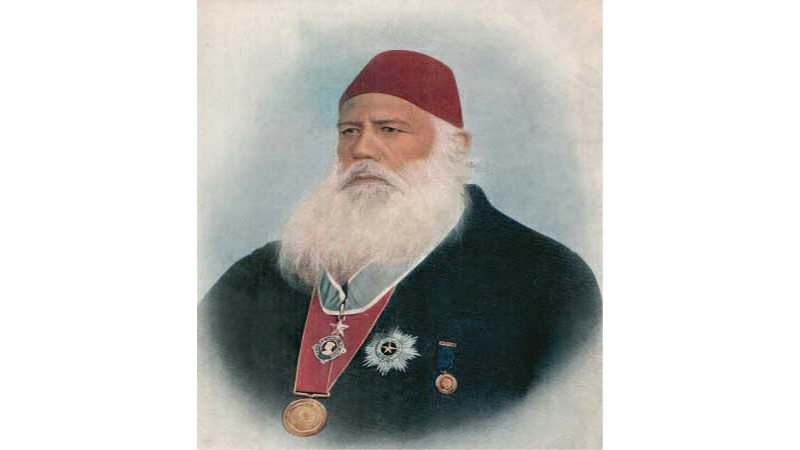
Sir Syed Ahmad Khan (1817-1898) emerged as a key leader of the Indian Muslim community at a critical juncture in Indian history. This was during the aftermath of the War of Independence of 1857, the strengthening of British colonialism and a crisis for Indian Muslims. He was a thoroughly modern Muslim in a thoroughly pre-modern age, responding to the material conditions and needs of Indian society. Yet he is marginalised in Pakistani textbooks as merely the originator of the Two-Nation Theory, and the founder of the Aligarh Movement, as well as a founding father of Pakistan. Less celebrated are his achievements in providing a thoroughly modern, scientific and rational interpretation of Islam and the Quran (There cannot be a contradiction in the word and work of Allah), as well his debates on culture and with his eminent intellectual rivals like Jamaluddin Afghani, the poet Akbar Allahabadi and later his own mentees like Deputy Nazeer Ahmad and Shibli Nomani. These intellectual efforts in the face of stern opposition from fundamentalists and his detractors sowed the seeds of enlightenment and progress among the Muslims of India. Sir Syed is responsible for establishing an intellectual front against blind worship of tradition and backwardness, later paving the way for personalities like Allama Iqbal. However Sir Syed’s thought was politically conservative but socially progressive, evolving from a traditional, past-worshipping understanding to a more scientific and rational one. This essay traces the evolution of Sir Syed’s thought as a modern Muslim in a pre-modern age, and examines his thoughts on culture and his debates with his opponents and detractors. It is my personal tribute to one of our most important, albeit neglected thinkers on the occasion of his bicentennial, being observed today. Like the great German sage Karl Marx, born just a year after him and who Sir Syed outlived, the latter was our very own Muslim Marx. He took up the cudgels on behalf of an endangered minority in colonial India under very challenging circumstances and at the risk of great opprobrium from within and without. Like Marx, Sir Syed’s role and legacy in the Indian subcontinent continue to be hotly debated. He is both adored and reviled in equal measure.
Sir Syed’s Views on Culture
Sir Syed Ahmad Khan was probably the first intellectual who presented the meaning of 19th century western culture. He comprehensively defined culture and also reviewed the elements and dynamics of culture. In the first edition of his journal Tehzeeb al-Akhlaq Sir Syed wrote: The objective of issuing this journal is to persuade Indian Muslims to adopt a complete degree of civilized culture, so that the hatred with which the civilized (cultured) nations view them should go away and they may also be said to be exalted and cultured nations of the world.
Like Marx, Sir Syed’s role and legacy in the Indian subcontinent continue to be hotly debated. He is both adored and reviled in equal measure
Civilization is an English world which we have translated as culture but its meaning is very vast. It means to raise all the intentional actions, morals along with society itself and civilization and its ways and the use of time and knowledge and every kind of arts and skill to a high quality of finesse and to deal with them with great excellence and method, which is the source of real happiness and bodily quality and from which dignity and grace and value and stature is attained and the difference between barbarity and humanity is witnessed. (‘Dabistan-e-Tarikh-e-Urdu’ by Hamid Hasan Qadri, Karachi, 1966 pp. 344)
Sir Syed has mixed up culture and civilization but he is not at fault here; in fact by that time the idea of culture and civilization was unclear to various thinkers of the West itself. Sir Syed also wrote two detailed essays on culture in Tehzeeb al-Akhlaq. The title of the first essay was ‘Culture and its Definition’; while the second was titled ‘Civilization or, Sophistication and Culture’. These essays, as Sir Syed himself admitted are based on the book by Thomas Buckle (1821-1862). Buckle was an eminent British historian. He wanted to write a detailed history of world civilization in multiple volumes. But he had published only two volumes (1861) when he passed away.
Buckle had tried to write the history of human civilisation in the light of scientific knowledge and had also fashioned a few ‘laws’ of human history based on rules of inductive reasoning, for example the law of season which asserted that physical environment and seasons greatly affect human culture. Though Buckle’s ‘ideologies’ were totally against historical facts (the physical environment of the ancient cultures of the Indus Valley, Nile Valley and the Tigris and Euphrates Valley was different from Europe but no one can deny the greatness of these cultures) but despite this, the people of the West enthusiastically welcomed Buckle’s thoughts, because he had fashioned the dominance of the white nations and the slavery of Asian nations into a natural law and thus presented an ideological justification for Britain’s imperialist interests.
Though the laws of the evolution of human culture had been discovered by Hegel, Marx and other Western thinkers long before Buckle, it seems that Sir Syed was not aware of the theories these thinkers presented. Nevertheless it is no mean achievement by Sir Syed that he made us aware of the modern meaning of culture. While explaining culture, Sir Syed writes:
When a group of humans gathers together in some place and settles then often their needs, wishes, diet, clothes, knowledge, thoughts, joyful conversations and hate all become common and that is why thoughts of good and evil also become common and the desire to exchange evil with good is common in all. This collective desire for exchange or the exchange brought about by collective desire is the civilization of that nation or group. (‘Maqaalat-e-Sir Syed’, Volume 6, pp. 3, Lahore 1962)
Sir Syed Ahmad Khan wrote such progressive things about man and human culture 150 years ago which still hold true and reflect on which one is greatly aided in understanding the actual reality of culture. For example, he used to say, “There is a close relationship between human actions and the laws of nature.” (Ibid. pp. 35), meaning that the laws of human society and the movement of nature are identical. Secondly, that human actions and the work of their mutual milieu are subject to some predetermined law, and not coincidental. Thirdly, that “Man’s actions are not the results of their wishes but the results of past events.”Fourth that “Any human society is not free of culture” and fifth that “Man changes nature and nature changes Man and all events are made from this mutual exchange.”
While mentioning the specific qualities of Man, he writes that Man’s “organs and body are higher and better compared to other living creatures. This is not his only superiority but the work which he is able to do with the help of his intelligence, as well as with such hands which are his very obedient workers; because of them he has great superiority and due to both these sources he is able to live a very happy and comfortable life compared to other creatures and is able to bring himself into a higher level of existence and compared to the status of his natural life, he is able to provide it with a lot of luxury.”(‘Maqalaat-e-Sir Syed’ Volume 12, pp. 63-64, Lahore 1963)
A comprehensive review of the intellectual services of Sir Syed is out of the scope of this essay. Although it needs to be said that Sir Syed was the first Muslim thinker who explained the changes in the creations of the world and human society in terms of the laws of society and the conditions of it’s creation. He did not include the intent or desire of any supernatural or other worldly force.
Sir Syed’s Evolution
If we review the thoughts of Sir Syed Ahmad Khan, his services for the intellectual and sensitive reform of the Muslims of the Indian subcontinent are known to all. But if we observe history we see that when he was compiling the Aine-Akbari in 1848 and later when he wrote Asar al-Sanadid, other intellectuals of the era, such as Mirza Ghalib wrote to him questioning the worth of the ancient texts Sir Syed was studying. Ghalib wrote to Sir Syed, asking him;“Why are you engaged in worshipping the past and nourishing the dead, come out of it and see the variety of amazing scientific inventions the savants of the West have pioneered like the ship, the electric wire, the matchstick and steam-powered machines!” Sir Syed became upset with Ghalib’s advice.
Put aside the Ain, and parley with me
Open thine eyes in this old world
And examine the life of the Englishmen
(Note: All the translations from the Urdu are by the author unless otherwise stated)
The writer is a Pakistani social scientist, book critic and an award-winning translator and dramatic reader based in Lahore. He is currently the president of the Progressive Writers Association in Lahore. His most recent publication is an introduction to the re-issued edition of Abdullah Hussein’s classic Partition novel ‘The Weary Generations.’ He can be reached at: [email protected]
Published in Daily Times, October 17th 2017.
The second part published in October 18th, 2017 edition of Daily Times can be read here.