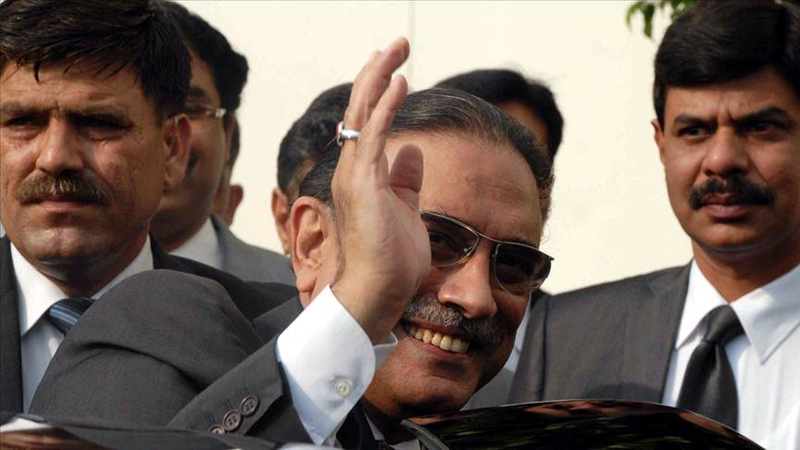
 Pakistani lawmakers on Saturday elected Asif Ali Zardari, co-chairman of the center-left Pakistan People’s Party (PPP) as the country’s 14th president.
Zardari, 68, the widower of two-time Prime Minister Benazir Bhutto, defeated Mahmood Khan Achakzai, a veteran politician from southwestern Balochistan province, and a candidate of the opposition Sunni Ittehad Council, a religiopolitical group that now includes lawmakers from jailed ex-Prime Minister Imran Khan’s Pakistan Tehreek-e-Insaf (PTI) party.
A candidate for the ruling coalition led by Prime Minister Shahbaz Sharif’s Pakistan Muslim League-Nawaz (PML-N), Zardari is the only politician who has been elected to the country’s highest yet symbolic office for a second term. He previously served as president from 2008 to 2013 during his party government. He is also the first ever democratically elected president to complete his tenure in the South Asian Muslim-majority country’s 75-year history.
Early life and political journey
Zardari was born in July 1955 to a Sindhi landlord family and received his early education at Saint Patrick’s School in Karachi, Pakistan’s commercial hub and the capital of southern Sindh province.
He graduated from Cadet College Pitaro, near Hyderabad, the second largest city of Sindh, and later studied business in London.
Although his father, Hakim Ali Zardari, was an active politician, he initially showed no interest in politics. Before becoming an avid polo player, junior Zardari appeared as a child star in a local film.
His betrothal to Benazir Bhutto, who had returned from self-exile in London in 1986, surprised many people in the country.
The two got married in 1987, which marked his entry into politics. The couple shared three children, Bilawal Bhutto Zardari, Bakhtawar and Assefa.
Bilawal is currently the PPP chairman and remained Islamabad’s top diplomat under Premier Sharif’s previous government from April 2022 to August 2023.
Zardari came into the limelight after Benazir Bhutto was elected as the country’s first- woman prime minister in 1988, but his opponents quickly accused him of corruption and kickbacks.
His first government position was as environment minister during Benazir’s second term, which lasted from 1993 to 1996. He was also the minister of investment from 1995 to 1996.
His opponents dubbed him “Mr. 10%” and blamed him for the dismissal of Benazir’s two governments due to allegations of corruption.
Later, he served several jail terms from 1990 to 2004 in cases for crimes ranging from corruption to murder, money laundering, and kidnapping for ransom. None of the charges, however, has ever been proven in the courts.
From nowhere to presidency
Zardari has been elected as a member of the lower house, or the National Assembly, four times and once as a senator from 1990 to 2024. He resigned from parliament after being elected as president on Saturday.
In Benazir’s last years, Zardari remained out of politics and mostly stayed in the US, amid rumors of a strained relationship with his spouse. He also sought treatment for psychological distress caused by his years-long imprisonment, which had taken a toll on his physical and mental health.
He only returned to the country a few days after Benazir was assassinated at a rally in Rawalpindi, a garrison city in northeast Pakistan, in Dec. 2007.
Amid countrywide violent protests against Benazir’s assassination, Zardari immediately took reigns of the party, appointed Bilawal as chairman and himself co-chairman on the “pretext” of his spouse’s “will.”
His smart handling of a heavily charged atmosphere, mainly in Sindh following Benazir’s assassination, not only earned him a reputation as a sagacious politician.
Months after his party won the 2008 general elections, he was elected president, making him the de facto ruler of a country that practices parliamentary democracy, with the prime minister serving as the chief executive.
While making history, observers insisted Zardari’s five-year stint was tainted with controversies and corruption charges.
Nonetheless, they credit him with restoring the 1973 constitution by surrendering his powers to parliament and setting up a National Finance Commission award aimed at the distribution of resources among provinces.
Before the 2010 constitutional amendment, although the premier was the chief executive, major powers like appointment of judges, attorney general, provincial governors and chiefs of the army, naval and air force were in the hands of the president.
Moreover, Article 58-2B of the constitution empowered the president to dissolve the elected government.
However, under the 2010 amendment, which was a joint work of the PPP and the PML, all the respective powers were transferred back to the prime minister and the parliament.
He was once again arrested during the PTI government in a graft case in 2019 but released on bail after six months.
Still wields influence
The high-stakes Feb. 8 elections resulted in a hung parliament, forcing mainstream political parties to stitch coalitions.
The incumbent ruling coalition includes the PML-N and PPP, which finished second and third in terms of seats, respectively, as well as several regional parties.
Though the PTI-backed independents won the most seats, they were unable to form a government with any coalition partners.
Although the president’s office has a ceremonial status since the 18th amendment, the peculiar formation of the current coalition government gives him an advantage.
The PML-N-led government is heavily reliant on the PPP, the ruling coalition’s second-largest partner, leaving plenty of room for Zardari to have a say in state affairs.
“Despite having no official powers, he will remain as powerful as he was during his previous tenure because of the PML-N’s dependence on the PPP to sustain its government,” Abdul Khalique Ali, a Karachi-based political commentator, told Anadolu.
“With two provincial governments – in Sindh and Balochistan – and the president’s office, Zardari will be the one who will actually call the shots and simultaneously avoid the public’s flak against the government policies,” he added.
Former presidents
Iskander Mirza, who became the first president of Pakistan in 1956, was deposed two years later in a military coup by General Ayub Khan.
Khan was forced to step down under pressure from the opposition, handing over power to General Yahya Khan, who resigned two years later after Pakistan lost its 1971 war against India.
Zulfikar Ali Bhutto, the PPP founder, was elected president in Dec. 1971 but resigned two years later to serve as prime minister under Pakistan’s new constitution, which established a parliamentary government system in the country.
Fazl Elahi Chaudry became president in 1973 and resigned in 1978, a few months after the Bhutto government was overthrown by a military coup led by then-army chief Gen. Zia-ul-Haq.
Zia died in a plane crash in 1988.
Ghulam Ishaq Khan was elected to office the same year. He resigned in 1993 as part of a deal brokered by the army after a political crisis with then-Prime Minister Nawaz Sharif.
Farooq Leghari of the PPP was elected president in 1993 but was forced to resign in 1997.
A few months later, Muhammad Rafiq Tarar of the PML-N was elected president. He resigned in 2001, two years after a military coup by Gen. Pervez Musharraf.
Musharraf ruled Pakistan until 2008 when he stepped down to avoid impeachment.
After the completion of Zardari’s term, the PML-N’s Mamnoon Hussein was elected president in 2013 and served until 2018.
Hussein was replaced by the PTI’s Arif Alvi in 2018 and served until the latest presidential election. anadolu agency