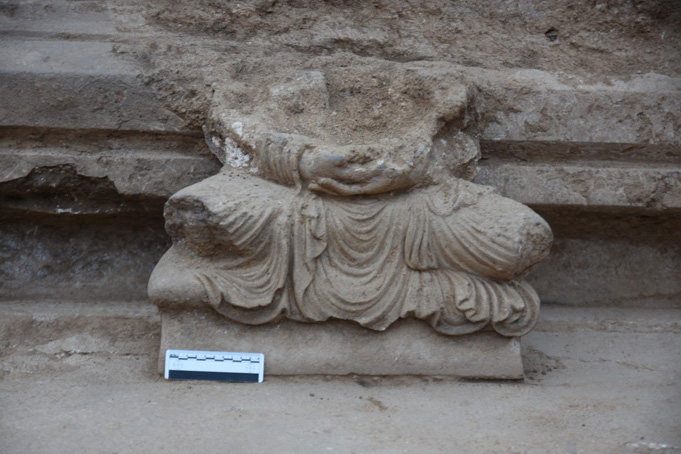
 Archeologists have found Buddha artifacts in northwest Pakistan dated back to 1,800 years, an official said. The rare artifacts have been found in the Swabi district, located some 83 kilometers (52 miles) from Peshawar, the capital of Khyber Pakhtunkhwa province, Abdul Samad, the provincial director of Archeology Department, told Anadolu Agency.
“We have found around 400 new antiquities belonging to Gandhara Civilization during an ongoing excavation at Baho Dheri village of Swabi over the past six months,” he said.
The discoveries include a 73-meter high stupa, the largest of its kind so far found in the region, and a rare 10-feet life-size statue of Gautam Buddha, the founder of Buddhism. The stupa, which is 73-meter high, is the largest of its kind found in this region so far.
“This statue is not in intact form. We need to work to restore in its original shape,” Samad said. Other antiquities include seated Buddha statues, the original floor of the largest stupa dated back to 1,800 years, and a statue in meditation pose, he added.
“These antiquities are not mere art pieces but they were used for worship purposes,” he further said adding that the Buddhist disciples used to take rounds of the stupa in the anti-clockwise direction.
Mostly, he said, round, Indian, and Ashokan-style stupas have been found in the region, some of them dated back to 2,200 years, in addition to square stupas, which were introduced by the ancient Khyber Pakhtunkhwa. The latest discoveries are the outcome of an ongoing excavation in the region over the past six months.
“We have so far done (completed) 40% of the planned excavation. Sixty percent (excavation) is still left,” said Fawad Khan, head of a 20-member team of the archeologists involved in the excavation.
Speaking to Anadolu Agency, he said that more “interesting” discoveries are expected. Important region for Buddhism Khan said that the fresh discoveries have added a “new chapter” to the history of the Gandhara Civilization.
Emerged in 500 B.C., the ancient Gandhara Civilization sprawled the region, which included Peshawar, Mardan, Swabi, Swat, Buner, and Bajaur situated in the northwest, and Texila in the northeast of today’s Pakistan, in addition to Kabul and northern Afghanistan.
Khyber Pakhtunkhwa province – once a hub for terrorism and suicide bombings – is home to 70% of the sites in the country sacred to Buddhists.
Once known as the heart of the Gandhara civilization, Takhtbai or Takht-i-Bhai (throne of origins) – a small scenic town located some 112 km ( 69 miles) 112 km (69.6 miles) from Peshawar – is the most visited site by the Buddhists, who flock to see the ancient monastery dated back to the 1st century, according to Samad. In the entire Khyber Pakhtunkhwa province, which borders neighboring Afghanistan, there are some 20,000 archeological sites, of them, 2,000 belong to Buddhist Civilization.
“The region comprising Swabi and Mardan is so important for Buddhists in general and for the Korean peninsula in particular as Buddhism was introduced to that region (Korea) by a monk from Swabi some 1,600 years ago,” Khan said. Discoveries to boost religious tourism
Thousands of tourists from Japan, China, Sri Lanka, South Korea, Hong Kong, and Myanmar visit the Buddhist sites in Pakistan every year, following an improved law and order in the country in recent years. Pakistan army has launched a series of onslaughts on militants, particularly in the northwestern tribal region along the Afghan border since 2014, claiming to clear 95% area of terrorists. According to the interior ministry figures, there has been an 80% decline in the number of terrorist attacks in the country since 2014. The fresh discoveries, archeologists, and tourism authorities believe will give a further boost to already picking up religious tourism in Pakistan.
Pakistan is just 70 years old, but it is situated in a region that has been home to the world’s three major religions – Hinduism, Buddhism, and Sikhism – for centuries. The Muslim nuclear state hosts scores of revered pilgrimage sites – dated back to 5,000 years – for not only the followers of the three religions but also from some pre-historic religions such as Aryan, Vedic, Barhaman, and ancient Iranian and Greek religions. Badly hit by the events related to the 9/11 terrorist attack on Washington and New York, Pakistan’s religious tourism is now picking up mainly because of the improved law and order, and the government’s realization of the economic and political importance of this sector. “These latest discoveries, which include rare stupas and other artifacts will certainly boost the religious tourism in Pakistan, which is already picking up,” Samad observed. Echoing his views, Khan, the chief archeologist, said the discoveries would attract the Buddhist community from across the world.
Located some 27 km (17 mi) from Islamabad, Taxila – also known as Tukshla in olden times – is another holy site, which includes a Mesolithic cave and the archaeological remains of several Buddhist monasteries. Apart from Khyber Pakhtunkhwa, northeastern Punjab, the country’s largest province, is home to the five most important pilgrimage sites for Sikhs.
They include the birthplace of Baba Guru Nanak, the founder of the Sikh religion who was born in 1469 in Nankana Saheb district, and Gurdwara (monastery) Punja Sahib in Hasan Abdal town, where the handprint of Guru Nanak is believed to be imprinted on a boulder at the monastery. The two sites are visited by thousands of Sikhs from neighboring India, Europe, and America every year. Katas Raj temple in northeastern Chakwal district and Sadhu Bela temple in southern Sukkur district are the two most visited religious sites by Hindus from across the world. Hindus – Pakistan’s largest minority – equally revere the water of a lake in the Katas Raj temple as they believe the lake was filled with the tears of Shiva, one of the principal deities of Hinduism. Hindus make up 4,% of Pakistan’s 210 million population.