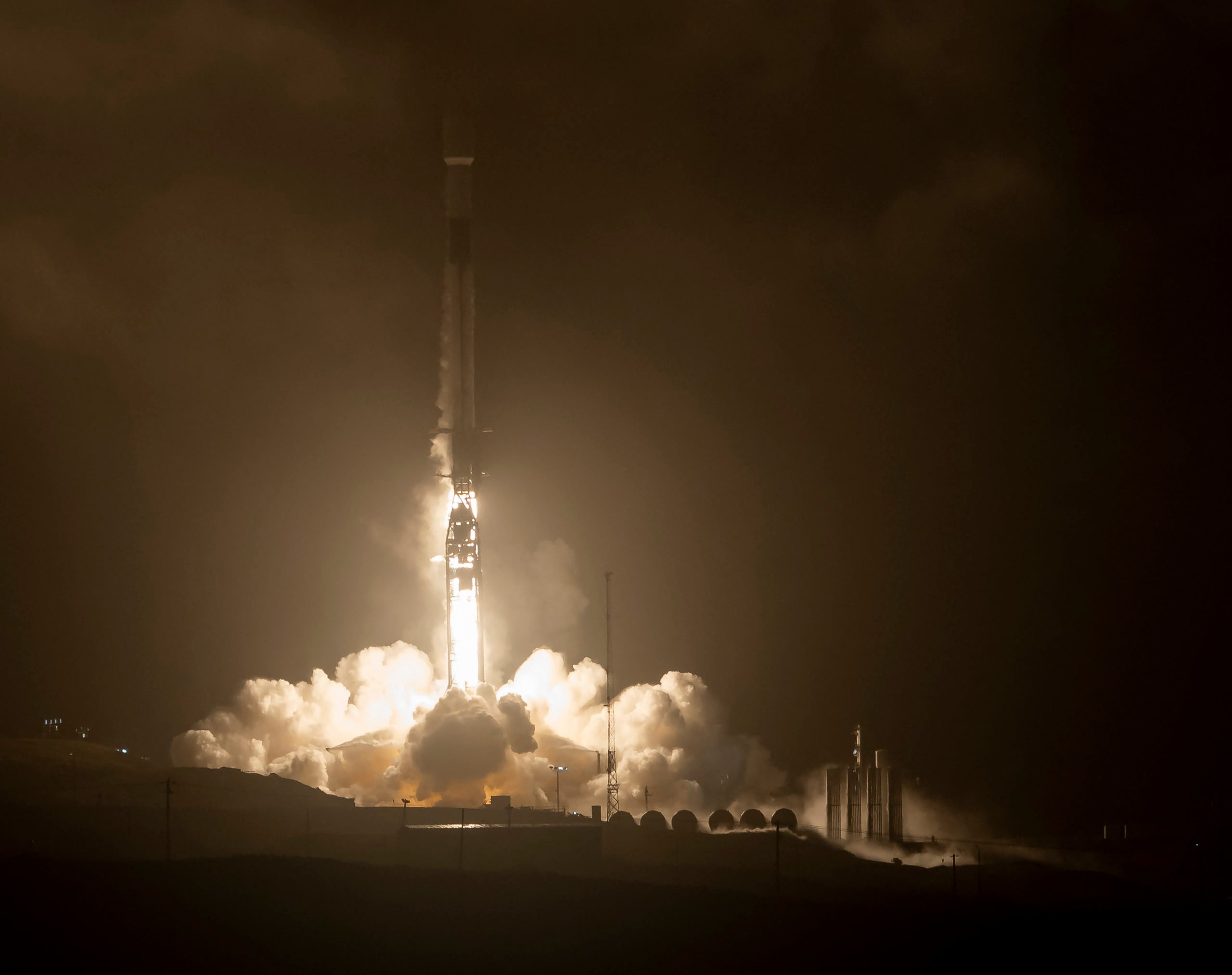
Washington: A chunk of a SpaceX rocket that blasted off seven years ago and was abandoned in space after completing its mission will crash into the Moon in March, experts say.
The rocket was deployed in 2015 to put into orbit a NASA satellite called the Deep Space Climate Observatory (DSCOVR).
Since then, the second stage of the rocket, or booster, has been floating in what mathematicians call a chaotic orbit, astronomer Bill Gray told AFP Wednesday.
It was Gray who calculated the space junk’s new collision course with the Moon.
The booster passed quite close to the Moon in January in a rendezvous that altered its orbit, said Gray.
He is behind Project Pluto, software that allows for calculating the trajectory of asteroids and other objects in space and is used in NASA-financed space observation programs.
A week after the rocket stage whizzed close to the Moon, Gray observed it again and concluded it would crash into the Moon’s dark side on March 4 at more than 5,500 miles per hour (9,000 kilometers per hour).
Gray appealed to the amateur astronomer community to join him in observing the booster, and his conclusion was confirmed.
The exact time and spot of impact may change slightly from his forecast but there is widespread agreement that there will be a collision on the Moon that day.
“I’ve been tracking junk of this sort for about 15 years. And this is the first unintentional lunar impact that we’ve had,” Gray told AFP.
Astronomer Jonathan McDowell told AFP it’s possible similar impacts have taken place unnoticed.
“There’re at least 50 objects that were left in deep Earth orbit in the ’60s, ’70s and ’80s that were just abandoned there. We didn’t track them,” he said.
“Now we’re picking up a couple of them… but a lot of them we’re not finding and so they’re not there anymore,” he added. “Probably at least a few of them hit the moon accidentally and we just didn’t notice.”
The impact of the SpaceX rocket chunk weighing four tons on the Moon will not be visible from Earth in real time.
But it will leave a crater that scientists will be able to observe with spacecraft and satellites like NASA’s Lunar Reconnaissance Orbiter or India’s Chandrayaan-2, and thus learn more about the geology of the Moon.
Spacecraft have been intentionally crashed into the Moon before for scientific purposes, such as during the Apollo missions to test seismometers.
In 2009, NASA sent a rocket stage hurling into the Moon near its south pole to look for water.
But most rockets do not go so far from Earth. SpaceX brings its rocket boosters back through the Earth’s atmosphere so they disintegrate over the ocean. The first stage is recovered and reused.
Gray said there could be more unintentional crashes into the Moon in the future as the US and Chinese space programs leave more junk in orbit.
McDowell noted these events “start to be problematic when there’s a lot more traffic.”
“It’s actually no one’s job to keep track of the junk that we leave out in deep earth orbit,” he added. “I think now’s the time to start regulating it.”
SpaceX did not immediately respond to request for comment from AFP.
Elon Musk’s company is currently developing a lunar lander that should allow NASA to send astronauts back to the Moon by 2025 at the earliest.