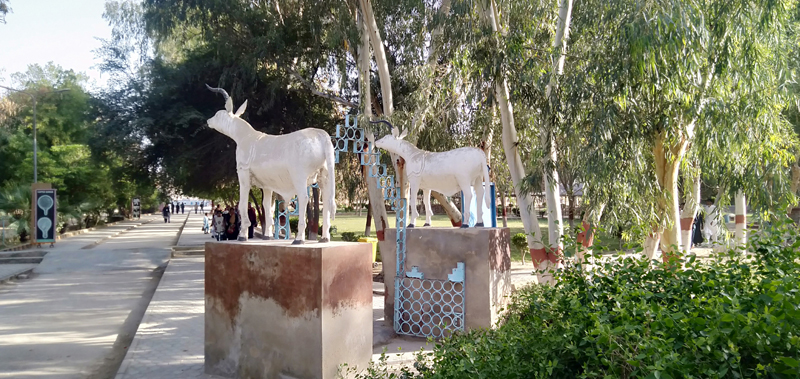
 Recently, a group of 20 persons including the district government officers and women organisation representatives headed over to visit the Mohenjo-daro site.
The purpose was to have a peep in glorious past of Sindh epitomized in one of the earliest settlement and planned city, Moen jo Daro, contemplate on our todays abysmal civic infrastructure and service sector and get inspiration. Majority of the visiting group members who were visiting the city first time, were awestruck by exquisitely planned city with paved streets, excellent drainage system and observe remains persevered in museum. I have visited the site in late 1990s but since then much has been changed for better as for as provision of facilities for visitors by government is concerned.
The Mohenjo-daro city is situated at a distance of 28 kilometres from Larkana. It is believed that City was built around 2500 BCE and is contemporary of other civilizations i.e. ancient Egypt, Mesopotamia, Minoan Crete, and Norte Chico. Moenjo-Daro is believed to be abandoned in the 19th century BCE as the Indus Valley Civilization declined,
There is lot of controversy about the name of the city. Official textbooks call it Mohenjo-daro or mound of the dead. Others call it Mohan Jo Daro. And mohindar Daro. Wikipedia has interesting information about the nomenclature of the ancient city; “The city’s original name is unknown. Based on his analysis of a Mohenjo-daro seal, Iravatham Mahadevan speculates that the city’s ancient name could have been Kukkutarma or Cock-fighting may have had ritual and religious significance for the city, with domesticated chickens bred there for sacred purposes, rather than as a food source”
There is lot of controversy about the name of the city. Official textbooks call it Mohenjo-daro or mound of the dead. Others call it Mohan Jo Daro and mohindar Daro. Wikipedia has interesting information about the nomenclature of the ancient city; ‘The city’s original name is unknown’
For a visitor it would be exhilarating experience to find remains testifying the glory of the past. There are measurement stones and scales, exquisite pottery, seals, jewellery as a proof of prosperity and well established governance. The replica of Ships, Bull carts, affirm that there was thriving trade and the city have links with faraway cities and other contemporary civilisations.
Different weapon displayed at museum also indicate that denizens of the city of Moen Jo Daro were well aware about the internal and external security threats and were well prepared to defend against invading marauders or armies.
Discovery of the idol of mother Goddess by John Marshall in 1931 appears to have similarities about some characteristics that match the Mother Goddess belief pervading in many early Near East civilisation. The fertility and motherhood aspects of the figurine can be considered offerings to the goddess, as opposed to the typical understanding of them being idols representing the goddess’s likeness.
In 1927, a seated male soapstone figure was found in a building with unusually ornamental brickwork and a wall-niche. Though there is no evidence that priests or monarchs ruled Mohenjo-daro, archaeologists dubbed this dignified figure a “Priest-King”.
One of the person present at the site shared with visiting group on the condition of enormity that original figurine of present king is placed at Karachi museum and before partition lot of precious remains were taken to India by Indian officials
The estimated area of the city is believed to be 300 hectors. The city was divided in Upper part of citadel city and lower part. The Citadel, a mud-brick mound contained public baths, a large residential structure designed to house around 5,000 citizens. two large assembly halls. A central marketplace, with a large central well. households were supplied water from smaller wells. Waste water was discharged through covered drains lined along with major streets. Houses for religious leaders, included rooms with bathing, Majority of the houses had inner courtyards, with doors that opened into side-lanes. Some buildings had two stories.
The ruins of the city remained undiscovered for around 3,700 years until RD Banerji, an officer of the Archaeological Survey of India, visited the site in 1919-20 identifying what he thought to be a Buddhist stupa finding a flint scraper which convinced him of the site’s antiquity. This led to large-scale excavations of Mohenjo-daro led by Kashinath Narayan Dikshit in 1924-25 and John Marshall in 1925-26. In the 1930s major excavations were conducted at the site under the leadership of Marshall, DK Dikshitar and Ernest Mackay. Further excavations were carried out in 1945 by Mortimer Wheeler and Ahmad Hasan Dani. The last major series of excavations were conducted in 1964 and 1965 by George F Dales. A guide at the site shared that excavation of the site first took place in 1912 and was stopped after 1965. He shared that due to adverse geological conditions like water logging and salinity it was feared that further excavation would damage the parts of the city.
Hakim Ali Bhukhari a veteran arachnologist from Sindh is of the view that we have failed to preserved and protect the archaeological and historic site already discovered. Thus we should not uncover the remaining remains and that should be left for future generations.
As mentioned above government of Sindh has done good job to take steps for preservation and protection of the site of Moen Jo Daro. As responsible citizens it is responsibility of each visitor to take utmost care and avoid damage to the site. The media usually reports that during holidays or national and religious celebrations the local visitors throng the cite with little or no care and trample irresponsible on the cite and vandalize this prestigious cites.
Furthermore, government should resume the extracting and draining the ever rising underground water by using tube wells to ward off present and future threat of waning of the discovered and undiscovered area of the Moen Jo Daro Site
The writer can be reached at [email protected]