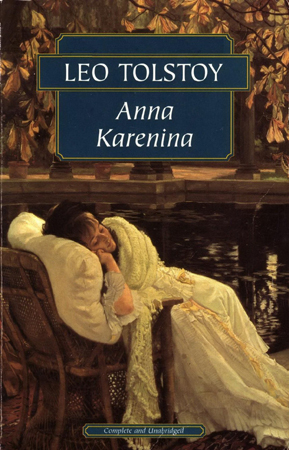
 It is said that when famed American novelist William Faulkner was asked to name any three greatest novels ever written, leaving a many flabbergasted, he retorted, “Anna Karenina, Anna Karenina and Anna Karenina.”
In addition, Nabokov, one of the beacons of Russian fiction, renowned for his master-piece Lolita, remarked a compliment that is now history about Tolstoy: ” when you’re reading Turgenev you know you’re reading Turgenev. When you read Tolstoy, you’re reading just because you cannot stop.”
I’ve was lately engrossed with reading an exceptionally sensational and emotive novel that is about darkness at meridian. What? Darkness at meridian? Not literally; take this metaphorically. And that novel is none other than Anna Karenina. How would you feel when at one fell swoop sun disappears at noon hours leaving you with momentous horror and terrifyingly bizarre? Of course, that would be a gut-wrenching condition for you as it is unanticipated and unexpected to happen, suddenly all at once. Similarly, beginning Anna Karenina took me to that kind of a doom wherein sun disappears at noon hours.
I’ll also try to share some snippets in the meantime from the novel I’m sharing my ideas about. Here goes this:
“Well, what of that? I never stop thinking of death,’ said Levin. ‘It really is time for me to die. All things are mere nonsense. I’ll tell you frankly: I value my idea and my work immensely, but really… Just think! This whole world of ours is only a speck of mildew sprung up on a tiny planet; yet we think we can have something great___ thoughts, actions! They are all but grains of sands.”
It is a novel about emotionally bankrupt families and weary matrimonial lives. It addresses the dark and shameful partition of society, issues like destiny, human relationships and irreconcilable contradictions. The very first sentence of this novel is purportedly the most affectionate opening in world literature. It goes like this: All happy families are alike but each unhappy family is unhappy in its own way. After reading this aphorism one can easily get on board the novel and anticipate what would unfold next? Of course, disasters, misfortunes and tragedies.
I was lately engrossed with reading an exceptionally sensational and emotive novel that is about darkness at meridian. What? Darkness at meridian? Not literally; take this metaphorically
Anna Karenina is a baggy book and is over 800 pages and that is exceedingly lengthy. It’s heaviness daunts you intermittently and sometimes you feel…When will it get finished? In doomsday? Reader’s block. But, all in all, it holds its own distinct style of engaging you till very end.
“Oblonsky was saying something about the freshness of a girl, comparing her to a fresh kernel just taken from its shell.” Comparing the freshness of a girl to a fresh kernel is appreciable. It manifests the prowess of Tolstoy to connect and bring together very different things nigh.
As we piecemeal delve into the novel we are thrusted in a pickle, a maddening chaos and a turmoil concerning Oblonsky’ wretched household. He had an extra-marital affair with the French governess of his childrens and now his wife Dolly is angry with him. Oblonsky’s infidelity has hurt Dolly to the extent that now she is imminent to part and leave Oblonsky without any further ado. But, Oblonsky is intimidated and ashamed of his deeds and wants to atone for wrongs he has done. Dolly is unconvinced. Amidst these events we get to know that Oblonsky’s favourite sister Anna Karenina is coming from Petersburg to Moscow for reconciling her brother with his wife. Fortunately, Dolly is fond of and is near to his sister. Due to Anna Karenina’s obtrude and intervention Dolly precipitated her anger and acquiesced. But now Anna Karenina herself got trapped in an abyss from where it was hard for her to shake off.
Tolstoy began the novel on 18 march 1873 and finished it by July 1877. Tolstoy was struck by an event occurred in his lifetime that ultimately led to this master-piece. One of Tolstoy’s acquaintance and a landowner betrayed his mistress Anna Pirogava and fell in love with an another woman. Out of sheer jealousy, Anna Pirogava went to a nearby railway station and threw herself under a goods train. It is all about the ‘present’ lives of Russians of that time.
Being plotless and discontinuous, Tolstoy has written Anna Karenina in brief dramatic chapters of two to three pages. Each chapter is not bound to follow the previous one chronologically. Because, there are two to three paralell plots heading together that you have to follow and connect yourself.
“To me the more beautiful it is the more natural it seems.”
Milan Kundera, one of the pioneering literary giants, who has introduced avant-garde trends in fiction, once in an interview said that the credit of interior monologue goes to Tolstoy and not to James Joyce. He further added that Tolstoy was the first novelist who used the device of interior monologue in his novels particularly in Anna Karenina.
Moreover, beginning with Oblonsky and Dolly’s state of affair in following chapters we are introduced to Constantine Levin who has come to Moscow to get married and enjoy the luxuries of marriage life. But, with whom he wants to marry is already, courted and wooed by a Military officer viz. Count Varonsky. And, Levin, in a melodramatic way, gets this momentous news from Oblonsky who tells him that he has a handsome rival for kitty’s hand. This breaks his heart and the repercussions of this news linger on till very end of the novel. Kitty, who now has two contestants, for her hand, is an 18-year-old girl. She is the younger daughter of prince and princess Shcherbatsky and is also the younger sister of Dolly.
Everything in Anna Karenina is so realistic and on the grounds that it seems to be a novel reflecting everyone’s life. No doubt, Anna Karenina stands as a colossus in world literature and represents the concerns, miseries and veiled projections of races unbeknownst to one another.
Furthermore, in an ironical shift, Varonksy, who was wooing Kitty, now yielded to the infatuation caused by Anna unpremeditatedly in a railway station when he showed up to receive his mother wherein Anna was also on board.
Subsequently, after that encounter Count Varonksy jilts Kitty for Anna. Love here is mind-bogglingly impervious to arguments and reasons. Everything is just flowing and you’re relishing all these indefinite situations, affairs and infatuations absent-mindedly.
So, now Anna and Varonksy fall in love ardently for the intensity of their sudden surge of feelings for one another is out of control that’s why they yield to it and embrace each other without knowing this will later damn Anna ruthlessly and scourge Varonksy terribly. As Anna is married and has an eight years old son, so soon impediments start up barricading their way to realise their love. Most of all, husband of Anna, after finding out that his wife Anna has an affair with Count Varonksy, inflames with fury and explodes his anger to Anna by snatching away her son and this leaves deleterious imprints to her. And then, Anna elopes with Varonksy to Italy for a while and to country side later for some time and this travelling goes on.
Years later, after several ordeals and trials of their love: Anna’s doomed adventure reaches to a grinding halt. She, in one way or other, on her own, construes that Varonksy has now become bored of her. She feels that she has lost her erstwhile value in Varonksy eyes. Therefore, everything turns upside down for her.
Even though Tolstoy loathed Shakespeare but the tinges of popular Shakespearean line: ” Frailty, thy name is women.” can be traced and related to Anna’s depressingly dark situation. Because, the nonchalant and indifferent behaviour of Varonksy in addition to the scourges of society that dealt with her like an outcast contributed richly in the decision of Anna to quit and do away with herself.
Then came the day when she threw herself under a train and did suicide for the sole reason to reignite her love in Varonsky’s heart and restore her dignity in society. Who reached her to this point to opt for suicide? Who should be considered and accountable for incorporating despairing ideas insider her mind and leaving her with the only option of suicide? I think, men in general, are responsible and must answer. And I relatively object on Tolstoy letting Anna to do suicide, creating a hurting picture of a daunting woman.
Anna Karenina is brimming with flummoxed epiphanies. The prolonged discombobulating of events confuses the reader, involuntarily. Nevertheless, it still keeps itself prosaically luxuriant and enjoyable for its readers. That is for it hand in hand further the small details of characters who are suffering ironic agonies and torments proportionately.
If you carry the determination to understand Tolstoy and Russian everyday life where peasants are living with frugal meals and passing their lives in worst of conditions, then you’ve to know how Tolstoy relate things that on surface have no connection at all. Here, my point is, that the characters which Tolstoy creates are tough and psychologically ragged and to unlock their appalling secrets you’ve to connect the dots and sketch out the big picture with the salient features in a flood of data.
Lastly, I’d share this humble excerpt which more or less educates an artist to be gentle after receiving appalling reviews of creations.
“He always attributed to those judges a better understanding than his own, and always expected to hear from them something he had himself not noticed in his work, often fancying that in their criticisms he had really found that something.”