Since Narendra Modi, the leader of the ruling party BJP, became the Indian Prime Minister in 2014, he started implementing ideology of Hindutva (Hindu Nationalism). Under his regime, the persecution of religious minorities such as Dalits, Sikhs, Christians, and particularly Muslims, including even lower cast-Hindus, might be cited as instance.
In this regard, the Indian Citizenship Amendment Act 2019 (CAA), passed by the Indian Parliament further exposed the discriminatory policies of the Modi government. The CAA, coupled with the National Register of Citizens (NRC), is mainly against the Muslim immigrants, especially from Pakistan, Bangladesh and Afghanistan.
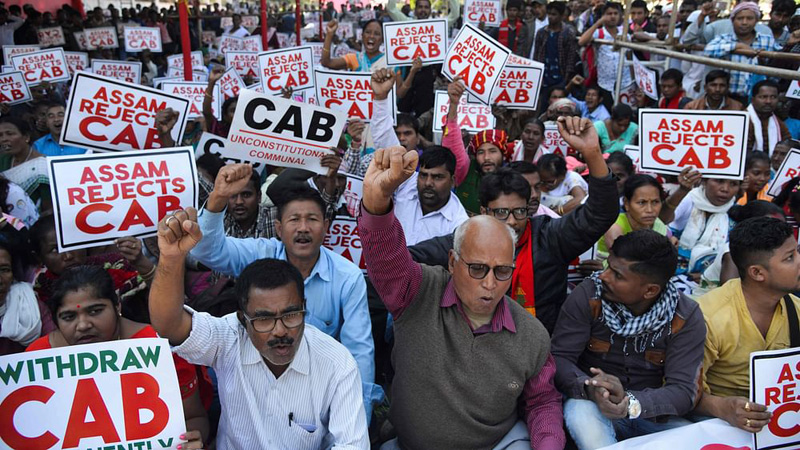
Since December 15, 2019, mass protests, even by the moderate Hindus, have been taking place across every state in India against the CAA and the NRC, which resulted in the killing of more than 100 persons and injuring 800-mostly Muslims by the police and fanatic Hindus. But, Modi-led regime has not withdrawn the CAA/NRC.
States accuse New Delhi of apathy towards their issues
It is mentionable that more than seven months have been passed. But Indian extremist government, led by the extremist prime minister, Modi, continued the lockdown in the Indian occupied Kashmir (IOK). While Indian fanatic rulers are also escalating tensions with Pakistan to divert attention from the drastic situation in the IOK and had continued shelling inside the Pakistani side of Kashmir by violating the ceasefire agreement in relation to the Line of Control (LoC).
Indian forces have broken all previous records of gross human rights abuses since August 5, 2019, when Indian Prime Minister Modi’s government ended special status of the Jummu and Kashmir by abolishing articles 35A and 370 of the Constitution to turn the Muslim majority into minority in the Indian held Kashmir. Implementing the August 5 announcement, Indian central government issued a notorious map on October 31, 2019. In accordance, Jammu and Kashmir was bifurcated into two union territories-Jammu and Kashmir and Ladakh.
 Besides Pakistan, China also rejected the Indian map. In this regard, China objected to the bifurcation of Jammu and Kashmir in two union territories as “unlawful and void,” saying that India’s decision to “include” some of Chinese territory in its administrative jurisdiction “challenged” Beijing’s sovereignty. Border dispute between New Delhi and China, which remains unsettled, has increased tension between the two countries.
It is noteworthy that the former Soviet Union, which had subjugated the minorities and ethnic groups in various provinces and regions through its military, disintegrated in 1991. Learning no lesson from its previous close friend, New Delhi has been acting upon the similar policies in some way or the other.
However, India, dominated by politicians from the Hindi heartland-Hindutva-have been using brutal force ruthlessly against any move to free Assam, Kashmir, Khalistan, Mizoram, Nagaland, Tamil Nadu and Tripura where wars of liberation continue in one form or the other.
Due to the discrimination against the Sikh community, Sikhs have been fighting for Khalistan as an independent state.
In the recent years, Maoist intensified their struggle by attacking official installments. In this context, Indian media admitted that Maoists have entered the cities, expanding their activities against the Indian union. On April 22 and April 23, 2018, at least 39 Maoists were killed in an alleged encounter with Indian security forces in district Gadchiroli. The Maoist uprising is the second major freedom movement after that of the Occupied Kashmir.
Indian former Prime Minister Manmohan Singh had called the Maoist insurrection, “the single biggest internal-security challenge,” whereas Home Secretary G K Pillai had reiterated the magnitude of this threat by saying that the Maoists want to completely overthrow the Indian state by 2050. The Naxalite-Maoists, as they call themselves, are the liberators, representing landless farmers and the downtrodden masses who have been entangled into vicious circle of poverty, misery and deprivation.
Tamil Nadu is another area where separatist movements are haunting federation of India.
And the seven states of Northeastern India, which are called the “Seven Sisters” are ethnically and linguistically different from rest of the country. These states are rocked by a large number of armed and violent rebellions, some seeking separate states, some fighting for autonomy and others demanding complete independence. States, which include Assam, Arunachal Pradesh, Meghalaya, Manipur, Mizoram, Nagaland and Tripura, accuse New Delhi of apathy towards their issues. Illiteracy, poverty and lack of economic opportunities have fueled the natives’ demand for autonomy and independence.
As regards the state of Assam, the BJP-led alliance has been targeting the 4 million Assamese Muslims who are being denied Indian citizenship under the NRC. On August 31, 2019, nearly two million people have been excluded from a list of citizens in India’s Assam, raising fears they could be rendered stateless.
Undoubtedly, these states have witnessed various sorts of India’s state terrorism, but, did not stop their struggle. Instead of redressing the grievances of the people by eliminating injustices against them, Modi-led Indian regime is depending upon ruthless force to crush these extremist and secessionist movements. Therefore, India’s unrealistic counterinsurgency strategy has badly failed.
It is of particular attention that Indian Minister of External affairs Jaswant Singh who served the BJP for 30 years was expelled from the party for praising Mohammad Ali Jinnah [Founder of Pakistan] and echoing the pain of the Indian Muslims in his book, “Jinnah: India, Partition, Independence.”
Pointing out the BJP’s attitude towards the minorities, Singh wrote: “Every Muslim that lives in India is a loyal Indian…look into the eyes of Indian Muslims and see the pain.” He warned in his book, if such a policy continued, “India could have third partition.”
We can conclude that Modi’s “New India”, which is “Meta Nationalism”, is transforming the country into a “fascist and extremist India”, as Modi is intolerant and inflexible to any kind of opposition. So, Prime Minister Narender Modi’s extremist policies have broadened the split of India’s federation which will disintegrate like the former Soviet Union..
The writer writes on international affairs and is the author of the book, “US vs Islamic Militants, Invisible Balance of Power: Dangerous Shift in International Relations.” He can be reached at [email protected].