Among her many eccentricities, my wife Isabel fancies that in a previous life she may have been a Cathar.
The idea was suggested to her years ago by a dodgy clairvoyant and it took root.
It’s not an obsession, you understand. She doesn’t float around the house in medieval garb denouncing the sins of the material world. It’s more of a whimsy.
But it’s the reason we found ourselves eating duck gizzards and sipping cool pink wine inside the wonderful walled city of Carcassonne.
For those who don’t know the story, the Cathars were a Christian sect of the Middle Ages, flourishing mainly in the Languedoc region of France and over the Pyrenees in Spanish Aragon.
They believed the earthly world was essentially evil and the way to spiritual perfection was through devotion, good works and a life of humble self-denial (Isabel hasn’t quite mastered that last bit yet).
But it’s the reason we found ourselves eating duck gizzards and sipping cool pink wine inside the wonderful walled city of Carcassonne
Tragically, their contempt for the hypocrisies of the Roman Catholic Church brought about a mighty vengeance. In 1209, the highly inappropriately named Pope Innocent III declared them all heretics and launched a crusade.
In their first engagement at Beziers, the crusaders massacred every man, woman and child in the town – some 20,000 souls – and razed it. After a further orgy of blindings, burnings and mutilations in the surrounding countryside, they laid siege to Carcassonne.
They broke the city’s resistance by slow starvation after fouling the water supply. But. this time, the surrendering townspeople were allowed to leave unhindered, provided they went with nothing but the shirts on their backs.
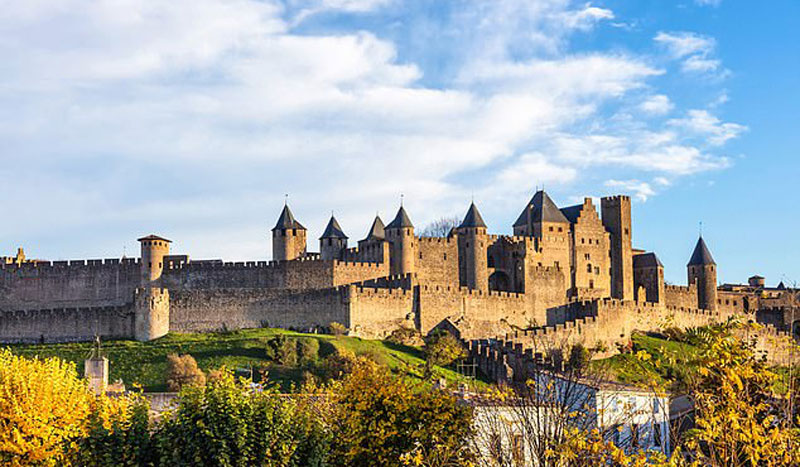 In consequence, though the population was cruelly dispossessed, the fabric of the city was saved.
With its round towers, pointed spires, and vertiginous walls, it has a curiously Disneyish appearance, and can be thick with French schoolchildren learning about its grisly past.
After hours, the place, which counts model Lara Stone among its fans, takes on a very different demeanour. Wandering around the ancient streets in the relative quiet of the evening has a weighty feel. The Museum of the Inquisition compounds the sensation and is a reminder of the savagery meted out in the name of Christ.
On our first evening, we ate at a little bistro looking straight across at the ramparts. The maitre d’ must have seen the look on my face when an intense young man with a guitar began to pour out his sorrows in song.
We were shown to a perfect table outside on the rear patio. Still within earshot of the Leonard Cohen tribute act, but only just.
We had decided to stay at one of the two hotels – Le Donjon – inside the bastide, which turned out to be a good decision. You can amble around at leisure without having to worry about driving anywhere later, and after a couple of days you develop an agreeable sense of belonging.
A delightful young French-Moroccan woman checked us in, made us coffee, offered tourist advice and later served us at the bar. When I complimented her on her multi-tasking, she replied: ‘Yes. I think the English call it modern slavery.’
Two or three nights is enough to take in the sights and sensations of old Carcassonne, but there are plenty of other places of interest within a two or three-hour drive.
If you haven’t had enough of the Cathars, the mountain castles of Queribus and Peyrepertuse, and their last redoubt at Montsegur, are not far. But be warned: the drive to these eyries is not for the faint-hearted. Precipitous mountain roads, hairpin bends, and a constantly squealing passenger make it quite a challenge.
We crossed the mountains into Spain for a few days in the arty whitewashed village of Cadaques. Our hotel overlooked the adjoining bay at Portlligat, with its simple beach restaurants and fishing boats bobbing on the breeze. It reminded me of the Greek islands, before mass tourism and the euro. A perfect place to do very little.
Sojourn over, it was back in the car for the return to Toulouse. Across one range of mountains and into another. Back through the Land of the Cathars, up one track that would have given a Himalayan goat a nosebleed, sustaining a minor scrape on the hire car (not my fault, obviously) and arriving at the airport more than four hours early to find our flight delayed. Still, as torture goes, it was hardly in the same league as the Cathars – as Isabel could no doubt tell you.
Carcassonne is a French fortified city in the department of Aude, in the region of Occitanie. A prefecture, it has a population of about 50,000.
Inhabited since the Neolithic period, Carcassonne is located in the plain of the river Aude between historic trade routes, linking the Atlantic to the Mediterranean Sea and the Massif Central to the Pyrénées. Its strategic importance was quickly recognized by the Romans, who occupied its hilltop until the demise of the Western Roman Empire. In the fifth century, it was taken over by the Visigoths, who founded the city. Its strategic location led successive rulers to expand its fortifications until the Treaty of the Pyrenees in 1659.
Its citadel, known as the Cité de Carcassonne, is a medieval fortress dating back to the Gallo-Roman period and restored by the theorist and architect Eugène Viollet-le-Duc in 1853. It was added to the UNESCO list of World Heritage Sites in 1997.
Consequently, Carcassonne relies heavily on tourism but also counts manufacturing and wine-making as some of its other key economic sectors.