
Anyone who speaks of electricity in Pakistan these days does not forget to lament in the same breath how unaffordable it has lately become. Even the terms ‘capacity trap’ and spiraling ‘circular debt’ have now become topics of everyday household discussions.
 Most people expect electricity to be available when they turn on a switch and gone when they turn it off. However, few realise that to provide its customers this control and flexibility, day in and day out, under scorching heat or in bitter colds, during heavy rains or choking dust storms, an electric utility has to make tremendous investment in generation, transmission, and distribution facilities.
Electricity supply and delivery system is among the most complex and expensive of infrastructure facilities for any country, but is also the lifeline for its economy and society. Electricity is also a unique commodity. It must be produced and delivered the moment it is demanded, as its storage at any significant scale is still very expensive, if not impossible.
Most of the complexity and cost in the electric utility business is due to the random nature of consumer demand, which varies not only from moment to moment, over the day, week and season, but also over the years. An electric utility must have resources and facilities available and ready to precisely match this demand at all times, from next moment to next couple of decades; otherwise, the economy could suffer huge losses and society a great deal of inconvenience.
Over a period of roughly one and a half century, a variety of technologies have evolved essentially to enable electric utilities to serve the demand on their systems reliably, safely, with high quality of service, and at minimum economic, social, and environmental costs.
The portfolio of generating technologies a utility employs to serve its customers is commonly termed as power generation-mix, which is of two further types: capacity-mix that describes the proportion of different plant capacities in the portfolio, and energy-mix that describes the extent of utilisation of these plants. The capacity-mix serves mainly to ensure reliability in the system, while the energy-mix serves to minimise operating costs.
Generation-mix-capacity as well as energy-for any given system is not fixed; it can vary a great deal over time, albeit slowly, for a host of reasons. For Pakistan, for instance, the capacity-mix only a decade back was 65.3 percent thermal, 32.4 percent hydel and 2.3 percent nuclear; and energy-mix 67.4 percent thermal, 29.4 percent hydel and 2.9 percent nuclear. Last year, the capacity-mix was 64 percent thermal, 27 percent hydro, 4 percent nuclear, and 5 percent renewables; and energy-mix 66 percent thermal, 21.4 percent hydro, 7 percent nuclear, and 3 percent renewables. Apparently, power generation-mix has remained largely static over the past decade, except some increase in nuclear generation and renewables making a small entry. But when one looks deeply into the thermal part of the mix, one can notice a real change. Oil-fired generation gradually has been replaced with gas-and coal-fired plants.
We leave the issue of why this change took place in Pakistan for some other time and contend presently only on discussing the role that generation-mix plays in the electric utilities’ quest of reliably serving demand in their system and try to answer the question: can we really have a power generation-mix for a system we can consider perfect? Well, a whole lot depends on the nature of demand an electric utility has to serve, now as well as in the next many years to come. Let’s see how. Consumers’ electricity demand is often classified into three major categories: base load that remains on the system round the clock, peak load that comes on the system only for a few hours in the year, and intermediate load that falls in between. Sometimes, the peak load is further classified into normal peak and super peak, and intermediate load into intermediate and shoulder peak.
Most of the complexity and cost in the electric utility business is due to the random nature of consumer demand
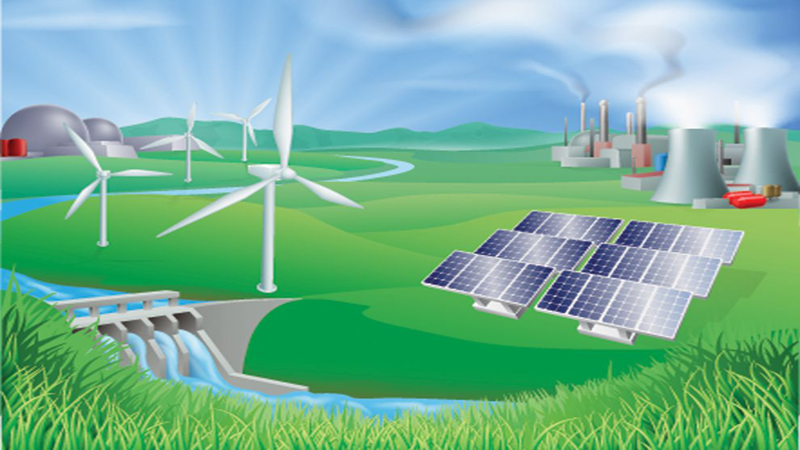
A variety of technologies have evolved to enable the electric utilities to serve demand on their systems reliably and at minimum cost. We have high upfront but low fuel cost plants like coal and nuclear, on one hand, used primarily to serve base load. On the other extreme, we have low upfront but high fuel cost plants like combustion oil and gas turbines and diesel generators to serve the peak load. And there’re a host of other technologies to serve the intermediate loads. A number of considerations go into working out an optimal set of plants to serve consumer demand on a temporal scale that extends from the next moment to a couple of decades into the future. Though cost act is a common denominator behind many of these considerations, it isn’t the only one.
Some of the major considerations that power system planners use in finding out an appropriate fit of a candidate power generating technology in the overall generation portfolio include the following: (1) its service function in the system, to serve base, intermediate, or peak demand and its operational flexibility; (2) its upfront capital cost, lead time to construction, and useful life; (3) fuel and O&M costs; (4) technology’s maturity and modularity; (5) resource availability and plant dependability; (6) its impact on local, regional, and global environment; (7) impact on local employment; and (8) its contribution to self-reliance, etc.
Not every consideration in the above list is reducible to monetary terms, and system planners often have to use their professional experience and judgment to make tradeoffs at the margin that sometimes can go wrong. But this is the necessary evil that power system planners have to live with.
As should be evident from above, it’s a never-ending struggle on the part of an electric utility to match the continuously changing demand on its system with a supply portfolio that itself is subject to changes as a result of technical developments, global and local market upheavals, and continuously varying geopolitical landscape. It’s more like a moving target that an electric utility has to chase all the time.
Many complex and highly sophisticated tools have been developed over the years to deal with the multitude of variables and associated uncertainties, both on the demand as well as supply sides of the equation; still, the goal of finding a generation-mix for a given system that can be considered ‘perfect’ remains largely elusive.
The best a system planner can do is to identify a multiple set of plausible scenarios for consumer demand in his system and the technology and resource choices that are available to him in serving this demand in the most cost-effective manner, keeping in mind the socioeconomic priorities of the government as well as the technical and environmental constraints that could influence his choices. He should then use the tools at his disposal intelligently to evaluate the strength of various combinations of generating technologies to serve demand, and finally using his professional judgment, select a portfolio of power generation technologies that is economical, flexible, and robust across multiple scenarios, still hoping that there won’t be any unpredictable surprises along the way.
The writer is a freelance consultant, specialising in sustainable energy and power system planning and development