
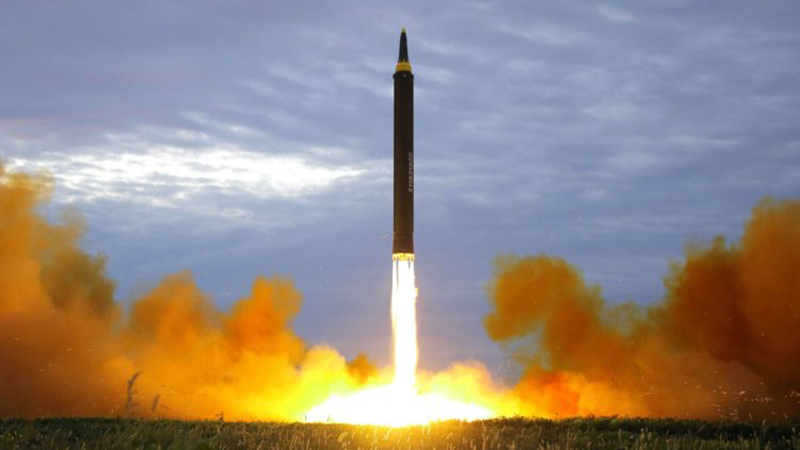
Make no mistake; “safe havens” and (Pakistani) “nuclear weapons and materials” remain the preoccupation of the US administration, and it will continue to exert “pressure of all sorts” to bend Pakistan into compliance to President Trump’s South Asia Strategy.
“We can no longer be silent about the fact that some externally focused terrorist groups enjoy safe haven in Pakistan’s territory,” Acting Deputy Assistant Secretary Henry Ensher said in the keynote speech he delivered at a recent Pakistan-focused conference, jointly organised by the Woodrow Wilson Center and Indus.
Delivered before a largely Pakistani-American audience plus a number of American South Asia watchers, the blunt, though not entirely unexpected, speech in fact brought out the real contours of President Trump’s Pakistan policy.
And surprisingly, it also spelt out Washington’s two “highest priorities” in Pakistan and throughout the region:
a) concerns about continued existence of safe havens that enable terrorists to carry out attacks that threaten regional and global security, and
b) need to prevent nuclear weapons and materials from coming into the hands of terrorists.
Ensher shocked many among the audience with this crudely direct identification of the priorities vis-a-vis Pakistan, as well as the to-do-list on Pakistan – a display of the typical carrot-and-stick approach. The entire speech in fact was actually loaded with concerns, demands and expectations from Pakistan. His salient points were:
i) Efforts to bring stability to Afghanistan is our primary and major area of policy divergence with Pakistan at this moment. No partnership can survive such a disconnect. As long as that continues, it will continue to colour and take centre stage in the bilateral relationship.
ii) Even as we have broadened our regional diplomacy, there remains a special role for Pakistan … we have sharpened our approach to Pakistan with an eye to improving mutually favorable outcomes.
iii) Pakistan can address terrorism on its territory when it is determined to do so … but … we have not seen the decisive steps from Pakistan that would demonstrate commitment to ensuring that its territory cannot be used by the Taliban, the Haqqani Network and other groups that would sew violence and instability in the region.
iv) Pakistan has much to gain from partnering with our peace effort in Afghanistan and much to lose by providing safe haven to terrorists who pose a threat to peace and stability in Afghanistan.
v) It is time for Pakistan to demonstrate that it will be a constructive partner for peace in the region …. there is truth to the idea that we are applying pressure to Pakistan, and it’s an important component of our policy … to advance U.S. national interests.
vi) Suspension of security assistance and coalition support fund payments in January of 2018 reflect US concern over Pakistan’s continued counterproductive policies.
vii) Shift in Pakistani policy in line with South Asia Strategy, is very much in Pakistan’s own interest.
viii) Pakistan’s battlefield nuclear weapons pose a greater risk from theft and misuse and increase the risk that a conventional conflict between India and Pakistan could escalate to use of nuclear weapons.
ix) The new government has the opportunity to be our partner in bringing peace and stability to Afghanistan and prosperity and security to Pakistan. Doing so would enable a more mutually beneficial relationship.
x) Opportunities, however, cannot be merely discussed, they must be seized and action taken.
Eshner’s speech left little doubt about his country’s expectations of Pakistan.
The Financial Action Task Force (FATF) that grey-listed Pakistan and sought measures to end money laundering and terror financing is one of the multilateral instruments serving as a potential noose. It may eventually push us into the black-list, thereby creating enormous financial and travel difficulties for Pakistanis. The next possible punitive step – bilateral – could be economic sanctions if one early morning President Trump “takes to twitter to announce these measures.”
Although the US officials denied the FATF measures were politically motivated, yet the reference to Jamaat-ud-Dawa chief Hafiz Saeed, safe havens, and non-state actors threatening other countries served as euphemisms connecting the Indo-Afghan-US narrative on Pakistan.
Islamabad and Rawalpindi, therefore, have formidable tasks ahead; finding a balance between safeguarding “national interests” on the one hand, and addressing the “primary priorities” of Washington vis-a-vis Pakistan, on the other. FATF legitimately expects a curb on terror financing and money-laundering. In its own interest and as a responsible member, Pakistan must comply. It must also demonstrate its rejection of all types of non-state actors. Nevertheless, it is an altogether different story whether this will lead to a change in the geo-politically coloured US view on Pakistan.
Published in Daily Times, October 22nd 2018.