
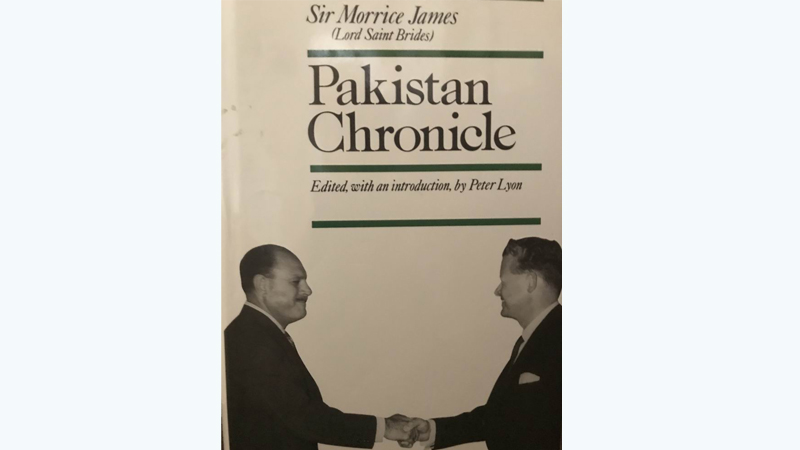
Morrice James was a British diplomat who served in Pakistan for a dozen years. Sir Morrice was knighted by the Queen in 1962.He was High Commissioner during the 1965 war.
His book is brimming with riveting portrayals of Pakistan’s leaders, of whom the most prominent is Field Marshal Ayub Khan who is shown on the cover with Sir Morrice.
In his judgment, Ayub was personally an honest man but there was “an element of intellectual dishonesty” in the way in which he concealed the real motive for Pakistan to sign military agreements with the US.
From 1951 onwards, Ayub had a big hand in making the army the strongest institution in the country. Unfortunately, that also meant ensuring that the civil administration remained weaker than the army and the politicians remained weaker than the civil administration.
Sir Morrice noticed a change in Ayub when he gave himself the title of field marshal and took over the presidency. After seven years of unchallenged power, the field marshal had “ceased to be alert and self-critical.” Ayub, convinced of his infallibility, began making all the big decisions by himself. That was a gross error since his intellectual grasp was that of a philistine.
He trusted ZA Bhutto and Aziz Ahmed on Kashmir more so than his generals. Ayub should have known better: “Bhutto had never been within hundred miles of a battle, and his ignorance of military matters was total.”
When the attack on the Indian outpost of Akhnur became imminent on the 1st of September, Ayub turned cautious. He feared an Indian response and called it off. But it was too late. Ayub thought he could defeat India in just two weeks he realised his folly when he was informed that Pakistan was running out of arms and ammunitions.Sir Morrice says that even though he liked Ayub enormously, after the Kashmir aberration he thought it best to leave Pakistan.
In his judgment, “Ayub was par excellence a hard headed administrator, with a hatred of sloth, untidiness, and self-seeking. But he never fully mastered the art of describing his long term goals to his countrymen. His style was too brisk, military and matter-of-fact to touch their hearts.”
Sir Morrice moved on to become High Commissioner to India. In September 1969, he and his wife visited Ayub at his house. He had been out of office since March and was leading a quiet life in Islamabad.
Ayub’s “drawing room was decorated with a life-size portrait of himself, and there were silver-framed photographs arrayed everywhere showing him with various heads of state.”He seemed to be “a man touched with greatness who now lived in the past”.
When the high commissioner and his wife rose to leave, the former president invited them to stay for dinner, “adding with unconscious pathos that he had no other engagements”. Unfortunately, they declined because of another dinner commitment; something he says would have been unthinkable just six months ago.
There is not much that is new in the book about General Yahya, Ayub’s successor as military president, other than the observation that while Ayub, facing unrest in the East, had simply talked about using the language of weapons, Yahya had actually given the order to fire them. The disastrous end was foreordained when the first bullet was fired since the army resorted to fighting a classic colonial war against the majority of its citizens.
Zulfikar Ali Bhutto, Ayub’s protégé who fell out of favor with him after Tashkent,was put in power by the army. Ayub had recognised Bhutto’s strengths but also his weaknesses but thought that the former would overcome the latter since :“Bhutto had the right qualities for reaching the heights…drive, charm, imagination, a quick and penetrating mind, a zest for life, eloquence, energy, a strong constitution, a sense of humor and a thick skin.”
However, as Sir Morrice says, “there was the rank odor of hellfire about him. He was a Lucifer, a flawed angel. …Despite his gifts I judged that one day Bhutto would destroy himself. In 1965 I sent a dispatch to Her Majesty’s Government that Bhutto was born to be hanged.”He had used the expression figuratively and was deeply disturbed when he got the news that Bhutto had been hanged in the wee hours of an April morning in 1979. Bhutto had a “talent for dissimulation,” which he had sharpened during his teenage years.
In his judgment, “Ayub was par excellence a hard headed administrator, with a hatred of sloth, untidiness, and self-seeking. But he never fully mastered the art of describing his long term goals to his countrymen. His style was too brisk, military and matter-of-fact to touch their hearts.”
Commenting on the third military ruler, he says that General Zia “handled with skill and steadiness the problems created for Pakistan by the Soviet invasion of Afghanistan. Impressively clad in the dashing cavalry uniform of an Ouida hero and with his jet-black hair, eyebrows and mustache, and with lustrous, slightly feral eyes, Zia radiated in equal parts style, strength, and a desire to please. His manner was mild, almost deferential, but behind the velvet voice there was an edge of steel.”The book discusses how Zia stitched religiosity into the national fabric and the consequences of that dangerous policy.
Kashmir, long a cornerstone of Pakistan’s foreign policy, is discussed at length in the book. Sir Morrice reminds the reader that in 1964, during the course of bilateral negotiations with India, India had suggested a partition along the cease-fire line of 1948. Pakistan countered with a new boundary that would give itself the whole of Jammu and Kashmir and simply let India keep the south-east corner of Jammu. The talks broke down. War came in the next year.
When the war concluded inconclusively in September, and a peace agreement was signed the following January with the Indians under Russian auspices, there was virtually no impact on the cease-fire line. Sir Morrice questioned the army’s wisdom of attacking Kashmir by force, which caused Pakistan not only to lose face but also to lose thousands of lives and treasure.
Sir Morrice says that Pakistan lost is moral ground in Kashmir when the army engaged in a brutal suppression of Bengalis in 1971. He points out that repression was on a much bigger scale than India’s repression of the much smaller population in Kashmir.
He suggests Pakistan should focus on getting its own house in order, integrating minorities into the national fabric, and reducing the army’ footprint. Only then will it realize its true potential.
The book reads well, as befits an Oxford graduate. I wish the author had delved more into Pakistan’s military history, given that he had served as a colonel in the British military. Regardless, it’s a must-read.
Published in Daily Times, October 1, 2018.