
India’s constant opposition to China Pakistan Economic Corridor (CPEC) will not affect the project in any way. It is purely a development project and there is no reason to restrain the development work in the disputed areas. India is reiterating that CPEC passes through the disputed area and is therefore a serious concern for the country.
CPEC is a flagship project of China’s One Belt One Road Initiative which includes more than 65 countries of the world and it is not like a Multilateral Export Control Regime ‘an international body that states use to organise their national export control systems’/regime like NSG in which a consensus of the member countries is needed for new developments. Instead, the CPEC project is open and inclusive and invites other countries to invest for the mutual benefit and shared prosperity of the respective regions. Pakistan and China are working on the economic cooperative initiative and it is backed by the UN and several other countries of the world which suggests it is not directed against any third party.
Will the disputes between or among countries obstruct the overall development of the region and the populace residing in those areas?
On Tuesday, India’s Ambassador to China Gautam Bambawale said, “Beijing should pay serious attention to New Delhi’s concerns about the China-Pakistan Economic Corridor (CPEC) and not ignore them. The China-Pakistan Economic Corridor passes through Indian-claimed territory and hence violates our territorial integrity. This is a major problem for us.”
The CPEC project is open and inclusive and invites other countries to invest for mutual benefit and shared prosperity of the respective regions.
Since the introduction of this project, these kinds of statements have been up roaring on different international or national forums from the India’s Side. Despite these stern statements, the project has been progressing very well. Moreover, the US has also shown its weight behind India by saying that it too believes the route of corridor passes through a disputed territory – a reference to Northern areas of Pakistan. The statement has come at a time when Foreign Minister Khawaja Asif was in Washington and held series of talks with the US officials to normalise the tense relations. This new stance has started another debate and is undoubtedly going to further damage the bilateral ties, as it is profusely obvious now that US envision a greater role for India in the region.
Apart from the vicious existence of terrorism in South Asia, the Kashmir dispute between Pakistan and India is also the biggest hindrance for any possibility of a large scale of investment coming into the region. India should be on the front line to negotiate with Pakistan to resolve this conflict as a solution to the concern on CPEC to promote prosperity and development in that area because the northern part of India bordering Pakistan and Indian Held Kashmir lacks the basic infrastructure.
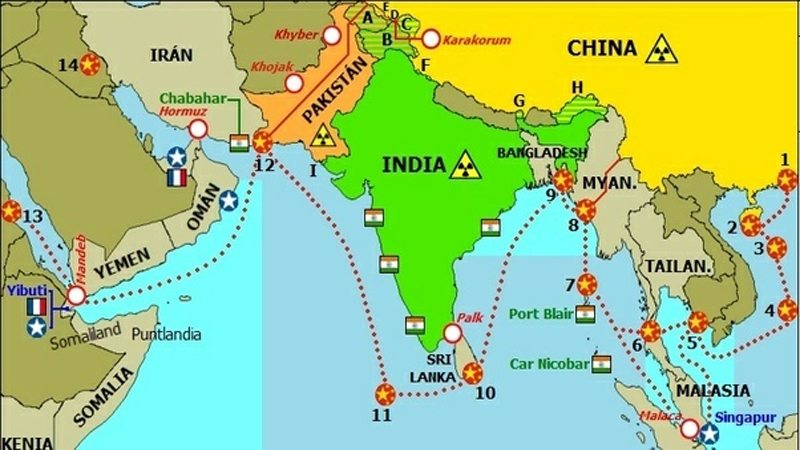 India’s perceived sense of insecurity regarding this project is that through CPEC the sources and standards of livelihood of the people living in Pakistan’s side of Kashmir would be raised. This is a serious anxiety in India as this situation presents Pakistan’s GB stark contrast to the situation in Indian occupied Kashmir, where the occupation forces have unleashed a reign of terror against innocent Kashmiris for committing the ‘sin’ of demanding legitimate socio-political rights.
China would not give up CPEC just because of protests in India. The Indian government will not cease its developmental activities in Arunachal Pradesh either. But is it not important to respect the voices of communities residing in disputed territories as a priority rather than following the institutional norms in developmental activities? From inter-governmental institutions like ADB/World Bank to each country sharing disputed territories like India or China or Pakistan, it is foremost important to stand up with rights to development of communities. Otherwise, Sustainable Development Goals (SDGs) cannot be considered ‘universal’. Indians are only good in massacring its own minority races like Sikhs and Muslims.
In a nutshell, India’s regional aspirations to contain China’s growing regional influence will not affect the latter’s commitment towards CPEC. The relations between India and China often turned unfavourable even when there was no CPEC. India, being the major country of the region, should play its part towards the development of the region by making peace with the neighbouring states.
Lastly, if India is striving hard by investing in Chabahar Port and other initiatives, such as its support to 116 influential projects in 31 provinces in Afghanistan, then why it is protesting the developments in the disputed areas through which CPEC passes? These 116 India-sponsored projects will cover hydropower construction, farmland water conservation projects and renewable energy among others that will directly affect lives of the common people of Afghanistan. Regional development is possible through the CPEC if India looks at this project through the prism of the development and not enmity.
The writer is an independent Researcher and M.Phil Scholar at Strategic Studies, Quaid-i-Azam University Islamabad. She has written various articles on China-Pakistan Strategic Partnership, CPEC, Gwadar Port
Published in Daily Times, February 3rd 2018.