In Pakistan’s political history, some thinkers and writers are remembered not for the age in which they lived, but for the enduring relevance of their ideas. While time consigns most men of letters to history, a rare few transcend it, becoming lasting points of reference. Their thoughts outlive their era, continuing to illuminate the path for generations to come.
Among them stood Professor Waris Mir-the distinguished progressive scholar, journalist, and public intellectual who regarded the pen not as a means of livelihood but as a sacred trust held on behalf of the people. At a time when democracy, constitutionalism, freedom of expression, and liberty of thought were treated as subversive ideals; when dissent was branded as rebellion and criticism as treason, Waris Mir refused to compromise. His life affirmed an enduring truth: a man may be silenced, but his ideas can never be buried.
When Waris Mir died suddenly under mysterious circumstances on 9 July 1987, at the age of just forty-eight, Pakistan remained firmly under the grip of General Zia-ul-Haq’s military dictatorship. It was an era defined not only by political repression but by intellectual suffocation, ruthless censorship, judicial intimidation, and institutional coercion. Many writers chose silence; others surrendered to expediency, while some willingly became apologists for authoritarian rule. Waris Mir remained accountable only to his conscience. It is for this reason that, decades after his death, his writings continue to serve as enduring landmarks in Pakistan’s struggle for democracy and civil liberties.
His intellectual identity was never confined to any political party, ideological camp, or school of thought. His allegiance was to principles that underpin every civilised society: constitutional supremacy, representative government, justice, human dignity, freedom of expression, and the courage to tolerate dissent. He rejected the notion that the authority of the state should supersede the liberties of its citizens. To him, the state existed to protect the rights of the people-not to silence them.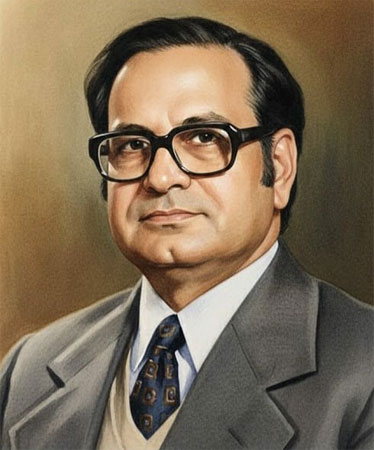
Pakistan’s history of military intervention reveals a recurring pattern: every period of martial rule produced not only political upheaval but also intellectual paralysis. Under General Ayub Khan, the state’s developmental narrative sought to marginalise dissent. Under General Zia-ul-Haq, the fusion of religion, politics, and state power narrowed the space for independent thought even further. In such an atmosphere, speaking the truth was not merely a professional duty-it was an act of courage. Waris Mir accepted that risk without hesitation, resolving that his pen would serve truth rather than fear.
He believed the greatest danger posed by dictatorship was its capacity to cripple a society’s ability to think independently. When a state criminalises questions, treats disagreement as disloyalty, and brands criticism as treason, he argued, it condemns itself not merely to political decline but to intellectual decay. The fate of every nation, he maintained, ultimately rests upon the integrity of its scholars and thinkers. Once they barter away their conscience, truth becomes scarce, and the narrative of power begins to masquerade as reality.
What distinguished Waris Mir’s prose was that it never degenerated into opposition for its own sake
As censorship tightened during the Zia era, Waris Mir reminded fellow writers of their enduring responsibility in words that remain profoundly relevant today:
“One sign of a living nation is that no matter how many chains are fastened upon its writers and readers, no matter how many locks are placed upon their lips, they will always find some way-even if only through a sigh or a whisper-to register their protest.”
These words were more than a reflection on journalism; they were a timeless affirmation of the intellectual spirit upon which every free society depends.
Elsewhere, he wrote:
“A true writer can never become the instrument of any government, political party, or institution, for he represents the conscience of the people. The writer’s pen is held in trust for the public. It must not be employed to win the favour of those in power, but to give expression to the truth.”
This conviction lay at the heart of his philosophy of journalism. To Waris Mir, the press was never intended to serve as the mouthpiece of the state; its highest calling was to reflect the conscience of society.
Throughout his writings, Waris Mir paid tribute to those who refused to bow before tyranny. From Socrates and Galileo to Ibn Rushd and distinguished scholars of the Indian subcontinent, he admired all who endured persecution rather than betray their conscience. In many ways, his own life became a continuation of that noble tradition. He did not merely chronicle history-he lived its harshest realities.
Following General Zia-ul-Haq’s overthrow of the government of Zulfikar Ali Bhutto in 1977, censorship reached unprecedented levels. Newspapers were tightly controlled, journalists were imprisoned, and some were publicly flogged. Amid this climate of fear, Waris Mir argued that Pakistan’s fundamental crisis was not simply the replacement of one government by another, but the persistence of a political order that placed greater faith in the power of the gun than in the will of the people. A government sustained by military force, he wrote, could never truly command the confidence of its citizens. To express such views in that era demanded exceptional courage, for every sentence carried the risk of severe consequences.
What distinguished Waris Mir’s prose was that it never degenerated into opposition for its own sake. Every argument rested upon history, constitutional law, philosophy, religion, and political thought. His writings were marked less by rhetoric than by disciplined reasoning. Rather than imposing conclusions upon his readers, he persuaded them through evidence, logic, and historical perspective. He asked difficult questions instead of offering comforting certainties.
That is why, nearly four decades after his death, his writings retain their remarkable freshness. Many of the questions he raised continue to confront Pakistan with undiminished urgency. At the core of his intellectual struggle lay a simple yet profound belief: reason must prevail over force, liberty over coercion, dialogue over silence, and democracy over dictatorship. He never advocated violence as the answer to oppression; instead, he placed his faith in the power of the pen, rational discourse, and enlightened thought. In doing so, he became more than a distinguished journalist or scholar-he emerged as one of Pakistan’s foremost champions of democratic values and free expression.
Perhaps the most remarkable quality of Waris Mir’s thought was its refusal to surrender to despair. Though he relentlessly exposed dictatorship, censorship, intellectual stagnation, and social injustice, he never lost faith in the triumph of ideas. He believed that truth and independent thought might be suppressed for a time, but they could never be extinguished. It was this unwavering conviction that sustained him throughout his life, and it remains the most enduring legacy he has bequeathed to Pakistan’s democratic and intellectual tradition.
The writer is a senior journalist known for his research-oriented books on Islamic militancy and terrorism in Pakistan.