

Eighty-year-old Bani Gul runs a small shop of used utensils in the historical city of Shabqadar. He is not able to walk or talk due to weakness, but still he remembers the Indo-Pak partition seen by this city. “I was only 11-year-old at that time when the conflict started in this historical city. In summer vacations, I always came to my grandmother’s house for 2 to 3 months to pass my vacations in Shabqadar. Most of the property owners were Hindus and Sikhs. As it was the hub of Hindus and Sikhs, the city was named as Shankargarh. It was May or June of the partition year and I was in my grandmother’s house and my grandmother sent me to bring some milk from the shop for the guests. I got the milk and was on my way back home when suddenly a blast occurred in the main bazaar of the city. I rushed back, but saw the dead and injured bodies on the road. Everyone in the city was running from the blast site. I hid myself inside a shop, but the milk had been spilt. Tears rolled down from my face as I was upset about what would be the response of my grandmother. After the situation became normal, I started running to my house and informed my grandmother. Then the unstopped attacks started by Muslims and Hindus on each other. I left my grandmother’s house after some days because the city was not safe. After partition, I visited the city again and people told me that Hindus and Sikhs had been kept in the historical fort built by Ranjeet Singh,” he said.
Ranjeet Singh’s fort was designed by a Hindu architect Tota Ram in 1830 and built in Shabqadar. Tota Ram’s son Shankar Das was born here. Later, the place was named Shankar Garh. In the 19th century, to counter the Pakhtuns, the Hindus and Sikhs were shifted here from Hindustan. The Hindus migrated from the city, but still there were a few Sikhs left in the city. Shankargarh, now Shabqadar, witnessed various ups and downs in its history from Mughals to the British.
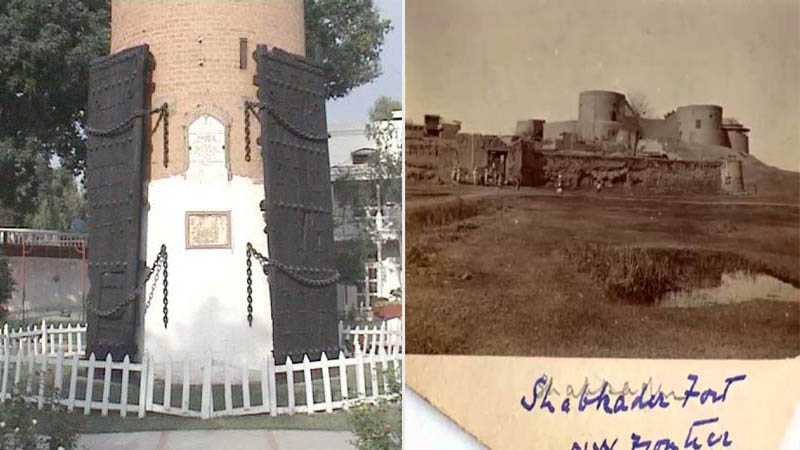
The city was the hub of Mughal emperors as well. However, after the downfall of the Mughals, the rulers were replaced by the British. The tribes living in Shabqadar came with the invaders of Shahabuddin Ghauri and Mahmood Ghaznavi in early stages and settled here in the valley linked to Pashklawati now Charsadda.
Abdul Sattar Bacha, the president of the market, have some memories. He did not see Indo-Pak partition. However, he has a couple of stories in his memory that he heard from his elders.
Abdul Sattar Bacha said this city was an example of the brotherhood and as well the religious interfaith harmony of people from diverse religious backgrounds.
“All the property was owned by Hindus and Sikhs. There was no conflict between Muslims and Hindus or Sikhs in the past. There were mandars (temples) and Gordwaras within the city. Hindus prayed in temples and Sikhs in gordwaras. There was no hatred towards anyone. Everyone prayed openly. No one interfered in the religious beliefs of the other. There was an environment of brotherhood in business as well in family functions. No one remarked about the religious background of anyone.
We never heard from our elders that there was a conflict on religious basis between the people living here. But one Hindu was killed and the conflict arose before the partition and then insecurity emerged in minorities living here in city. But the partition in 1947 cleaned up the city of Hindus. Later, the war on terror in Khyber Pakhtunkhwa hit the Sikh community very badly. After their target killings, they shifted to other safer cities like Hassan Abdal and Nankana Sahab. Most went to India,” he said.
At the end of the 19th century, warlords from Mohmand Agency and Shabqadar attacked Ranjeet Singh’s fort. Haji Shahab Turankzae became a symbol of resistance against the Sikhs and the British. The broke through the main door of the fort and the Sikhs faced economic as well as human losses. The son of Ranjeet Singh, Sher Singh, ordered the military to do punish the main gate. The French army general, Ventura, imprisoned the main gate. After the decision, the main gate was tied up with iron chains. After 200 years, the main gate is still in the same position.
There were about 50 to 60 families of Sikh community in the city linked with different businesses. As violence rose in the province, the Sikhs were targeted. The families left due to fear and insecurity and shifted to Punjab and India. Now, there is not a single shop owned by a Sikh in whole market. Their historical buildings and worship places still exist. According to another local residence of the area, Shabqadar had two old names in 19th century as Sikh Dheri and Shankargarh. After protests by Muslims, Shankargarh was replaced with Shabqadar.
He said that the government did not repair the old buildings of Hindus and Sikhs. “The government has no policy regarding this. We ask the government to reconstruct these old buildings or demolish them,” he said.
Shabqadar was the hub of All- India Congress before partition. Bacha Khan started a movement from here against the British colonialism. Later, the British imprisoned him. He started the activities from Shabqadar after being set free. Then he joined All India Congress. Bacha Khan, along with Mahatma Gandhi, visited Shabqadar along with other prominent members of the party in 1946.
He addressed the people of the area. These were the reasons that Congress got more votes from this historical city of Shankargarh. Gandhi wanted to merge this place with India. However, later due to its rough geographical location, he ignored the area.
According to historian Arif Khan, the fort has two major huts. “The British Prime Minister Sir Winston Churchill visited this fort in the time of British and stayed here for some days. That is why one of the huts is named Churchill hut. The other hut used to house an telephone exchange in the past. Shabqadar has a strategic importance. That is why every king wanted to have a strong fort in the area to stop the resistance of Pakhtun warlords. This fort was built for the strategic importance of the area. But Pakhtuns in the area never welcomed the warriors or colonial powers. During attack of the Pakhtun fighters on the fort, many British soldiers were killed. Their graves are still inside the fort. Another historical fact is that they died naturally. When the warriors attacked the British Army, the British soldiers burnt down the houses and guest houses of the local people and imposed 8 rupees fine on every house according to collective responsibility called Tamba Grab( fine on every house) derived from Pashton Wali concept. These were the major reasons that people hated the rulers,” he said.
“The resistance increased and later turned hostile. It was the unlucky year of 1876 when historical city of Shankargarh turned into Shabqadar. Two stories are told about it. One is that people agitated for changing the name. The other is that Muslims were celebrating Shab-e-Qadar event so this name turned into Shabqadar,” he said.
Ranjeet Singh’s fort is now in the hands of FC. Recruits are trained and then deploy in various areas of FATA and KP. This fort faced a suicide attack some years ago. Dozens of cadets lost their lives.
A history student, Darwesh Ali, said that Shankargarh had turned into Shabqadar. “However, there was interfaith harmony and brotherhood. The city now in the turmoil due to extremism,” he said.
Abdullah Malik is a freelance Journalist working in FATA, KP and Baluchistan working on culture, minorities, militancy and human rights.
He can be reached on Twitter @AbdullahMalikJ
Published in Daily Times, December 3rd 2017.