
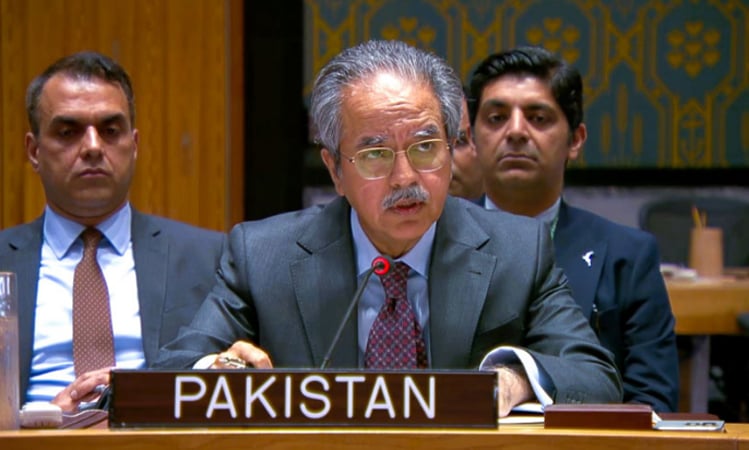
 Pakistan has warned the UN Security Council that the time for corrective action by the Afghan Taliban is “rapidly running out”, saying Islamabad will act in self-defence whenever necessary if terrorist groups operating from Afghan soil continue to attack Pakistani civilians and security forces.
Speaking during a Security Council meeting on Afghanistan on Monday, Pakistan’s Permanent Representative to the UN, Ambassador Asim Iftikhar Ahmad, said Islamabad expected the Taliban authorities to take “concrete and verifiable” action against the banned Tehreek-e-Taliban Pakistan, Balochistan Liberation Army, its Majeed Brigade, Daesh Khorasan, East Turkestan Islamic Movement and affiliated groups.
“Regrettably, they have taken no action and have completely ignored the legitimate security concerns of Pakistan and other countries,” he told the Council.
The statement marked one of Pakistan’s strongest recent interventions at the UN on Afghanistan, placing cross-border terrorism at the centre of a wider debate that also covered inclusive governance, human rights, women and girls’ rights, and the Taliban’s pledge that Afghan soil would not be used against any country.
Pakistan says it faced more than 5,300 terrorist incidents originating from Afghanistan in 2025 alone, losing more than 1,200 lives.
Ambassador Ahmad noted Pakistan had suffered the most from the freedom enjoyed by these groups in Afghanistan and what he described as the Taliban’s growing links with them. He added that a significant number of Afghan nationals had once again been found involved in terrorist activities inside Pakistan.
Pakistan has maintained that the TTP and BLA have developed operational linkages, while the TTP’s ties with Al Qaeda are also known. Kabul has repeatedly denied allowing its soil to be used against Pakistan.
The Pakistani envoy said that terrorist groups in Afghanistan had access to modern weapons and advanced equipment, including drones. Most of these weapons, he said, could be traced to “billions of dollars’ worth of arms and ammunition” left behind by foreign forces in Afghanistan.
In a right of reply, Ambassador Ahmad rejected allegations about Pakistan’s counterterrorism operations conducted in March, emphasising the strikes were “directed solely against the terrorist and military support infrastructure that is operating from Afghanistan” and were “in no way directed against the brotherly people of Afghanistan.”
He explained the targets included “drone storage and technical support infrastructure and ammunition storage sites” being used to carry out attacks against Pakistani civilians.
“No hospital or drug rehabilitation centre or civilian facility was targeted by these strikes,” he asserted, adding that video footage of all six strikes had been released by Pakistan’s Ministry of Information and that “secondary explosions” confirmed ammunition sites had been hit. “All insinuations to the contrary are not based on facts and are in fact just propaganda,” he said.
The Pakistani envoy also strongly criticised India’s statement at the Council, accusing New Delhi of using the Afghanistan debate to target Pakistan while avoiding any condemnation of the TTP and BLA, adding that more than 1,200 Pakistanis killed last year were “human beings with families like all of us, with ambitions, with hopes for a better future.”
“India’s key aims and objectives in Afghanistan are solely driven by the singular goal of destabilising Pakistan, including by using terrorist groups operating from Afghan soil,” he remarked.
He described the BLA as “Fitna al Hindustan” and said it was “supported and financed by India to destabilise and target Pakistan.” He added that India’s “newfound love for the Taliban” was not a coincidence, but had followed Pakistan’s counterterrorism operations against militant hideouts and camps inside Afghanistan.
Ambassador Ahmad continued, “India was calling on others to comply with international law and adhere to the dictates of humanity, “as shared later on social media. “It would be laughable if we are not aware of India’s own record, and if the matter under consideration in the Council was not that serious, for we know that India’s true face is truly exposed before the international community. It is a serial violator of international law.”
Pakistan, he asserted, would not allow terrorist infrastructure to be nourished on Afghan soil. “We have stopped them before, and we will do it again, and we will do it always,” he told the Council.
At the same time, Islamabad sought to keep the diplomatic door open, appreciating “sincere mediation” efforts by Qatar, Turkiye, Saudi Arabia and China.
However, he added, the Taliban’s continued refusal to publicly condemn and disassociate itself from groups such as the TTP and BLA was “deeply worrying.”
Responding to concerns about border restrictions, the Pakistani envoy noted the closure did not affect the delivery of humanitarian assistance from Islamabad’s side.
He also defended Pakistan’s policy on Afghan refugees, saying the country had hosted millions of Afghans for more than four decades despite limited capacity and insufficient international support.
“Although we are providing every possible facilitation, the international community must also step forward and fulfil its responsibility,” he said. “Blaming Afghanistan’s problems on returning Afghans will not solve the issue.”
“Pakistan’s demand from the Taliban is simple and clear: verifiable and decisive action against terrorists,” he concluded.