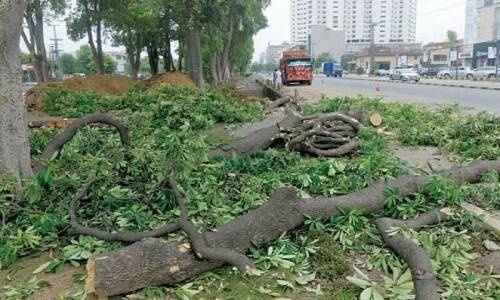
ISLAMABAD: Shakarparian, one of Islamabad’s most scenic green belts, has been left largely barren after massive tree cutting, sparking concern among residents and environmentalists. Four patches near Lok Virsa, collectively spanning around 15 acres, now appear “bald and exposed,” with the once-thick forest cleared, revealing the Expressway and surrounding areas.
Read More: NA committee perturbed over massive deforestation in Pakistan
Local citizens questioned the Capital Development Authority’s (CDA) claim that only paper mulberry trees were removed, arguing that other species, including Sheesham, were likely cut. Mohammad Kaleem, a resident, said, “No area in Islamabad has 100% paper mulberry trees; other species must have been affected.” Residents warned that the large-scale felling could increase local temperatures and degrade the environment.
CDA spokesperson Shahid Kiani defended the action, stating the removal followed a Supreme Court order from 2023 identifying paper mulberry as a severe allergen. He said the decision aimed to reduce pollen-related health risks affecting approximately 37% of Islamabad’s population during March–April. The authority plans to plant 30,000 indigenous trees in Shakarparian to restore greenery and enhance biodiversity.
Tree cutting has also taken place along H-8 Expressway and Park Road, linked to park development and dual-carriageway construction for the Margalla Enclave project. CDA assured compensatory planting at these sites, stressing alignment with ecological balance and public welfare.
Read More: ‘Green gold’: Pakistan plants hundreds of millions of trees
The widespread felling has triggered social media uproar, with former Senator Mushtaq Ahmed Khan and others calling for a formal inquiry. Interior Minister Syed Mohsin Naqvi previously emphasized efforts to avoid tree loss during construction, but no investigation has yet been ordered for Shakarparian or other affected areas.