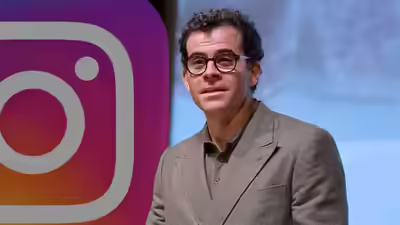
Instagram chief Adam Mosseri has declared the era of the platform’s highly curated and “polished” feed effectively over, warning that rapid advances in artificial intelligence are forcing social media to fundamentally change or risk becoming irrelevant.
In an end-of-year message shared on Meta-owned Threads this week, Mosseri said that Instagram’s traditional aesthetic — long defined by flawless images, heavy filters and carefully composed photography — no longer reflects how people actually use the platform.
Read More: Tokyo is the #1 most Instagrammable city for 2021
“Unless you’re under 25 and use Instagram, you probably think of the app as a feed of square photos,” Mosseri wrote, describing the once-dominant look of makeup-heavy portraits, skin smoothing and high-contrast visuals. “That feed is dead.”
Instagram head Adam Mosseri just wrote 1,240 words on how AI will affect Instagram creators and social media.
Here are 9 takeaways:
1. By 2026, “authenticity” will be infinitely reproducible: deepfakes and AI media will look real.
2. The internet already shifted power from… pic.twitter.com/LOz18JJc9l
— Bearly AI (@bearlyai) December 31, 2025
According to Mosseri, users largely stopped sharing personal moments on the public feed years ago. Instead, they now prefer informal, unfiltered content shared privately through direct messages, such as casual snapshots and candid photos meant only for close friends.
The Instagram head said the growing flood of AI-generated images has further eroded the value of perfectly produced visuals. With tools such as Midjourney and Sora making it easy to create striking but synthetic content, Mosseri argued that “flattering imagery is cheap to produce and boring to consume.”
He urged creators to shift away from highly curated grids and professional photography toward a more authentic and raw style. “People want content that feels real,” he said, warning that social media feeds are increasingly filling up with “synthetic everything.”
Mosseri acknowledged the irony that Meta itself has helped accelerate the AI boom, pointing to Instagram’s AI studio that allows users to create digital likenesses and the company’s experiments with AI-generated influencers.
Read More: Chicken ‘billionaire’ Poland is Europe’s poultry king
Admitting that detecting fake content will become increasingly difficult, Mosseri suggested solutions such as cryptographic signatures embedded by camera companies to verify real images. He stressed that platforms must clearly label AI-generated content to maintain user trust.
“For most of my life, I could assume photos and videos were accurate reflections of reality,” he said. “That is clearly no longer the case.”