Pakistan’s Greatest Paradox — The Team That Had Everything Except Wins
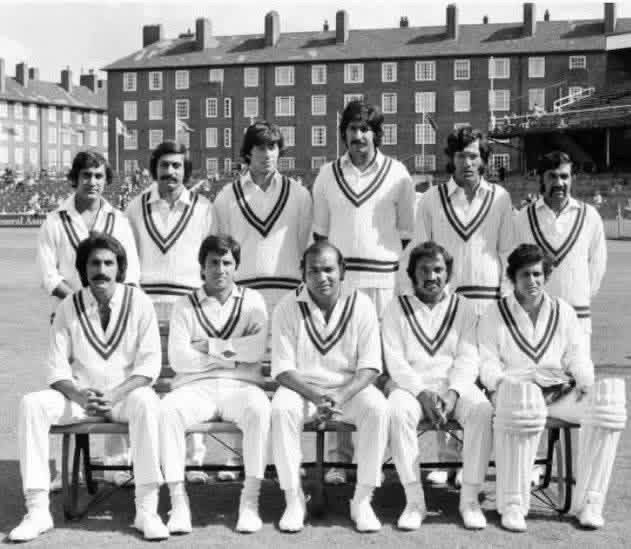
Look at that photograph from 1971: eleven men in pristine whites before an English pavilion. This wasn’t just any side—this was arguably the most gifted Pakistani squad ever assembled.
Sitting: Asif Masood, Majid Khan, Intikhab Alam (captain), Mushtaq Mohammad, Wasim Bari
Standing: Aftab Baloch, Wasim Raja, Imran Khan, Sarfraz Nawaz, Zaheer Abbas, Sadiq Mohammad
Read those names again: an 18-year-old Imran Khan; Zaheer Abbas, the “Asian Bradman”; Majid’s artistry; Sarfraz’s reverse swing; Bari’s glovework; and the Mohammad brothers—both Test-class. A constellation any captain would beg to lead.
The Record That Haunts the Talent
Under Intikhab Alam’s captaincy from 1969 to 1975, Pakistan won just one Test in seventeen. Eleven were drawn. With that talent.
The Summer of 1974: Invincible, Yet Winless
In England, Pakistan completed an entire 22-match itinerary undefeated—the first touring team to do so since Bradman’s 1948 “Invincibles.” And yet all three Tests were drawn. The side that brushed aside county attacks became cautious when it mattered most. This was not about skill; it was about choices. With Imran’s pace, Sarfraz’s guile, Zaheer’s elegance, and Majid’s timing available, safety edged out ambition.
The Captain Who Wouldn’t Pull the Trigger
By all accounts, Intikhab was a gentleman—respected, knowledgeable, seasoned by county cricket. What he lacked was the killer instinct. At hinge moments—a bold declaration, an attacking field, risk on day five—he defaulted to preservation. One win in seventeen isn’t misfortune; it’s a mentality.
Fast Forward: The Unlikely Champion
Enter Misbah-ul-Haq. In 2010 he inherited a team in pieces—six captains in six years, scandal, shredded morale. He didn’t have a galaxy of superstars, yet he led Pakistan in 56 Tests for 26 wins, 19 losses, 11 draws—the most wins by a Pakistan Test captain—and took them to No. 1 in 2016.
Under Misbah:
3–0 whitewash of No.1-ranked England in the UAE (2012).
2–0 over Australia in the UAE (2014)—Pakistan’s first series win over Australia in 20 years (not in Australia).
How did he do more with less? He made decisions.
Anatomy of Leadership
The gap between Intikhab and Misbah wasn’t textbook knowledge; it was appetite for risk. Misbah grasped a simple truth: draws don’t build dynasties. He declared boldly, set attacking fields with modest attacks, and refused stalemate. The mindset showed up in his batting, too—averaging 55+ as captain and blasting the then-fastest Test fifty at age 40. The point isn’t flair; it’s intent.
The Uncomfortable Truth
We love the myth that assembling the best players guarantees trophies. The Intikhab era proves the opposite: without decisive leadership, brilliance diffuses into beautiful stalemates. You can field an all-timer in the making, a Bradmanesque accumulator, the inventor of reverse swing, multiple 40-plus batters, and a world-class keeper—and still win one in seventeen if the captain won’t pull the trigger.
Decision-Making Under Pressure
Great captains aren’t those who know more; they’re the ones who act when the outcome is uncertain. Intikhab understood declarations and fields; he just wouldn’t cross the bridge from knowing to doing. Misbah did—sometimes it failed, often it didn’t—but he never dodged the decision. That’s leadership.
Legacy, In Full
Intikhab’s service to Pakistan cricket is substantial: later, as manager, he oversaw the 1992 World Cup and 2009 T20 World Cup triumphs. But as a Test captain, he underachieved with over-talented resources. Misbah, by contrast, over-achieved with ordinary resources, stabilising Pakistan and delivering its winningest Test-captaincy era.
Beyond Cricket
This is a case study in organisational effectiveness. Talent is necessary; it is never sufficient. Without a leader willing to harness the light—by choosing, risking, and owning the consequences—stars remain just that: scattered points. Leadership turns constellations into navigation.
Conclusion: The Captain’s Burden
Return to that 1971 photograph. Eleven supremely talented cricketers. Many became greats. But they won one Test in seventeen because their captain—talented, diplomatic, informed—wouldn’t make the hard calls.
Decades later, Misbah led a less-storied group to 26 Test wins because he did.
That’s the difference between having great players and being a great team.
Between knowing what to do and having the courage to do it.
Between being remembered for potential—and being remembered for performance.
Test Captaincy Snapshot
Intikhab Alam (1969–1975): 17 Tests — 1 W, 5 L, 11 D
Misbah-ul-Haq (2010–2017): 56 Tests — 26 W, 19 L, 11 D (Pakistan’s most Test wins by a captain)