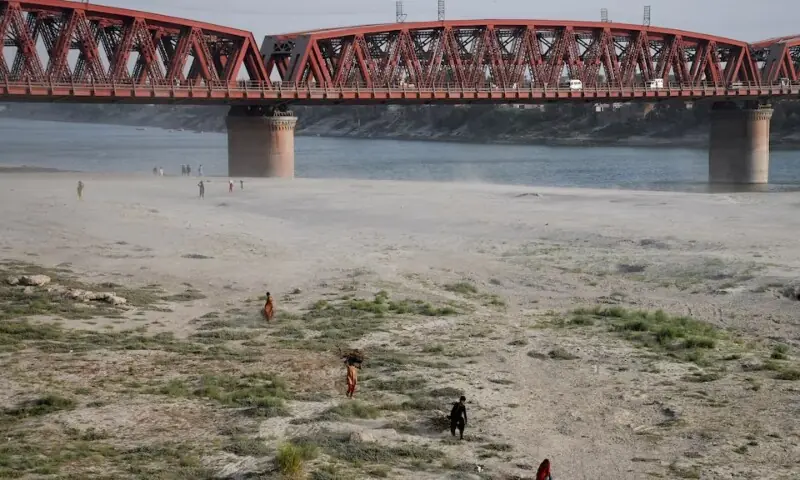
ISLAMABAD: India cannot abruptly stop the Indus River or completely divert its tributaries, but it can influence the timing of water flows to Pakistan within its technical limits, posing a significant short-term threat, the Ecological Threat Report 2025 has warned. The study, published by the Sydney-based Institute for Economics and Peace (IEP), highlights Pakistan’s vulnerability due to limited water storage capacity and dependence on Indus basin rivers for agriculture.
According to the report, even minor disruptions by India at crucial moments could severely impact Pakistan’s agricultural productivity. The country’s dams can hold only about 30 days of Indus flow, leaving it ill-prepared to manage prolonged water shortages. While India’s current infrastructure limits its ability to entirely “turn off” the river, its dam operations can still be timed to Pakistan’s disadvantage.
Read More: Pakistan Water Week 2024 begins to tackle water and food security crisis
The report underscores that India’s western river dams are primarily run-of-the-river projects with minimal storage. However, tensions have escalated since India suspended the Indus Waters Treaty (IWT) earlier this year — a move that has raised international concern. China, a close ally of Pakistan, has reportedly accelerated work on the Mohmand Dam project, signalling support for Islamabad amid growing regional water tensions.
In May, India carried out “reservoir flushing” operations on the Chenab River’s Salal and Baglihar dams without notifying Pakistan — a violation of treaty norms. The action temporarily dried sections of the Chenab in Punjab before releasing sediment-heavy torrents, underscoring the fragile state of water diplomacy between the two neighbours.
Read More: The Battle for Water
The IEP report cautions that if the IWT collapses, regional powers like China, Afghanistan, and Saudi Arabia could become entangled in South Asia’s water politics. For now, while the treaty has prevented open conflict, repeated unilateral actions and declining trust have placed decades of cooperation under serious strain.