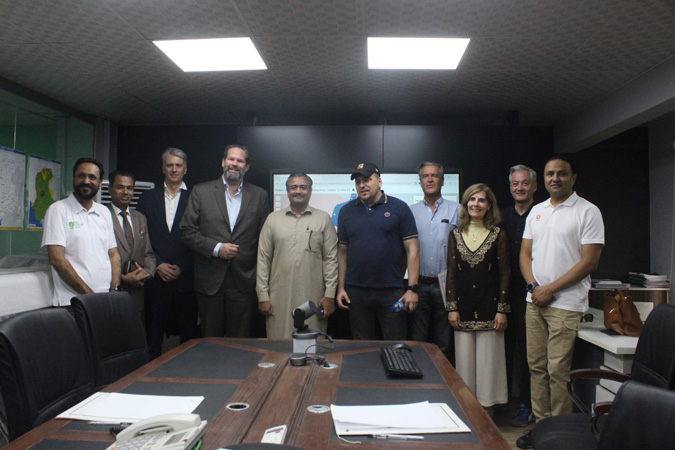
 A high-level delegation comprising Members of the European Parliament (MEPs) and officials from the European Civil Protection and Humanitarian Aid Operations (ECHO) Pakistan Team visited the Provincial Disaster Management Authority (PDMA) Sindh Headquarters to review progress under the Building Institutional Capacity and Resilience Against Natural Disasters (BRAND) project. The delegation was led by Lukas Mandl, Member of the European Parliament. The BRAND project, jointly implemented by Welthungerhilfe (WHH) and CESVI, is funded by the European Civil Protection and Humanitarian Aid Operations (ECHO). It aims to strengthen institutional disaster preparedness and response mechanisms in Sindh, enhancing coordination, digitalization, and community resilience.
The project, which runs from June 2023 to December 2025, directly and indirectly benefits more than three million people across the province, with pilot activities in Dadu and Mirpur Khas districts. During the visit, the delegation was received by Mr. Syed Salman Shah, Director General PDMA Sindh. Senior officials from PDMA Sindh and technical representatives from partner organizations briefed the visitors on the milestones achieved under the project. Speaking on the occasion, DG PDMA Sindh Syed Salman Shah appreciated the European Union and ECHO for their continued support, emphasizing that digital transformation and inter-agency coordination are vital for improving disaster response efficiency in Sindh. Answering to the questions, raised by the delegation DG PDMA Salman Shah said that PDMA Sindh has already started working on engaging volunteers in disaster back in 2019.
We started registration of volunteers who will be trained so that this force can be used for the response and to intervene in community. There are some modifications in modules of acquiring volunteers and we are working on it. In Sindh 93 percent of population has access to mobile phone while the percentage for smart phones reaches 68. We need to spread awareness regarding this application so that people can be familiar with it and they use to start this application. In recent rains and flood like situation we used telecommunication companies to spread awareness messages but it seems too expensive for this job. Along with that we also used conventional messages like using our administration, FM Radios, loud speakers etc. We have also started adding chapters and lessons related to disasters, preparation in curriculum. We have also added some kind of layers in our interactive map where general public can find some information related to their surroundings, disasters, impact of flood, relief camps, emergency contact details.
Other senior members of the European Parliament included Tomáš Zdechovský, Member of the European Parliament, Taheeni Thammannagoda, The head of the European Commission’s humanitarian office in Pakistan, Robert Biedro? (Vice Chair, DEVE), Juan Fernando Lopez Aguilar (S&D, Spain), MEP Reinhold Lopatka (EPP, Austria) MS Isabel Head of Programs WHH, Mr. Babar Ali, DRR Adviser WHH, Farhan Ahmed Khan, Country Director CESVI. The meeting concluded with a mutual commitment to explore further areas of cooperation, expand digital innovation in disaster management, and ensure sustainable resilience against future emergencies.