
Last month the Electoral Reforms Bill was passed by the Senate. It was approved and signed by President Mamnoon Hussain on 2nd October. The provision submitted by PPP, ANP and PML-Q leaders suggested an amendment was rejected in the Senate by one vote.
The provision read, “Provided that the person shall not be appointed or serve as office-bearer of a political party if he is not qualified to be, or is disqualified from being elected or chosen as a member of Majlis-e-Shoora (Parliament) under any law for the time being in force.”
A debate had been raging since 2014 after the sit-in by the PTI and PAT, who said a fool-proof system should be in place to prevent poll-rigging and that the Election Commission of Pakistan should be given more powers. It is now clear that the cry for electoral reforms was not to empower commoners but to make the electoral system more satisfying to oligarchs.
Nobody outside the political class or ruling elite had harboured this fancy idea, as it was not meant to promote fair and accountable democracy. In fact, it has nothing to do with the masses. The sudden interest in reforms was palpably motivated solely by the rabid supporters of the oligarchs controlling the nation’s political narrative. It’s aim was to strengthen the oligarch’s hold on power.
Democracy is a form of government in which the supreme power is vested in the people, and exercised directly by them or by their elected representatives. Electoral democracy empowers voters to take away the powers of elected members if they fall short of popular aspirations or grossly violate the fundamental ideology of democracy.
Abraham Lincoln defined democracy as ‘government of the people, by the people, for the people’. However, he was candid when he said: ‘Elections belong to the people. It’s their decision. If they decide to turn their back on the fire and burn their behinds, then they will just have to sit on their blisters’
While the system adequately provides a procedure to impeach office holders, the elected representatives go scot free. Unfortunately Pakistani democracy depicts a different ground reality as voters after having elected their representatives virtually become subjects of powerful elite who ride a rough shod over them and shatter all of the voter’s hopes by neglecting their problems. Promises made during election campaigns are forgotten, while the perks of public offices are fully enjoyed. The irony is that the same elite group gets elected repeatedly and election campaigns are held as rituals, because political parties have become dynasties. Top leaderships of the parties have assumed unprecedented powers by amending the constitution through 18th amendment.
Abraham Lincoln defined democracy as ‘government of the people, by the people’ for the people’. However, he was candid when he said: “Elections belong to the people. It’s their decision. If they decide to turn their back on the fire and burn their behinds, then they will just have to sit on their blisters.” Politics is the process through which communities and civil societies pursue collective goals and resolve the contradictions, disagreements and socio-political conflicts.
Civil society means accommodating plurality, establishing egalitarianism, safeguarding human rights and stipulating basic need oriented policies that give priority to development. In a larger sense, civil society is rooted in democracy, constitutionalism and is based on supremacy of civilian-led institutions anchored on distributive justice. People of Pakistan have used their sovereign rights by participating in the political process by electing their own representatives to govern them.
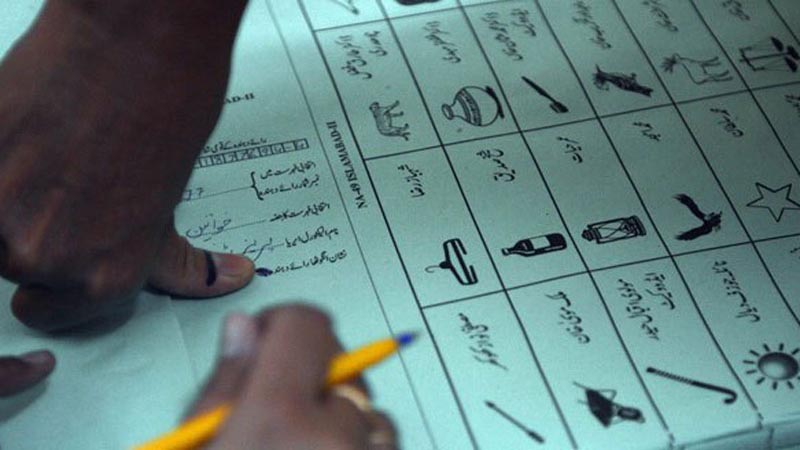
It doesn’t take a genius to conclude that elections are the battle in which commoners, who make the backbone of a real democracy, only figure as bystanders and not real participants. Indeed, in Pakistan the commoners cannot even think of getting into the electoral system. Not only because of the prohibitive costs involved, but also because a surging sea of the citizenry in the country still living in total bondage even in these contemporary times of tremendous human emancipation and liberty. The powerless, voiceless and cattle-like citizenry live as thralls of overbearing pirs, feudal lords, sardars, filthy rich gangster barons and moneyed upstarts. On paper this citizenry may be fully empowered and enfranchised but in reality they are not. They remain at the beck and call of their masters.
The stark reality is that the citizenry votes as its masters want it to vote, as its own will counts for nothing. But it gets no attention, no mention even in the prattle of the self-styled rights-watchdogs, puffed up intellectual luminaries, advocacy NGOs that are mostly foreign-funded and media lights parading themselves to be great champions of democracy. What electoral reforms could really be worth if this mass scale disenfranchisement is not put heed to and are not inducted effectively in the polling process? It is quite clear that land reforms can bring about the miracle of empowering the disempowered. But has anyone ever heard of voices talking about land reforms coming from political parties’ or media studios?
The writer is a freelance columnist. He can be reached at [email protected]
Published in Daily Times, October 20th 2017.