

Did the secession of 1971 validate the two nation theory which formed the basis for the partition of 1947? Some say yes and others no. Let’s review the arguments for and against validation.
The validation argument rests on three pillars.First, the text of the Lahore Resolution that was passed by the All-India Muslim League on March 23rd, 1940 read: “That geographically contiguous units are demarcated into regions which should be constituted, with such territorial readjustments as may be necessary that the areas in which the Muslims are numerically in a majority as in the North Western and Eastern Zones of (British) India should be grouped to constitute ‘independent states’ in which the constituent units should be autonomous and sovereign.” In other words, it envisagedtwo Muslim states.
Second, the name of the new country, ‘Pakistan,’ an acronym, coined in 1933 by Choudhary Rahmat Ali, a man from Punjab studying at Cambridge University in England, only included letters representing areas that lay in the west.
The proponents of the validation theory state that there was no ‘b’ for Bengal in the acronym (the letter ‘i’ was added later to ease the pronunciation). Thus Bengal was never intended to be part of Pakistan. Ergo, the separation of East Pakistan does not invalidate the two nation theory.
Third, the new nation of Bangladesh did not reunite with India, which it would have done had the two nation theorybeeninvalid.
The opposing argument asserts that secession invalidates the theory. The fundamental premise of the theory was that Muslims and Hindus living in India constituted two different nations. Thus, when Pakistan, whose population was overwhelmingly Muslim, broke up into two pieces, it killed the theory. The invalidation argument rebuts the three pillars of the validation argument as follows.
First, the resolution was passed in 1940 and conditions had changed when independence came in 1947. Two major changes had taken place which had changed the ground realities. The Second World War had ended. And Great Britain, depleted during the war, had begun the process of withdraw from its colonies. India was no longer the jewel in the crown. It was to be exited as soon as possible.
Furthermore, while the text of the resolution mentioned two independent Muslim states, it did not rule out the creation of a single Muslim state. That decision was to be taken by the elected representatives. So those who question the creation of a single Muslim state are asserting that they understood the 1940 resolution better than the Quaid-e-Azam and the Quaid-e-Millat, a preposterous assertion. The two Quaids preferred to go with the single-state solution, fully cognizant of thegeographical and cultural differences between the east and the west.
The proponents of the invalidation argument further state that the Bengali Muslims and their leaders never talked about having a separate Bengali stateeven though it would have given them greater control over their destiny.
In fact, there is no evidence that a two-state solution for Pakistan was even seriously suggested once Great Britain had decided to give independence to India. The only option on the table when negotiations had begun in earnest with the colonial power was a single state for the Muslims. There is no evidence that the last viceroy, Lord Mountbatten, ever countenanced the notion of two Muslim states.
Second, the invalidation argument proponents assert that the acronym, Pakistan, was created in 1933, long before the call for Pakistan acquired had a specific geographical shape. They remind us that the man who coined the acronym was disillusioned by the mass killings and mass migrations that were produced by the Partition that came in 1947. He only spent a few months in Pakistan in 1948. After getting into a major squabble with the Pakistani government, he returned to England where he had lived most of his adult life. He lies in repose in Cambridge.
Pakistan means the ‘Land of the Pure’ in Urdu and inserting the letter “b”for Bengal would have taken away that meaning. Furthermore, there is no evidence that anyone in East Pakistan felt they were not a part of Pakistan just because the letter “b” was missing in the country’s name.
Third,they say that the assertion that Bangladesh did not reunite with India cannot be viewed as evidence in support of the two nation theory. If the theory was valid, Bangladesh would have started sought out the former West Pakistan (by then renamed Pakistan) and entered into some type of federal arrangement.
Instead, after the secession, a deep animosity set in between the two countries. Religion failed to unite them. What had disunited them was the colonial manner in which the West had exploited the East for nearly a quarter century. When the East wanted to get some measure of autonomy, that pursuit by its leaders was equated with treason. Indeed, charges were filed against the leaders of the Awami League in 1968 in the infamous Agartala Conspiracy Case.
And when the Awami League won the national elections fair and square in 1970 with an absolute majority, they were not installed into office by General Yahya. Instead, the Pakistan army launched Operation Searchlight against the Bengali population. The bond of religion, which was at the core of the two nation theory, had snapped.
The proponents of the validation and invalidation arguments are poles apart and may just have to agree to disagree.
Regardless of who is right and who is wrong about the secession of 1971 and the two nation theory of 1947, every effort should now be made to preserve the Pakistan that exists today.
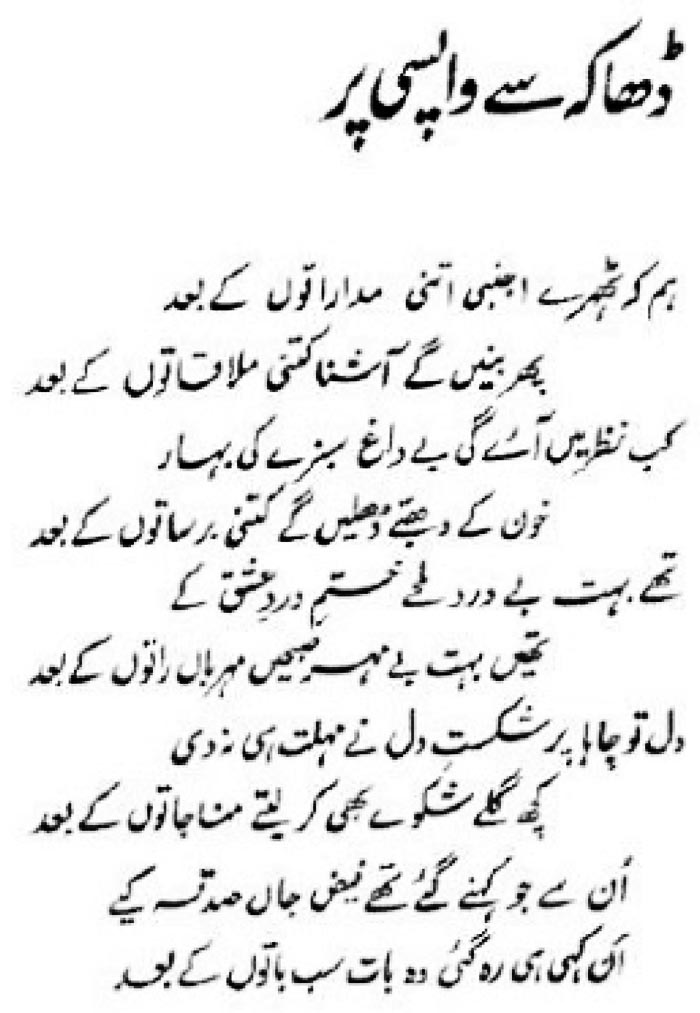
Decades have passed since Faiz penned his poem, Dhaka say wapsi par. Nothing has evoked the melancholy of separation better. There is nothing pleasant about it. As Shakespeare wrote in Romeo and Juliet, Parting is such sweet sorrow.
It is time for the estranged siblings to begin moving toward each other.On first glance, the people in Bangladeshmay have little or no motivation to pursue any type of reconciliation. However, it would make sense for Pakistan to pursue some type of rapprochement because the financial benefits clearly outweigh the mostly emotional costs.
The process could begin with an open and unconditional apology by Pakistan. The next move might be to holda multi-test series between the twocountries. The power of sports in managing tensions was shown by General Zia when he used cricket diplomacy to defuse tensions with India in 1987 during the Operations Brasstacks episode.
Pakistan and Bangladesh have much to learn from each other. Bangladesh has done a much better job in managing relations with India, controlling defence spending, and preventing terrorists from taking root in its soil. Its per capita income is now in line with Pakistan’s, because its population is now smaller than Pakistan’s, in a striking reversal from the situation in 1971.
Bangladesh is exporting more garments to the world than India and Pakistan combined. Similarly, Pakistan has move ahead in several other areassuch as software and its equity market which has delivered phenomenal returns to investors.
There is much to learn from each other.
The writer is a defence analyst and economist. He has authored Rethinking the National Security of Pakistan (Ashgate Publishing, 2003)
Published in Daily Times, September 29th 2017.