• Skip to primary navigation
  • Skip to main content
  • Skip to primary sidebar
  • Skip to footer
Trending:
  • Kashmir
  • Elections
Sunday, June 7, 2026

Daily Times

Your right to know

  • HOME
  • Latest
  • Iran-Israel war
  • Gilgit Baltistan Election
  • Pakistan
    • Balochistan
    • Gilgit Baltistan
    • Khyber Pakhtunkhwa
    • Punjab
    • Sindh
  • World
  • Editorials & Opinions
    • Editorials
    • Op-Eds
    • Commentary / Insight
    • Perspectives
    • Cartoons
    • Letters to the Editor
    • Featured
    • Blogs
      • Pakistan
      • World
      • Lifestyle
      • Culture
      • Sports
  • Business
  • Sports
  • E-PAPER
    • Lahore
    • Islamabad
    • Karachi

Agencies

‘Don’t steal our voices’: dubbing artists confront AI threat

Published on: June 21, 2023 2:50 PM

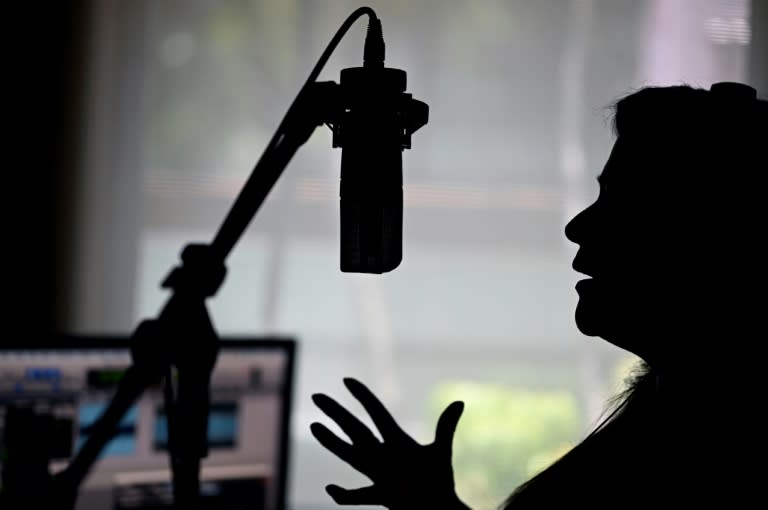
Voice actors around the globe are mobilizing against the unregulated use of artificial intelligence (AI) to generate and clone human voices that they fear poses a threat to their livelihoods.

“We’re fighting a very big monster,” said Mario Filio, a Mexican artist who has done voiceovers for Hollywood star Will Smith, the Obi-Wan Kenobi character in Star Wars and the party-loving lemur King Julien in the animated movie “Madagascar.”

Campaigning under the slogan “Don’t steal our voices,” more than 20 voice acting guilds, associations and unions from Europe, the United States and Latin America have created the United Voice Artists coalition.

It represents the faceless voiceover artists and narrators of commercials, movies, audiobooks and video games who fear that their voices will be replaced by machines, or even cloned by artificial intelligence without their consent.

“The undiscriminating and unregulated use of artificial intelligence is a risk that could lead to the extinction of an artistic heritage of creativity and wonder, an asset that machines cannot generate,” according to the group, which says its members include the US National Association of Voice Actors (NAVA) and Latin America’s Organization of United Voices.

“Our voices are our livelihood,” NAVA vice president Carin Gilfry said in a statement last month.

“And if we don’t have control over how those voices are used, we can’t make a living,” she added.

Voice artists were already competing with text-to-speech technology that turns written words into synthetic voice.

Now artificial intelligence has brought a new threat.

Thanks to machine learning, software can compare a voice sample with millions of existing ones, identifying patterns that generate a clone.

“It’s fed by voices that we’ve been providing for years,” said Dessiree Hernandez, president of the Mexican Association of Commercial Announcers.

“We’re talking about the right to use your voice without your consent,” she added.

‘Adapt or disappear’

Platforms offer human sounding text-to-speech services for a fraction of what professionals would charge.

One, revoicer.com, says that it does not intend to replace human voiceovers, but to offer a quicker and cheaper alternative.

Although they continued to be hired, voice actors suspect that companies are using their voices to build up their archives.

The artists are seeking tools to track their voices in the face of sophisticated piracy.

They want laws to prevent recordings of their voices being used to develop AI without their consent, and also support setting quotas for human voiceovers, said Colombian voice artist Daniel Soler de la Prada.

In the future, audiences could hear a famous actor’s voice in several languages but with the intonation of a dubbing artist, Filio said.

While that could generate employment and benefits for the public, voice artists “need to charge what’s fair,” he added.

Mexican voice artist Maclovia Gonzalez said that she would only sign a contract with an AI company if it provided enough information about how the content would be used.

“I want to be part of this revolution, but not at any price,” she said.

Art Dubbing, a company that has received several requests from clients to use synthetic voices, faces a dilemma: “adapt or disappear,” said its Mexican founder, Anuar Lopez de la Pena.

Filio for his part said that he stopped recording for many clients for fear of hurting his colleagues’ livelihoods.

But he is skeptical that artificial intelligence will replace voice actors completely because the machines have “no soul,” he added.

Filed Under: Science and Technology Tagged With: ‘Don’t steal our voices’: dubbing artists confront AI threat

Submit a Comment


Primary Sidebar


Latest News

Pope criticizes US-Israeli war on Iran

Turkish trawler sunk in Black Sea attack

Israeli strike threatens fragile Lebanon truce

Pakistan, Russia sign major security accords

Saudi Arabia condemns Iran missile attacks

Pakistan

Pakistan, Russia sign major security accords

Five killed in South Waziristan firing

PM Shehbaz reviews Tehran visit with Naqvi

No talks with agitators, says AJK PM

Pakistan urges UN action on Kashmir

More Posts from this Category

Business

Govt considers tax relief for salons, gyms in Budget 2026-27

PESCO approves one-month salary bonus for employees

SBP’s ‘Go Cashless’ campaign saw Rs 34bn in digital transactions on Eid

Short-term inflation down by 0.56%

Saudi-Pak Business Council shows interest in infrastructure investment

More Posts from this Category

World

Pope criticizes US-Israeli war on Iran

Turkish trawler sunk in Black Sea attack

Israeli strike threatens fragile Lebanon truce

More Posts from this Category


Footer

Home
Lead Stories
Latest News
Editor’s Picks

Culture
Life & Style
Featured
Videos

Editorials
OP-EDS
Commentary
Advertise

Cartoons
Letters
Blogs
Privacy Policy

Contact
Company’s Financials
Investor Information
Terms & Conditions

Facebook
Twitter
Instagram
Youtube

© 2026 Daily Times. All rights reserved.

Manage Consent
To provide the best experiences, we use technologies like cookies to store and/or access device information. Consenting to these technologies will allow us to process data such as browsing behavior or unique IDs on this site. Not consenting or withdrawing consent, may adversely affect certain features and functions.
Functional Always active
The technical storage or access is strictly necessary for the legitimate purpose of enabling the use of a specific service explicitly requested by the subscriber or user, or for the sole purpose of carrying out the transmission of a communication over an electronic communications network.
Preferences
The technical storage or access is necessary for the legitimate purpose of storing preferences that are not requested by the subscriber or user.
Statistics
The technical storage or access that is used exclusively for statistical purposes. The technical storage or access that is used exclusively for anonymous statistical purposes. Without a subpoena, voluntary compliance on the part of your Internet Service Provider, or additional records from a third party, information stored or retrieved for this purpose alone cannot usually be used to identify you.
Marketing
The technical storage or access is required to create user profiles to send advertising, or to track the user on a website or across several websites for similar marketing purposes.
  • Manage options
  • Manage services
  • Manage {vendor_count} vendors
  • Read more about these purposes
View preferences
  • {title}
  • {title}
  • {title}
We use cookies to ensure that we give you the best experience on our website. If you continue to use this site we will assume that you are happy with it.