• Skip to primary navigation
  • Skip to main content
  • Skip to primary sidebar
  • Skip to footer
Trending:
  • Kashmir
  • Elections
Sunday, June 7, 2026

Daily Times

Your right to know

  • HOME
  • Latest
  • Iran-Israel war
  • Gilgit Baltistan Election
  • Pakistan
    • Balochistan
    • Gilgit Baltistan
    • Khyber Pakhtunkhwa
    • Punjab
    • Sindh
  • World
  • Editorials & Opinions
    • Editorials
    • Op-Eds
    • Commentary / Insight
    • Perspectives
    • Cartoons
    • Letters to the Editor
    • Featured
    • Blogs
      • Pakistan
      • World
      • Lifestyle
      • Culture
      • Sports
  • Business
  • Sports
  • E-PAPER
    • Lahore
    • Islamabad
    • Karachi

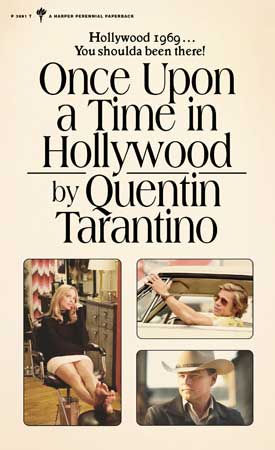
Once Upon a Time in Hollywood — Quentin Tarantino’s debut novel shines

Published on: June 30, 2021 5:33 AM

Quentin Tarantino made a career alchemising movie trash into gold: with a connoisseur’s ecstasy, he worked with B-movie language and grindhouse rhetoric.

Now he’s done the same with a genre the literary world wrinkles its nose at, the pulpiest of pulp fiction – the novelisation. This is normally the lowliest kind of movie brand promotion, which had its heyday before the VHS age, targeted at film fans who wanted a way to relive the experience.

Tarantino has turned his most recent film, Once Upon a Time in Hollywood, into a novel: messing with the timeline, cranking up the backstories, mulching up reality and alt reality pastiche, ladling in new episodes. The result comes packaged in something like those New English Library paperbacks that used to be on carousel displays in supermarkets and drugstores. In the endpapers he cheekily includes ads for old commercial paperbacks real and imagined, such as Erich Segal’s Oliver’s Story, sequel to Love Story.

Plenty of movie directors have written fiction: Michael Cimino, Gus Van Sant, Ethan Coen. Ousmane Sembène adapted his own novel, Mandabi, into a movie. But why this choice for a move into fiction? Perhaps because the Hollywood setting gives it the right Jackie Collins-style confection of glamour and excitement. So here again are his antiheroes from late 1960s Hollywood: Rick Dalton, played on screen by Leonardo DiCaprio, is the cheesy TV cowboy actor whose career is on the skids. The novel calls him “an Eisenhower actor in a Dennis Hopper Hollywood” – a nice line not used in the film, maybe because DiCaprio looked too gorgeously modern to be Eisenhoweresque. Cliff Booth, previously played by Brad Pitt, is Dalton’s best buddy and now unemployable stunt double; the industry loathes Cliff because he’s rumoured to have murdered his wife on a fishing boat. Tarantino expands that episode into a grisly and hilarious set piece; it’s cheerfully sympathetic to Cliff.

Plenty of movie directors have written fiction: Michael Cimino, Gus Van Sant, Ethan Coen. Ousmane Sembène adapted his own novel, Mandabi, into a movie. But why this choice for a move into fiction?

Rick’s personal crisis comes to a head when he realises he is living next door to the hottest young things around: Roman Polanski and Sharon Tate, whose terrible destiny was to coincide with that of cult leader Charles Manson and his followers, whose own lives, as in the film, are imagined with macabre black comedy.

As usual, the novel shows Tarantino as a black belt in provocation. He says that Cliff likes the spoof spy character Matt Helm despite or because Helm is “unconsciously racist, consciously misogynistic”, but the rest of the time his characters are crashing into our sensibilities.

At the Cannes press conference for the film, Tarantino was infuriated by questions that suggested he wasn’t interested in female characters. In the novel, the inner world of Sharon Tate and the fictional child actor Trudi Fraser are rounded out a fair bit, particularly Trudi, who has been developed from her screen persona into a character of real if eccentric charm.

The book is a reminder that Tarantino is, in fact, a really good writer, and it should not be so surprising that his brilliance as a screenwriter should be transferable into fiction, in the firework displays of dialogue but also the building blocks of narrative. He’s maybe not in the Elmore Leonard league but, like Leonard, he’s refreshingly unconcerned with the literary mainstream. I read this in one sitting – just like watching a film.

Filed Under: Reviews

Submit a Comment


Primary Sidebar


Latest News

Israeli strike threatens fragile Lebanon truce

Pakistan, Russia sign major security accords

Saudi Arabia condemns Iran missile attacks

Five killed in South Waziristan firing

Revival takes shape as Pakistan football rebuilds under Mohsen Gilani

Pakistan

Pakistan, Russia sign major security accords

Five killed in South Waziristan firing

PM Shehbaz reviews Tehran visit with Naqvi

No talks with agitators, says AJK PM

Pakistan urges UN action on Kashmir

More Posts from this Category

Business

Govt considers tax relief for salons, gyms in Budget 2026-27

PESCO approves one-month salary bonus for employees

SBP’s ‘Go Cashless’ campaign saw Rs 34bn in digital transactions on Eid

Short-term inflation down by 0.56%

Saudi-Pak Business Council shows interest in infrastructure investment

More Posts from this Category

World

Israeli strike threatens fragile Lebanon truce

Saudi Arabia condemns Iran missile attacks

Palestinian infant killed in West Bank shooting

More Posts from this Category


Footer

Home
Lead Stories
Latest News
Editor’s Picks

Culture
Life & Style
Featured
Videos

Editorials
OP-EDS
Commentary
Advertise

Cartoons
Letters
Blogs
Privacy Policy

Contact
Company’s Financials
Investor Information
Terms & Conditions

Facebook
Twitter
Instagram
Youtube

© 2026 Daily Times. All rights reserved.

Manage Consent
To provide the best experiences, we use technologies like cookies to store and/or access device information. Consenting to these technologies will allow us to process data such as browsing behavior or unique IDs on this site. Not consenting or withdrawing consent, may adversely affect certain features and functions.
Functional Always active
The technical storage or access is strictly necessary for the legitimate purpose of enabling the use of a specific service explicitly requested by the subscriber or user, or for the sole purpose of carrying out the transmission of a communication over an electronic communications network.
Preferences
The technical storage or access is necessary for the legitimate purpose of storing preferences that are not requested by the subscriber or user.
Statistics
The technical storage or access that is used exclusively for statistical purposes. The technical storage or access that is used exclusively for anonymous statistical purposes. Without a subpoena, voluntary compliance on the part of your Internet Service Provider, or additional records from a third party, information stored or retrieved for this purpose alone cannot usually be used to identify you.
Marketing
The technical storage or access is required to create user profiles to send advertising, or to track the user on a website or across several websites for similar marketing purposes.
  • Manage options
  • Manage services
  • Manage {vendor_count} vendors
  • Read more about these purposes
View preferences
  • {title}
  • {title}
  • {title}
We use cookies to ensure that we give you the best experience on our website. If you continue to use this site we will assume that you are happy with it.