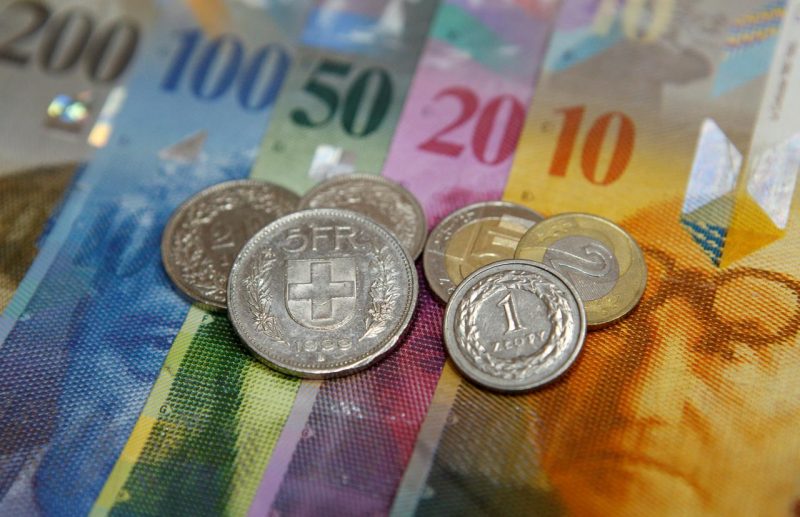
 Europe’s highest court will rule next week whether a bank in Poland broke the law by selling homeowners a Swiss franc mortgage, potentially unleashing lawsuits which could wipe out Polish banking profits for years to come.
It is nearly two decades since 700,000 Poles, attracted by interest rates far lower than those available in their zloty currency, took out mortgages denominated in Swiss francs.
Such foreign currency loans now total 124 billion zloty ($31 billion), almost one third of all Polish mortgages, but many homeowners are having to pay far bigger instalments than they expected due to a sharp rise in the value of the Swiss franc.
Although similar mortgage deals became a problem in other European countries, including Hungary, Romania and Croatia, Poland has been slower to resolve the plight of its borrowers.
Anna Wojtowicz-Bartlomiejczuk said she was left with huge debts when the franc jumped as she was preparing to move and pay off her previous foreign currency loan on a two-bedroom flat.
“It’s like I have thrown the cash out the window,” said the 39-year-old mother of two from Gdansk.
Since the collapse of Lehman Brothers in 2008 the Swiss franc has risen 85% from 2.18 zloty to 4.04 zloty, while this year alone it appreciated by 6% against the Polish currency.
The most painful year for Poles was 2015, when the franc skyrocketed as the Swiss central bank removed a currency cap.
Many borrowers have since turned to the courts, encouraged by a cut in the cost of taking action, in what has become the worst crisis to hit Poland’s banks since the end of communism.
And the European Court of Justice (ECJ) is now due to rule on Oct. 3 whether it was legal for Raiffeisen Bank to grant foreign currency-denominated mortgages, as Polish banks face increasing pressure to compensate thousands of borrowers.
The ECJ was asked by a Polish judge whether such contracts broke European law. The number of new cases in Polish courts in the first six months of 2019 rise by 39% to 2,021, justice ministry data shows.
“The (ECJ) judgment will cause an avalanche of lawsuits,” Janusz Szewczak, a lawmaker for Poland’s ruling nationalist Law and Justice (PiS) party, said.
Profit In Peril
The ZBP banking lobby estimates that the total cost could hit 60 billion zloty ($15 billion) if all those with such a loan were to succeed in court, four times more than the 2018 net profit of Poland’s banks.
Legal actions against the banks claim their contracts abused the rights of borrowers, with one estimate of more than 11,000 pending cases in Polish courts.
DM BOS brokerage analyst Michal Sobolewski said the ECJ ruling could determine that some of the Polish mortgages should be unwound and treated as if they were originally made in zloty.
“This is the biggest challenge for the banking sector at the moment,” chief economist at ING Bank Slaski Rafal Benecki said, predicting it could wipe out profits and require some banks to seek fresh capital.
The banks with the biggest foreign exchange-denominated mortgage portfolios include units of Santander, BCP and Commerzbank, as well as Poland’s biggest lender PKO BP and Getin Noble Bank.
While many are pursuing the banks, there is also anger with the way the problem has been treated by successive governments.
Jacek Sledzinski, a 45-year-old lawyer, resents the lack of support, even though he has been able to continue repayments on his Swiss franc loan on a 2-bedroom flat in Warsaw.
“Neither the previous nor the current governments helped Swiss franc mortgage holders,” he said.
With no end to the crisis in sight, there is also potential for legal changes to try to resolve the mortgage mess.
Jaroslaw Urbaniak, a lawmaker from Poland’s opposition centrist Civic Platform said his party wants to support homeowners in their tussle with the banks with new legislation.
This was the case in Croatia, where legal changes in 2015 meant that most foreign currency denominated loans were converted into euros, at the expense of the banks.
A recent ruling by Croatia’s Supreme Court means these borrowers can individually sue banks for compensation, although the lenders are trying to reverse that ruling in the Croatian Constitutional Court and European Union courts.
Foreign currency loans are no longer an issue in Romania as banks there rescheduled/converted most of them and following the financial crisis they represented about 5% of hard currency loans in the country, in contrast with others in the region.
In Slovenia, several cases are going through the courts, with some ruling in favour of the banks, while others have backed the borrowers. The majority of cases have not been finalised, however, as most can appeal to a higher court.
The outstanding amount of mortgages in Swiss francs in Slovenia in 2017 was 461 million euros ($504.20 million), although this has since fallen as many borrowers have converted them into euro loans in agreement with their banks.