
Given the mounting tensions between the United States and Iran, questions pertaining to Tehran’s strengths and vulnerabilities, nowadays, form the nucleus of many a political discourse. This piece is aimed at providing the readers with a SWOT (strengths, weaknesses, opportunities and threats) analysis of the Islamic Republic of Iran.
Strengths: One of the key strengths of Iran is its geography. It is ideally located between the Middle East and Central Asia. Access to major water bodies of the world – the Persian Gulf and the Caspian Sea – enhances its geo-political and geo-strategic importance. In terms of size, it is the second largest in the Middle East and the 18th largest country in the world, with a population of roughly 82 million people.
Iran’s gargantuan wealth of hydrocarbon resources multiplies its economic strength. It occupies the fourth largest oil reserves of the world after Venezuela, Saudi Arabia and Canada. Iran also holds the second largest proven gas reserves of the world behind Russia. This richness in energy resources makes its economy the 25th largest in the world in terms of GDP, and the 18th biggest in terms of purchasing power parity.
The Islamic Republic of Iran is also rich in human capital. It is the land of young and highly-educated people. About two-third of its population is below the age of 35. Nearly 10 million of its inhabitants have university degrees. An interesting figure in this regard is that Iran churns out about the same number, about 240,000, of engineering graduates every year as the US. In this regard it stands fourth in the world after India, China and the United States. Iran is also quite tech-savvy, and well-connected; 64 percent of Iranians are netizens, while mobile phone penetration has reached more than 110 percent, as many Iranians have more than one phone. Iranians have also proved their mettle in reverse engineering and technological innovation. Although stifled for years since the revolution, Iranians are also known for their entrepreneurial skills.
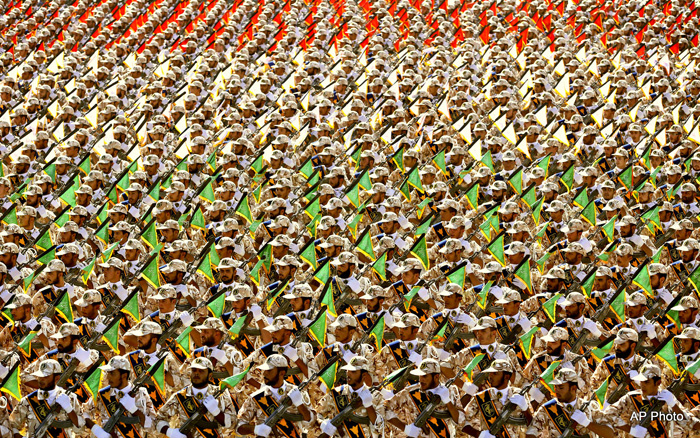 Iran has the 14th most powerful armed forces in the world according to the Global Firepower – 2019 Military Strength Rankings. Its military personnel strength is 873,000 (estimated). It consists of two parallel organisations: the regular armed forces and the Islamic Revolutionary Guards Corps (IRGC). Its army is well-equipped with modern and sophisticated weaponry. Iran has developed ballistic missiles with a range of up to 2,000 kilometres, such as the Sejjil series. Iran’s navy has been showcasing its Ghadir-class mini-submarines that can launch a cruise missile. The boats are believed to carry a crew of nine and weigh less than 150 metric tonnes.
In 2011, Iran took control of and captured the unmanned US Lockheed Martin RQ-170 sentinel while in flight, and used reverse engineering to create its own drone.
It has also been reported that Iran is one of the five countries that has a cyber-army capable of sustained cyber-warfare operations. To this end, Iran has established two garrisons, at Zanjan and Isfahan, for cyber warfare.
Weaknesses: One of the biggest weaknesses of the Islamic Republic of Iran, according to some political luminaries, is its dual system of government that mixes elections with the powers of a supreme leader. Ali Khamenei, the supreme leader, exercises a veto over Iranian decision-making, and heads the IRGC, the judicial system and the state television. Supremacy of the religious leader over the elected body eclipses the status of the latter.
Iran’s economy is in doldrums due to sanctions imposed by exogenous powers and the endogenous bottlenecks. It is plagued with corruption and mismanagement. The IRGC and various religious organisations control much of the economy, stifling competition and making reforms a herculean task. Private investment, therefore, remains skittish. Iran lacks export diversity. It is a one-product economy. Its economic growth relies heavily only on oil and gas industry.
Saudi Arabia, in order to gather international support to isolate Iran, has left no stone unturned to project the Islamic Republic as a ‘rogue state’
International sanctions discourage foreign investors to invest in Iran. The banking sector is under-developed due to monstrous sanctions. Oil revenues also hugely suffer from the sanctions. This worsening economic situation has created social unrest in Iran. Protests against the government have become a quotidian affair. Many Iranians have now reached a point where they hanker for a regime change and deem it as the only way out.
In addition to a weak economy, Iran’s hard power is limited. The expeditionary skill of the IRGC coupled with Iran’s use of proxies in Iraq, Lebanon, Syria, and Yemen often create a sense that Iran is militarily active throughout the Muslim world. While this may be true, it also highlights one of Iran’s biggest weaknesses: its lack of conventional military strength. Tehran lacks the ability to project a significant amount of conventional power beyond its borders. Analyst Thomas Juneau contends that, “Militarily, Iran can deter, deny, spoil, but it can rarely shape the events. As a result, it can subvert its neighbours, but it is vulnerable to conventional military pressure.”
As far as its soft power is concerned, Iran has miserably failed to showcase it to the world. Although home to one of the richest artistic traditions in the world history, encompassing many disciplines, including architecture, painting, weaving, pottery, calligraphy metalworking, and stonemasonry, the world remains oblivious to the softer aspect of the Islamic Republic of Iran.
Opportunities: Iran’s geo-strategic location coupled with its geographic spread and military preparedness give it the means to exercise a strong influence in the region. The US setbacks in Afghanistan and Iraq have been a blessing for Tehran.
Economically, there is a great room for growth and development. Iran’s gas sector is currently under-developed. Those at the helm have the opportunity to exploit this source of revenue. Iran’s banking sector is also in a shambles. If the situation between the US and Iran gets normal and the sanctions are lifted or relaxed, the Iranian economy may see a boom by harnessing its untapped gas potential and through export diversification. It is, therefore, advisable for Iran to resolve its issues through diplomatic means rather than engage in an armed conflict.
So far, Iran enjoys support from China and Russia; both oppose the sanctions against Iran. Iran should continue to cement its ties with these powers. Alliance with these countries would also help Tehran dilute ‘the maximum pressure campaign’ launched by America against it.
Threats: One of the biggest threats currently hovering over Iran is the ongoing escalation of tension between Washington and Tehran; it has brought the two countries to the brink of war. If the situation snowballs or lingers, it will have disastrous consequences for the whole region. Both the countries should, therefore, avoid an armed conflict by resorting to peaceful means of resolving the issue.
Saudi Arabia, an old adversary of Iran and a close ally of America in the region, also poses a big threat to Iran. Saudi Arabia, in order to gather international support to isolate Iran, has left no stone unturned to project the Islamic Republic as a ‘rogue state’. To delegitimise the regime after the 1979 revolution, Saudi Arabia emphasised Iran’s Shiite status, funded preachers around the world, and tried to repudiate revolution’s religious credentials.
Another big threat that Iran is confronted with is its economy. Despite being resilient to the US sanctions for a long time, it has eventually started feeling the impact of the sanctions on its economy. Corruption and economic mismanagement have also added salt to Iran’s economic wounds. The worsening economic situation has severely hit the purchasing power of the people and incubated high youth unemployment, engendering social unrest in the country. Many Iranian people live in despair. The discontent prevalent among the Iranian masses is a colossal threat that can be exploited by the adversaries of the Islamic Republic.
The writer is a lawyer based in Jafarabad, Balochistan