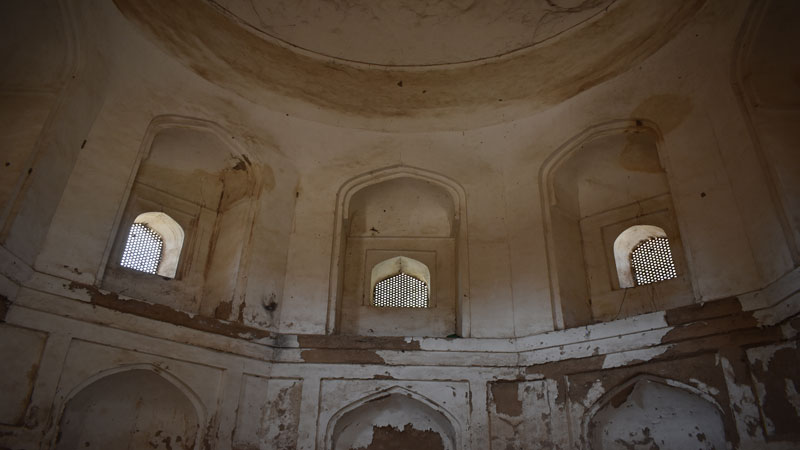
 Let me walk you through the story of a Baloch folk hero and his tomb which is located in Satghara.
Before we get to this historic tomb let us probe through the history of this hero who is revered by the Balochs. This is Mir Chakar Khan Rind and is popularly known as Chakar-i-Azam. He was a Baloch chieftain in the 16th century when the Mughal Emperor Humayun was finding his way to win the sub continent. It was Mir Chakar who aided Mughal Emperor Humayun in his re-conquest of the Subcontinent. You will also find Mir Chakar an important figure in the Baloch epic Hani and Sheh Mureed. This great Baloch Chief was also a notable poet.
If we go back into the history of this Baloch hero we get to know that Chakar Rind lived near Sibi and became the head of Rind tribe at the young age of 18 after the death of his father Mir Shahak Khan Rind. Chakar was a brave and fearless man who desired to make the Baloch nation powerful.
His power was short-lived because of a civil war between the Lashari and Rind tribes of Balochistan. Mir Chakar Rind went to war which resulted in thousands dead. The war and the gallantry of the two tribe leaders continued to be a part of the Baloch history. it is said that Rind defeated the Lasahris after almost 30 years.
When Mir Chakar left Sibi, his next stop was Sanghar Desert and he ruled the area for many years. No one could defeat Mir Chakar and his army until Mir Doda Khan arrived with his army and defeated Mir Chakar in the desert of Sanghar, after which Mir Chakar and his army left Sanghar and moved to the Multan area where he shook hands with the Multan king.
After some time the Multan king invited Mir Doda to dinner and asked him to be the part of his army. This ignited Mir Chakar and that was the time when the great Ring planned to attack Mir Doda. In the battle, Mir Doda was badly defeated and his people and army moved to Sindh and never came back.
Later, Mir Chakar went to Satghara and settled there. Rind gained power in the area and the locals respected him. That was the time when Sher Shah Suri was in power and was fighting against the Mughals. When Sher Shah Suri got familiar with the power and capabilities of Mir Chakar he invited Chakar to join him but Chakar humbly refused to help Sher Shah Suri. On the other hand Chakar’s forces, under the command of his son, Mir Shahdad Khan, joined the Mughal army of Emperor Humayun in 1555.
Humayun was in an exile in Persia and upon his return he recaptured Delhi, and forced out the Suri dynasty in 1556. At that critical time Mir Chakar assisted Humayun and became his close associates. Regardless of his own life Mir Chakar fought against the powerful army of Sher Shah and helped the Mughal King Humayun to regain his power.
When Mir Chakar left Sibi, his next stop was Sanghar Desert and he ruled the area for many years. No one could defeat his army until Doda Khan arrived and defeated Mir Chakar in the desert of Sanghar, after which Mir Chakar and his army moved to Multan where he shook hands with its king
As a reward, Emperor Humayun conferred a vast land, including horses and slaves, to Mir Chakar. He ruled this territory until he died in 1565. People who accompanied Mir Chakar to Satghara after leaving Balochistan constructed a tomb for Mir Chakar and this he lays buried in a small tomb inside the Satghara Fort.
You will see this tomb in the Satghara but unfortunately it is in a dilapidated condition. There are six graves inside the tomb and it is said by the locals that rest of the five graves are of the companions of Mir Chakar while the central one has been identified as the grave of great Baloch Chief.
His tomb is an octagonal structure crowned by a bulbous dome on the top. Though the exterior of the tomb was elaborate, the interior has simple graves at the centre, covered with a green cloth containing verses of the Quran. The structure of the tomb is a typical Mughal structure and matched the Tomb of Anarkali located in Lahore. It is simple with arches and ghalib kari.
During the Sikh Rule a wall was constructed around the tomb which damaged the structure of the building. Outside the tomb is an empty ground which is used by the children for playing and locals hold gatherings there. Once this entire area was a fort but now no remains are seen except for the fortified wall.
Let me tell you some interesting facts about Satghara which is a small walled city and many call it Satghara Fort as well. It is located near Renala Khurd a few kilometres away from the Multan road in Punjab. It ages more than the Mughal rule and Mughals made it their headquarters as well. Archaeologists claim that according to the coins found at Satghara it was inhabited in the time of the Kushan dynasty.
 It is said that during the second half of the 19th century this land was tormented by civil war. Various warlords had formed their own small armies and regularly raided other areas in search of reward. One such battle took place here at Satghara which was led by two brothers Wazir and Kamar Singh. The defeated family was known as Syedwala Sardars settled there and thus Satghara fell under the control of the Nikai family led by the Sikh brothers.
The current structure of the fort which is just one giant wall, covering the area from only one end, was built after this conquest. The Nikais, supporting Maharaja Ranjit Singh and then the British, were able to keep their control over the area till the time of partition, when the majority of their family migrated to India. A branch of the family though chose to convert to Islam and continued holding power in this area.
The area is well planned and has some of the historic remains including the gates just like the ones we see in Lahore’s Walled City. The Satghara is a typical backward area of the city and you will see small houses, unpaved roads and streets and open drains. The place along with the historic walls and other structures has been greatly damaged over the ages and the local people have been using the bricks of the fort to construct their own house and at many places the fortification wall has been much damaged.
At some distance from the fort there is an old Hindu Temple and a pond. The temples have been constructed in a simple style. At some distance are the remains of a tower are also situated over a high mound on the other side of the road.
Now let us come to the name of this place. The word Satghara is a combination of two words Sat and Ghara. Sat means seven in Urdu and Ghara means homes. Thus this word means seven homes.
Another sound historical folklore is narrated that some injured soldiers of Alexander the Great resided there and they named this ancient town as Stageira now called Satghara.
The writer can be reached at [email protected]