
 A man entered the commanding general’s chamber and handed him a chit: It read, “My Dear Abdullah, we have got you surrounded…Maj.-Gen. Gandharv Nagra.” The commanding general recognised the name. The two had been class mates at the Indian Military Academy. But how had the Indian forces broken through the security perimeter around Dhaka so quickly?
Lt.-Gen. A. A. K. Niazi was no longer his jovial self. When the situation had turned dire, Niazi had broken down in the company of other officers. He had let out a loud scream and begun sobbing like a baby.
This tale of woe is recounted in the memoirs of Maj.-Gen. Rao Farman Ali Khan, advisor to the governor on civil-military relations, How Pakistan Got Divided.
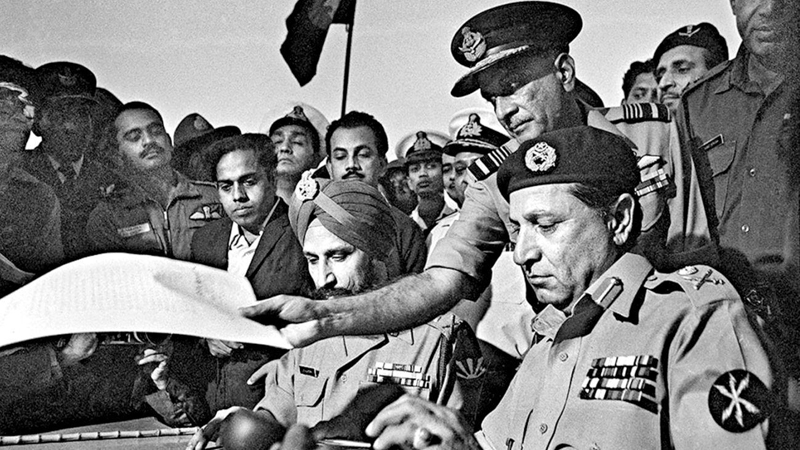
On December 16, 1971, East Pakistan broke away, making Pakistan the first major country that gained independence after the Second World War to break up into two.
The East had been simmering with a civil war since March when General Yahya Khan, the military ruler of Pakistan, refused to convene the National Assembly in Dhaka, preventing the Awami League led by Shaikh Mujib from forming a democratic government even though it had an absolute majority in parliament. Fighting intensified as the months progressed. Pakistan flew in two additional divisions to assist the sole division that was posted in the East. But they came without the usual complement of armor and artillery.
In less than two weeks, the Eastern Garrison surrendered unconditionally. Its troops were fatigued by months of fighting an insurgency and badly outnumbered vis-à-vis India. The results were a foregone conclusion
As the violence progressed, refugees began to stream into Indian Bengal and sometime in November Indian forces began to unleash an artillery barrage into East Pakistan. Pakistan upped the ante on the December 3 in the West when it sent its fighter bombers to raid Indian airfields in the West. The attack was anticipated and did not cause much harm to the IAF. Instead, it backfired, by giving India the excuse to unleash its full fury on the Pakistani army in the East.
In less than two weeks, the Eastern Garrison surrendered unconditionally. Its troops were fatigued by months of fighting an insurgency and badly outnumbered vis-à-vis India. The results were a foregone conclusion.
Rao Farman enumerates the reasons for the breakup. First, there was the result of the national elections of 1970. East Pakistanis accounted for 55 percent of the population but felt that the West, where the military and civil of the country resided, treated them like a colony of the West. They contributed a large share of the export earnings but their per capita income was significantly lower. Thus, the Awami League, won all but 2 seats in East Pakistan and that gave them 160 seats, an absolute majority in the National Assembly.
Second, General Yahya Khan, the military ruler, cancelled the session of the national assembly in Dhaka in March. He did this on the urging of Zulfikar Ali Bhutto, the chairman of the Pakistan People’s Party which was based entirely in the West. Bhutto connived with senior generals in the army to put pressure on Yahya to not convene the assembly because it would guarantee the transfer of power to the east, an unimaginable catastrophe for the generals and top bureaucrats in the West.
Third, when the situation deteriorated, he was advised by the governor, Vice Admiral Ahsan, and the military commander in the east, Maj.-Gen. Sahabzada Yaqub, to come and visit Shaikh Mujib, the head of the Awami League, in order to resolve the impasse. Yahya refused and would never again visit the East. Both the admiral and the general resigned their posts. Replacements were named, including Lt.-Gen. Tikka Khan and later Lt.-Gen. Niazi.
Fourth, a civil war broke out in the East when the army resorted to military action to establish the “writ of the state.” Members of the Awami League were termed “miscreants” and arrested, jailed or shot dead. By the end of March, the authority of the Pakistan government had ceased to exist. All governmental departments were reporting to Mujib.
Fifth, the army’s 45,000 troops were unable to quell the open rebellion that had broken out among the 75 million people of East Pakistan. Hindu refugees were spilling over into India, making the situation untenable. War with India was imminent.
 Sixth, the generals were deluded into thinking that they had the situation under control and that should India attack in the East, they would open a second front in the West and neutralise the Indian operation. They appeared to be believing in a fool’s paradise. He had done his best to present an accurate assessment of the situation to them. But the hawks in the West dismissed him for being a dove, as they had dismissed Ahsan and Yaqub.
Seventh, once military operations began, India neutralised the single PAF squadron in the East by blasting the runways. Only six helicopters remained in flying condition. The artillery equipment was obsolete with a limited range.
And, eighth, to compound matters, Niazi choose to deploy the troops in “penny packets” around the long border with India, a point also noted by Captain (later brigadier) Siddiq Salik in his memoir, Witness to Surrender.
When the day of reckoning arrived, and the two generals met, Niazi began by reciting Urdu couplets to impress Nagra. When Nagra replied that he had a master’s degree in Persian from Government College, Lahore, Niazi switched to Punjabi.
After the surrender, he retreated to the tents to party with the Indian generals. The shame of surrender was no longer on his shoulders and he began to exchange ribald jokes with his former classmates. Rao Farman says he lost whatever little respect he had for Niazi at that time.
With pathos, Rao Farman concludes, “The [Army’s] Higher Command … lacked sense of direction, political sagacity and sound military judgment…Though it took another nine months to take shape, the breakup of the country was the direct …consequence of two major political decisions: first, to postpone the National Assembly session and second, to launch military action.”
The general, who was later the minister of petroleum in General Zia’s government, does not blame India for the breakup of Pakistan, unlike Yahya Khan (and many others) who blamed it “on the treachery of the Indians.” Nor does he put the blame squarely on Bhutto. After all, the country was under military rule.
The book is a must-read, not because it’s a scholarly work replete with footnotes and sources, but because it’s written by a general officer of the Pakistani army who was on the ground during the war and who saw history in the making.
Published in Daily Times, December 4th 2018.