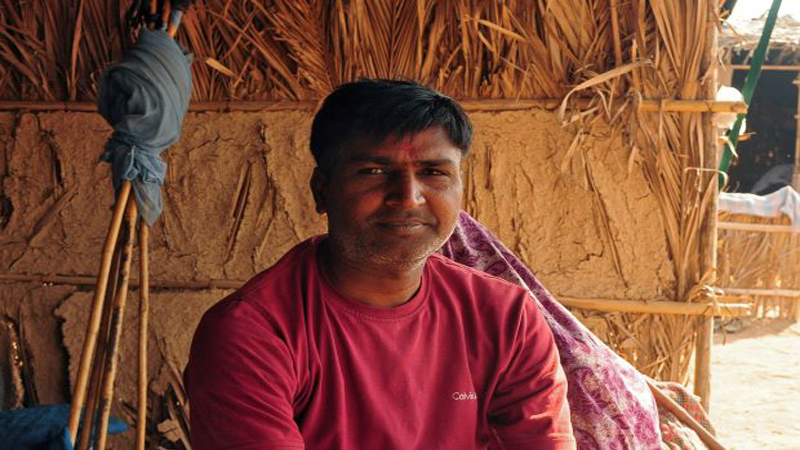
Nar Singh can vividly recall the day in 2014 when Narendra Modi promised to provide refuge to Hindus suffering around the world. The 39-year-old shop owner sat awestruck inside his two-bedroom house in Pakistan’s eastern Mirpur Khas district, as Modi’s voice boomed from the television during his successful campaign to become India’s prime minister.
“If there are atrocities on Hindus in Fiji, where will they go? Should they not come to India? If Hindus are persecuted in Mauritius, where should they go? Hindustan!” Modi declared to a roaring crowd.
For Singh, whose grandfather had been born in British-ruled India before the bloody partition that led to the creation of Pakistan in 1947, Modi’s words resonated deeply. “He spoke so wholeheartedly, it felt like a warm invitation,” said Singh. “I was so proud and happy.”
Living in Muslim-majority Pakistan, where Hindus say they often face religious discrimination and hate crimes, Singh had always felt drawn towards India. Seven months ago, he and his family stepped off a train in India’s border state of Rajasthan with a 25-day pilgrimage visa and no intention of returning. They now live in a hut on government-owned land on the outskirts of Jodhpur city, alongside about 150 other Hindu families from Pakistan.
He is hopeful he will be granted Indian citizenship – a process that, for immigrants such as Singh, would become much easier under a bill likely to be debated in India’s parliament next month. Drafted by the Modi administration, it would tweak the law to relax rules for Hindus and other non-Muslim minorities from Afghanistan, Pakistan and Bangladesh to become Indian citizens.
Critics say the bill is blatantly anti-Muslim and have called it an attempt by the ruling Hindu nationalist Bharatiya Janata Party (BJP) to increase its Hindu voter base ahead of a national election next year. Protests have erupted in recent weeks in the border state of Assam, where a movement against illegal immigrants from Bangladesh has simmered for decades.
Contrasting Fortunes
While the BJP denies the bill is discriminatory, it offers no concessions to Muslim asylum-seekers, whatever their predicament. That is evident in the tourist city of Jaipur, some 200 miles east of Singh’s new home in Jodhpur, where about 80 Muslim Rohingya families eking out a living share none of his optimism.
The group, among the estimated 40,000 Rohingya who live in India after fleeing waves of violence in Buddhist-majority Myanmar, have recently been asked to submit personal details that they fear will be used to deport them back to the country where they say they face persecution.
“We have no option but to fill these out,” said 38-year-old Rohingya community leader Noor Amin as he looked at a stack of forms handed to them by police last week.
Amin fled Myanmar in 2008, when he says his madrassa was shut down by the authorities and harsh restrictions on travel for Rohingya made it impossible for him to continue studying.
Bouts of violence in Myanmar’s western Rakhine state have continued for many years, culminating in a sweeping military campaign unleashed in August 2017 in response to militant attacks. That crackdown has forced more than 720,000 Rohingya to flee to Bangladesh, in what the United Nations’ human rights agency has called “a textbook example of ethnic cleansing”. Myanmar has denied almost all the accusations made by refugees against its troops, who is said engaged in legitimate counterinsurgency operations.
The Modi government has said the Rohingya in India are illegal immigrants and a security threat. It deported the first seven Rohingya men back to Myanmar last month, despite warnings by rights groups that conditions in Myanmar were not safe for their return and the move was a violation of international law.
India sends seven Rohingya to border to be deported to Myanmar
“They were sending a message to the whole world about what they really think about us,” said Sayadi Alam, another Rohingya leader in Jaipur.
Alam fled Myanmar a decade ago, hoping for a better life in India. Like many of the Rohingya in Jaipur, he started off picking up scrap and selling it for recycling, but now he drives an electric rickshaw.
“We are not asking for citizenship. We are not asking for anything more,” he said. “Just let us stay here. At least don’t send us back to Myanmar.”
Such is the fear of deportation among the Rohingya in India that some families have fled for Bangladesh in recent weeks, according to community leaders in the capital New Delhi.
Citizenship Law
If the Modi government bill passes, critics say it would for the first time seal into law the ruling party’s disregard for Muslims, and take the BJP a step closer to achieving its often-stated ambition to make India a Hindu nation.
“On the one hand the government says it doesn’t want illegal immigrants. Then why are they taking X refugees and not Y?” said Tridivesh Maini, a foreign policy analyst with the Jindal School of International Affairs.
Arun Chaturvedi, a BJP minister in Rajasthan, defended the bill, saying it was meant for persecuted minorities from specific countries. “This is not a dustbin,” he said. “Everyone cannot come here to claim citizenship. Rohingyas have to be deported because they are staying here illegally.”
Modi set up a task force shortly after coming to power in 2014 to speed up the process of granting Pakistani Hindus citizenship. In 2016 the government gave seven states, including Rajasthan, powers to issue citizenship to Hindus and other religious minorities from neighbouring Muslim countries, and allowed them to seek driving licences and national identity cards.
Published in Daily Times, November 16th 2018.