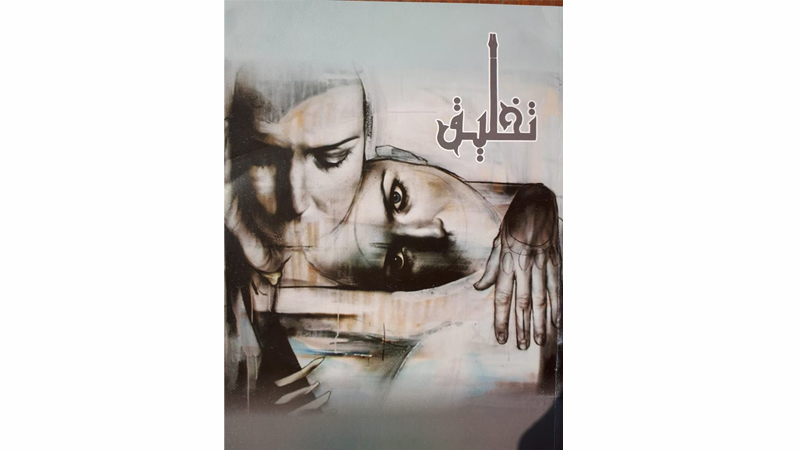
 Continuity, thy name is Takhleeq. Started by Azhar Javed and now continued by Sonaan Azhar Javed, the magazine has continued for years. In September 2018 issue’s editorial he is skeptical about writers’ dis-concern on the prevalent literary issues. He says that his literary magazine has only survived due to handful of concerned writers. It is an old story that the issues faced by the state of affairs of Urdu magazines and that of Urdu language are immense. Azhar Javed, despite being in a financial mess for forty years of publication of this literary magazine kept on publishing it somehow or the other, unhindered.
According to Sonaan, the quality of literature being ensued nowadays is deteriorating. A poet by writing a Ghazal claims that he is a poet. Everybody is stuck to Facebook or internet and shuns reading literary magazine or books. Without interacting with the society, literature is being created in drawing rooms. The question raised is that should issues such as terrorism, suicide bombing, kidnapping for ransom, targeted killing, inflation, poverty, clean water, electricity etc., not become part of themes for poetry and literature?
Dr Mubarak Ahmad discusses the book ‘Open Society and its Enemies’ by Karl Popper (Page 8). He has taken up the philosophies of Aristotle, Hegel and Marx and discussed their pros and cons. As per Dr Mubarak, Plato (Aflatoon) divides a society in four casts; Gold, Silver, Copper and Steel. Any person by sheer power of his wealth shall fall into the rich and downgraded casts. Plato, a Greek philosopher was the innovator of the written dialogue and dialectic forms in philosophy, the founder of Western political philosophy, with his Republic, and laws among other dialogues, providing some of the earliest extant treatments of political questions from a philosophical perspective.
Without interacting with the society, literature is being created in drawing rooms. The question raised is that shouldn’t issues such as terrorism, suicide bombing, kidnapping for ransom, targeted killing, inflation, poverty, clean water, electricity etc., become part of themes for poetry and literature?
Plato’s own most decisive philosophical influences are Socrates, Parmenides, Heraclitus and Pythagoras. Hegel had State’s backing and that is why no other philosopher stood in his way, Popper is critical. At that time in 1806, Napoleon had defeated Prussia, and nationalism movement took place. Hegel joined Berlin University and left Heidelberg University. Spirit is Hegel’s name for the collective consciousness of a given society, which shapes the ideas and consciousness of each individual. Hegel believed German as superior to other nations. He advanced the idea that anybody living in a State was subservient to it. In a way he supported the concept of Kingdom. Carl Marx, on the other hand was a product of the time of industrial revolution in England. Witnessing child labour and unhygienic conditions in the factories, he opposed this system and propagated respect to humanity. His philosophy was opposite to that of Hegel. Dr. Mubarak has summarized the three great philosophers with reference to Carl Popper’s book.
There are ten other essays in the section on essays. One of the essays is by Saud Usmani who recalls his seeing The Taj Mahal on December 27, 1998. The news alarmed him that 130 km and heavy rains had entered the southern gate of the mausoleum resulting in the falling of the adjacent minaret and tomb. Somebody remarked that it was the same gate from where one gets the first glimpse of The Taj. Saud Usmani goes into the details of the history of its construction, the reasons and quality of its construction, of a monument that seems to be breathing life all the time. Watching river Jamuna standing on the cool marble floor reminded Usmani of multi-meaning tear that was given life by Arjumand and Khurram. As per available information, this mausoleum in Agra is an inspirational memorial to eternal love. Built from between 1632 and 1647 by the Mughal Emperor Shah Jahan, the Taj Mahal was dedicated to Shah Jahan’s favorite wife, Mumtaz Mahal, who died during childbirth. It could slowly be sinking according to architects. The building’s foundations require a steady stream of moisture from the Jamuna River to retain its strength – but the river is slowly drying up.The last stanza of Sahir Ludhianvi’s famous poem, a satire says ‘The bank of Jamuna, this edifice, these groves and lawns,
These carved walls and doors, arches and alcoves,
An emperor on the strength of wealth, Has played with us a cruel joke.
Meet me hence, my love, at some other place’. Saud Usmani, on the other hand is lyrical when he says ‘Pathar Hei Magar Phool Kei Paikar Sei Bana Hei/Kaya Khwaab Hei Jo Sang-e-Munawer Sei Bana Hei’ (Made of stone but with the shape of a flower, it is a dream made of glittering stone).
Short stories have been contributed by Yaseen Ahmad from India, Tasneem Kausar, Dr. Muzammil Bhatti, Muhammad Aslam, Faisal Saeed Zargham and Azhar Javed. The latter’s short story ‘Gumshuda Mera Gaaon’ (my long lost village) deals with the bitter reality as to how simple beauty of village life has been destroyed by the development of infrastructure; its urbanization. Visiting after many years the narrator finds himself standing near the graveyard where his maternal grandfather was buried. He thought he was lost. He could recognise some things and could not some others. Only memories were alive. Changes had taken place; a full-fledged police station instead of a Chowki, a Lorry Adda in place of small shops etc. His forefathers’ property had been overtaken by his maternal uncle and his mother was a grey haired lady; a non-entity!
Interview of Dr Saleem Agha Qizilbash, son of Dr. Wazir Agha and a prolific writer, poet and critic in his own right – gains importance as at the time of writing this piece, social media mentioned his demise. He has sixteen books to his credit from 1980 to-date. He started writing when he was student. His first Inshaiya titled ‘Kursi’ (chair) appeared in Funoon, While studying for his Masters his first book of Inshaiyas titled ‘Sargoshian’ (whisperings) was published. Unlike his late father, he preferred to remain settled in his ancestral village Wazirkot, near Sargodha (Page 121). While comparing the styles and works of Dr. Jamil Jalibi and Dr. Wazir Agha, he observed that the former is a critic and researcher in a traditional manner whereas the latter has left a lot of work based on modern research and debate. Regarding as to what is a correct interview, he stated that the right question is usually more important than the right answer to the wrong question.
The present issue of the literary magazine contains Ghazals, remembrances, a travelogue by Neelum Ahmad Bashir, humour, autobiography, book reviews and a section on Punjabi literature making this issue a pleasant and informative reading for literature lovers.
Published in Daily Times, September 7th 2018.