• Skip to primary navigation
  • Skip to main content
  • Skip to primary sidebar
  • Skip to footer
Trending:
  • Kashmir
  • Elections
Friday, June 5, 2026

Daily Times

Your right to know

  • HOME
  • Latest
  • Iran-Israel war
  • Gilgit Baltistan Election
  • Pakistan
    • Balochistan
    • Gilgit Baltistan
    • Khyber Pakhtunkhwa
    • Punjab
    • Sindh
  • World
  • Editorials & Opinions
    • Editorials
    • Op-Eds
    • Commentary / Insight
    • Perspectives
    • Cartoons
    • Letters to the Editor
    • Featured
    • Blogs
      • Pakistan
      • World
      • Lifestyle
      • Culture
      • Sports
  • Business
  • Sports
  • E-PAPER
    • Lahore
    • Islamabad
    • Karachi

AFP

The G7/G8: where the big powers meet informally

Published on: June 9, 2018 9:36 AM

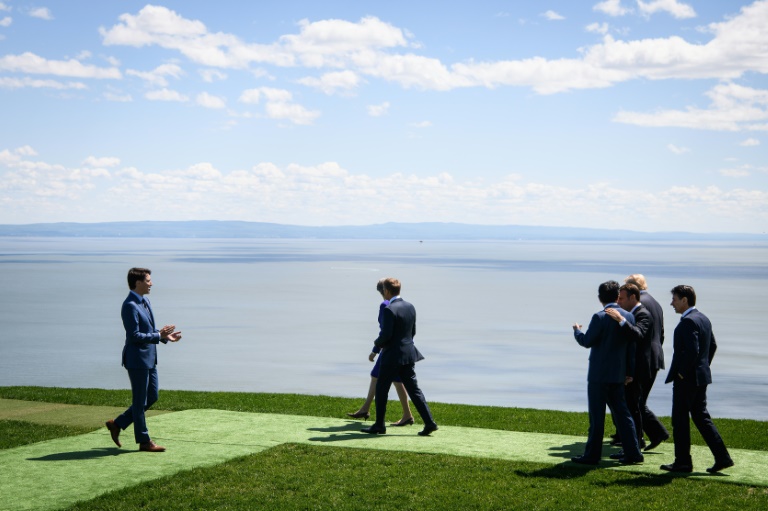
The G7, which ends a two-day summit in Canada on Saturday against a background of tensions, is an informal grouping of major powers created in 1975.

Originally established as a vehicle for leading industrialised democracies to discuss the global economy, it has expanded its scope to issues such as peace, the environment and terrorism.

Often the atmosphere between the partners becomes tense in the run-up to the annual summit, held in the country which holds the rotating presidency.

However G7 summits traditionally end with a face-saving joint declaration regarding the most important outcomes of the meeting.

This year’s summit promises to be fractious due to new import tariffs imposed by US President Donald Trump on his partners.

He has also called for the reintegration of Russia, a member of the group between 1998 and 2014 and which was thrown out after it annexed Ukraine’s Crimea peninsula.

– Origins in global economy –

The meetings date back to Rambouillet in France in 1975, in the wake of the first oil shock, during which oil prices soared.

Six countries — Britain, France, Germany, Italy, Japan and the United States — took part in this first “G6”, and were joined a year later by Canada making the “G7”.

The initiative came from French president Valery Giscard d’Estaing who wanted to elevate to the top level meetings already held by the countries’ finance ministers to tackle burning economic issues.

– From G7 to G8 –

During the 1980s, tensions between the East and West during the Cold War gave a more political slant to the meetings.

The Williamsburg summit in 1983 adopted, for the first time, a declaration on security in Europe.

The text of support for the policies of US president Ronald Reagan towards Moscow was adopted despite the reservations of French president Francois Mitterrand.

The collapse of the Soviet Union in late 1991 proved a gamechanger.

Russia, which attended the summit as a guest in 1992, was in 1998 allowed for the first time to attend all summit meetings. The grouping was officially renamed the “G8”.

– Exclusive club criticised –

From 1999, during a period of successive financial crises, the G8 was criticised for being an exclusive club.

The rich powers therefore also started meeting with emerging countries in the new “G20” grouping, in an attempt to resolve or avoid these crises.

In 2001 the G8’s summit in Genoa, Italy, was overshadowed by violent demonstrations by anti-globalisation protesters which left one person dead.

The protesters challenged the usefulness and legitimacy of the G8 and called for the cancellation of the poorest countries’ debts.

Protests dogged other G8 summits, which from then on were held under tight security.

– Putin and Trump –

In 2014 Vladimir Putin’s Russia was suspended from the G8 after it annexed Ukraine’s Crimea peninsula and sanctions were imposed on Moscow. The G8 summit planned for that year in Russia was cancelled and the G8 reverted to being the G7.

In 2017 the G7’s unity was shattered on the issue of climate change during its first summit with Trump in Sicily. Several days later he decided to pull out of the Paris climate accord.

Filed Under: World Tagged With: G7, Headline, industrialised democracies, Terrorism

Submit a Comment


Primary Sidebar


Latest News

SBP reserves climb to $17.19 billion

Naqvi calls for joint SCO security strategy

US-Iran peace could unlock $20bn for Pakistan

Govt unveils fixed tax scheme for traders

FIFA launches World Cup game on Netflix

Pakistan

Naqvi calls for joint SCO security strategy

US-Iran peace could unlock $20bn for Pakistan

Momina Iqbal’s PECA complaint lands MPA in case

AJK elections slated for July 27; EC issues code

Khawaja Asif rejects demand on AJK refugee seats issue

More Posts from this Category

Business

Govt introduces fixed tax scheme for small traders nationwide

Gold and silver prices decline after market correction

Bitcoin slump deepens as investors chase AI opportunities

Weekly inflation eases as prices of some essentials decline

Federal budget proposes funding for Karachi development projects

More Posts from this Category

World

Iran ties peace deal to Lebanon ceasefire

CNN claims Israel used secret Azerbaijan bases

Iran fires warning missiles at US warships

More Posts from this Category


Footer

Home
Lead Stories
Latest News
Editor’s Picks

Culture
Life & Style
Featured
Videos

Editorials
OP-EDS
Commentary
Advertise

Cartoons
Letters
Blogs
Privacy Policy

Contact
Company’s Financials
Investor Information
Terms & Conditions

Facebook
Twitter
Instagram
Youtube

© 2026 Daily Times. All rights reserved.

Manage Consent
To provide the best experiences, we use technologies like cookies to store and/or access device information. Consenting to these technologies will allow us to process data such as browsing behavior or unique IDs on this site. Not consenting or withdrawing consent, may adversely affect certain features and functions.
Functional Always active
The technical storage or access is strictly necessary for the legitimate purpose of enabling the use of a specific service explicitly requested by the subscriber or user, or for the sole purpose of carrying out the transmission of a communication over an electronic communications network.
Preferences
The technical storage or access is necessary for the legitimate purpose of storing preferences that are not requested by the subscriber or user.
Statistics
The technical storage or access that is used exclusively for statistical purposes. The technical storage or access that is used exclusively for anonymous statistical purposes. Without a subpoena, voluntary compliance on the part of your Internet Service Provider, or additional records from a third party, information stored or retrieved for this purpose alone cannot usually be used to identify you.
Marketing
The technical storage or access is required to create user profiles to send advertising, or to track the user on a website or across several websites for similar marketing purposes.
  • Manage options
  • Manage services
  • Manage {vendor_count} vendors
  • Read more about these purposes
View preferences
  • {title}
  • {title}
  • {title}
We use cookies to ensure that we give you the best experience on our website. If you continue to use this site we will assume that you are happy with it.