
Northeast Asia’s politics have historically been viewed through the prism of the Korean conflict. There have been efforts in the past to bring the two Koreas to the negotiating table. The Six-party talks, for instance, were an endeavour in this direction. Regional players as well as the US have been actively involved in ameliorating regional tensions.
In this backdrop, the recent dialogue between North and South Korea can be termed as a major political breakthrough. If it is able to achieve its desired goal of peace, moreover, it can initiate a new era in the lives of the Korean people who have been separated since 1953.
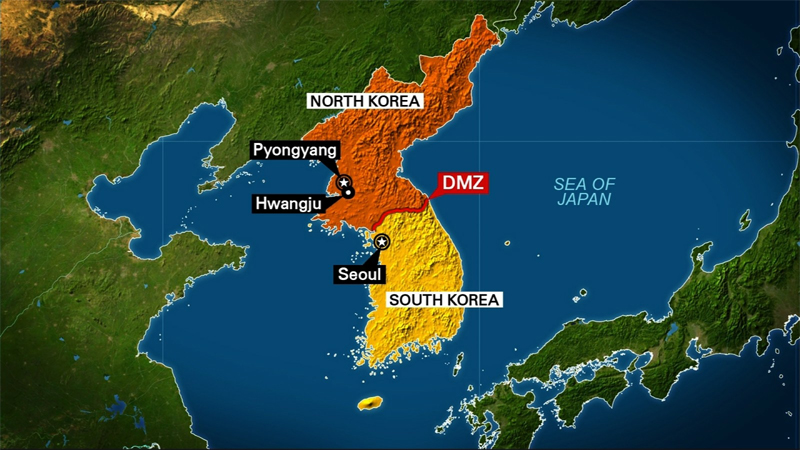
The talks between Kim Jong-Un and his Southern counterpart were held along the de-militarised zone, in Panmunjom village. Kim’s visit, in fact, is the first such visit by a North Korean leader to South Korea since the end of the Korean War. The visit is thus being hailed by regional players and by the world at large.
For instance, UN spokesman Stephane Dujarric remarked, “Many around the world were moved by the powerful imagery of the two leaders coming together to advance harmony and peace on the Korean Peninsula.”
The two leaders agreed at the meeting to conclude a peace treaty that will be signed by the end of 2018. Both Koreas will also undertake efforts to promote bilateral ties and to reunify the Korean peninsula, thus, ending 65 years of hostile relations. They will also encourage people-to-people contact between the two nations. The meeting also stipulates the formation of a joint liaison office in Kaesong, North Korea.
Kim Jong-Un’s statement that North Korea, “no longer needed to conduct nuclear tests or Intercontinental Ballistic Missile tests,” also marks a dramatic shift from the country’s previous policies. It appears that North Korea is trying to build its image as a responsible political player with the ultimate goal of achieving economic progress.
Backing out of negotiations at this stage will be difficult for all parties. This may also result in further economic sanctions, and lead to a deteriorating security situation on the peninsula
A realpolitik analysis of the dialogue reveals that it is South Korea which is more economically stable than North Korea, while the latter is the de-facto nuclear state. In order to thrive, however, both Koreas need a conducive regional environment. The dialogue’s aims to move towards a unified Korea, therefore, will make both states more stable, while a unified Korea will emerge as a stronger political player in the region.
China views the North-South meeting as a positive move in diffusing tensions in the Korean peninsula. As per a Chinese Foreign Ministry statement: ‘all parties can maintain the momentum for dialogue and can jointly promote the resolution process.’
Japan, another regional player, and a US ally, however, may not support a flexible approach to North Korea. The abduction of 17 Japanese citizens by North Korea back in 1970-80 continues to plague bilateral ties. Moreover, Japanese Prime Minister Shinzo Abe’s visit to the US in April, ahead of planned US-North Korea talks, shows that Japan wants the US to pay heed to its concerns before any meeting with North Korea.
The US does not support a nuclear North Korea, that much is apparent. President Donald Trump’s recent statement, in fact, serves to highlight this point: “Japan and the US are locked, and we are unified on the subject of North Korea.”
But how strategically are the US and Japan aligned over the issue? And will the US assure its allies that it will not overlook any threats to their security? Or will Pyongyang’s willingness for dialogue mollify the opposition? Taking the North-South rapprochement to the desired level will require bilateral as well as regional cooperation. In this regard, the upcoming US-North Korea talks are a significant development. A continuous diplomatic engagement between North and South along with the US can lead to a positive outcome.
China and Japan’s role in providing momentum to the peace talks is also crucial. However, backing out of negotiations at this stage will be difficult for all involved parties. This may also result in further economic sanctions, and lead to a deteriorating security situation on the peninsula.
The writer is a researcher at the Islamabad Policy Research Institute (IPRI)
Published in Daily Times, May 6th 2018.