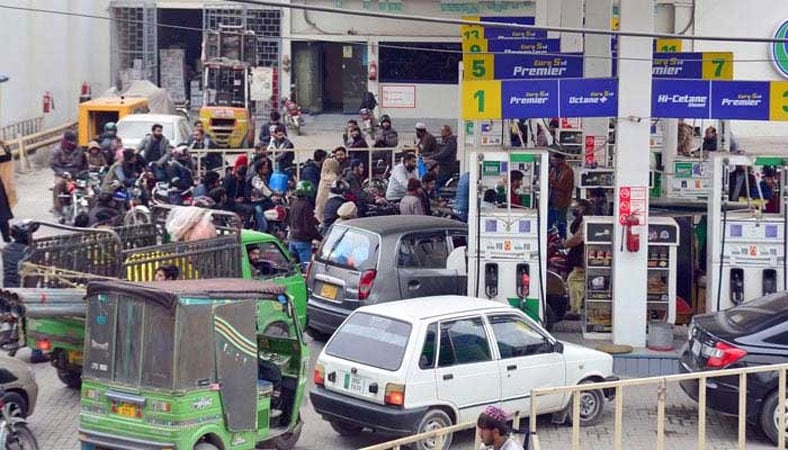
 The federal government on Friday increased the prices of petrol and high-speed diesel in its latest fuel price revision, with petrol becoming Rs5.44 per litre more expensive and diesel registering a much steeper Rs31.50 per litre increase.
The sharp rise comes against the backdrop of soaring international energy prices, with the government simultaneously announcing a major overhaul of the country’s petroleum pricing mechanism.
The announcement comes as the federal cabinet approved a new system that hands the responsibility for petroleum price determination to the Oil and Gas Regulatory Authority (OGRA) on a daily basis, replacing the existing periodic pricing mechanism.
Addressing a press conference alongside Information Minister Attaullah Tarar, Malik said the decision was approved by Prime Minister Shehbaz Sharif and the federal cabinet.
Renewed military strikes in the Middle East were also weighing on risk sentiment, keeping oil prices elevated and reigniting concerns about inflation and growth.
Oil prices were on the rise, with Brent crude futures LCOc1 up 0.6% at $84.75 a barrel, while US crude CLc1 advanced 1.1% to $79.8 per barrel.
He said the Oil and Gas Regulatory Authority (Ogra) would determine fuel prices daily, with updated rates to be published on its website.
Expressing concern over renewed tensions in the Middle East, the minister said the conflict heightened uncertainty in global energy markets. He noted that international diesel prices had risen sharply following the latest hostilities, increasing from around $110 per barrel to $140 per barrel.
Malik said the government continued its targeted fuel subsidy programme, but acknowledged that consumers were still feeling the impact of higher fuel costs.
He added that petroleum and carbon support levies on petrol and diesel remained lower than previous levels, while the government was also moving towards the deregulation of petroleum products.
Addressing the news conference, Tarar said the latest increase in domestic fuel prices was linked to regional developments and volatility in international oil markets.
He added that Pakistan’s energy requirements were met through imported cargoes from various countries.
The information minister said the country had not experienced any energy shortages due to the government’s policies.
He stressed that oil marketing companies (OMC) were operating under strict regulatory oversight and warned that no one would be allowed to engage in hoarding.
Tarar added that many countries immediately pass changes in petroleum prices on to consumers, describing the practice as a common feature of global energy markets.
The move to daily price reviews follows the government’s earlier decision to conduct weekly petroleum price adjustments after tensions escalated following the US-Israeli conflict with Iran on February 28.
During the last review, the government raised petrol and high-speed diesel (HSD) prices by Rs13.18 and Rs13.80 per litre, respectively, taking the rates to Rs310.71 and Rs323.30 per litre.
Separately, power companies on Friday sought a Rs1.20 per unit increase in fuel cost charges for consumers across the country in August, primarily due to the use of expensive imported fuels.
The request comes despite around 75pc of electricity generated in June having come from cheaper domestic sources, predominantly those with zero fuel costs.
Once approved, the power companies would charge consumers of all power utilities, including ex-Wapda Distribution Companies (Discos) and K-Electric, an additional Rs15.7 billion through August bills. The National Electric Power Regulatory Authority (Nepra) has called a public hearing on July 29 to examine the request for a fuel cost adjustment (FCA).
The Central Power Purchasing Agency (CPPA), which filed the petition seeking a higher FCA for June, said power consumption was slightly lower than in June 2025. It reported electricity consumption of 13,066bn units in June this year, compared to 13,310bn units in the same month last year.
The increase in fuel costs was primarily driven by the nearly doubled price of Regasified Liquefied Natural Gas (RLNG), which resulted in a fuel cost of Rs35 per unit, compared to Rs16 per unit in June last year.
The CPPA said the reference fuel cost for June 2026 had been set at Rs7.714 per unit, but the actual fuel cost stood at Rs8.90 per unit, necessitating an additional charge of Rs1.20 per unit to be recovered from consumers through the upcoming monthly bills.
Another reason for the higher fuel costs was the utilisation of furnace oil-based plants at Rs52 per unit and diesel at about Rs57 per unit. The combined contribution of these two fuels was less than 1pc of the overall grid supply.
This was despite the fact that 39pc of the power supply came from hydropower – a zero-fuel-cost energy source – followed by 10pc from local coal, 6.5pc from local gas and 13.5pc from nuclear power. Wind projects contributed 5pc to the supply, solar 0.82pc and bagasse-based generation 0.35pc.
The fuel cost of local coal-based generation came to Rs11.5 per unit, compared to Rs16.65 per unit for imported coal. Generation based on local gas cost Rs13.7 per unit, compared to Rs35.5 per unit for imported Regasified Liquefied Natural Gas (RLNG). Nuclear power’s fuel cost was reported at Rs2.85 per unit.