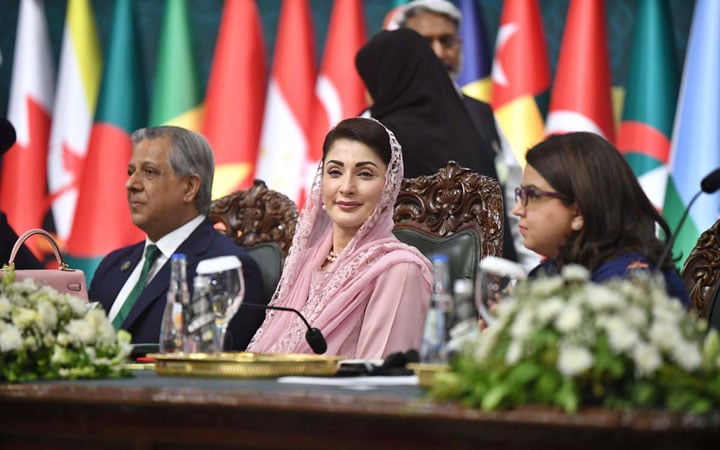
 Punjab Chief Minister Maryam Nawaz Sharif on Monday urged the Organisation of Islamic Cooperation (OIC) member states to launch a collective effort for women’s empowerment, saying empowering women was not the success of one segment of society but of the entire nation.
Addressing the 9th OIC Ministerial Conference on Women, the chief minister said every girl in the Muslim world should have access to education, opportunities, dignity and the freedom to pursue her dreams without fear. She said joint efforts through the OIC platform could help ensure greater opportunities, protection and empowerment for women.
Welcoming delegates to Lahore, CM Punjab described it as an honour to address the conference and said Islam provided clear guidance on the rights and dignity of women. She paid tribute to Mohtarma Fatima Jinnah for standing beside Quaid-i-Azam Mohammad Ali Jinnah and remembered her mother, Begum Kulsoom Nawaz, for her unwavering support to former prime minister Nawaz Sharif, saying she had learnt courage and resilience from her.
The chief minister said education, healthcare and employment were fundamental rights of women and stressed the need for collective measures to address challenges faced by women across the Muslim world.
Highlighting the Punjab government’s initiatives, she said women accounted for more than 60 per cent of beneficiaries under the provincial scholarship and laptop schemes. She added that women were also being included in programmes such as Apna Ghar Apni Chhat, Apna Khet Apna Rozgar and the Honhaar Scholarship Scheme, enabling them to secure education, employment and property ownership.
She said every village was becoming part of the global economy through digital connectivity and rural women were being economically empowered through livestock distribution, while products made by skilled women were being promoted through Sanatzar. Opportunities for financial independence were also being created for women with disabilities.
CM Punjab said the Dhee Rani Programme was supporting girls from financially disadvantaged families, while facilities for women lawyers were also being expanded. She said women were being provided healthcare services through Clinics on Wheels and field hospitals, adding that the government remained committed to ensuring quality healthcare for every mother and child.
The chief minister said women were being equipped with IT skills, while the Green Taxi Programme was enabling them to earn a livelihood as well as benefit from safe transportation. “The objective of women’s empowerment is to give women full control over their lives,” she said.
Referring to public safety measures, she said more than three million women had benefited from Safe City Authority services. She said 36 mobile police stations were providing assistance at the doorsteps of women unable to visit police stations, while over 900 mobile charging stations and safety buttons had become operational across Punjab to strengthen women’s security.
The chief minister said Islam guaranteed women honour, dignity and protection, adding that cultural traditions and Islamic teachings were being respected while pursuing the mission of women’s empowerment. She said creating employment opportunities for women remained one of her key priorities, while financial inclusion and entrepreneurship were being promoted across Pakistan.
Sharing her personal experiences, the chief minister said she had learnt during difficult times that commitment to principles required sacrifice and perseverance. She said standing beside her father had taught her resilience and strengthened her resolve to represent the aspirations of millions of Pakistanis.
She paid tribute to former prime minister Benazir Bhutto, describing her as the first woman prime minister of Pakistan and the Muslim world who paved the way for future generations of women. She also said the appointment of a woman as chief justice of a high court represented not merely an individual achievement but a milestone for millions of girls.
The chief minister said nearly one million people had benefited from the Apni Chhat Apna Ghar programme, while over three million women had received digital assistance through the Safe City Authority and more than one million women had availed services through the Virtual Police Station.
She concluded by saying that an empowered woman was not only educated or economically independent but also safe, and reiterated that women’s empowerment was synonymous with national progress. Inviting conference participants to visit Lahore, she described the city as a living museum of history, culture, poetry and hospitality. She expressed hope that the OIC platform would strengthen collective efforts to ensure education, dignity, opportunity and security for every woman across the Muslim world.