 Pakistan’s role in brokering a peace deal in the Iran war has led to widespread diplomatic acclaim that could bring Islamabad some economic benefits, but analysts question whether such gains can help resolve the fault lines in its economy.
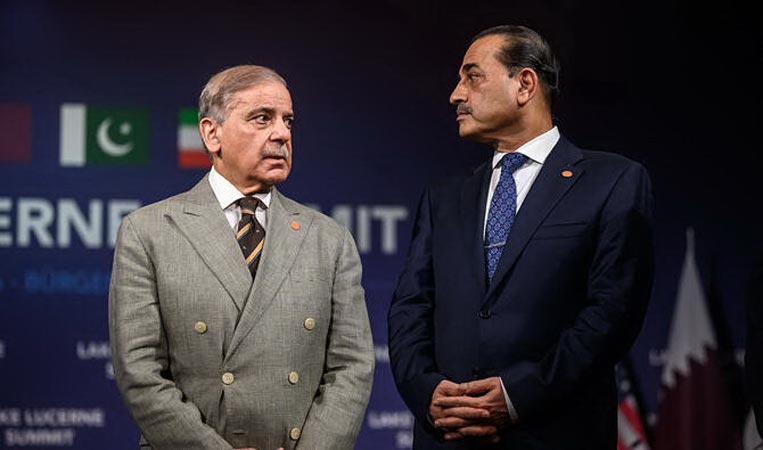
Prime Minister Shehbaz Sharif and army chief Field Marshal Asim Munir attended talks between Iran and the US in the Swiss town of Bürgenstock last weekend, the culmination of Pakistan’s months-long role in one of the world’s most consequential diplomatic negotiations.
“This guy. What’s up, man?” US Vice President JD Vance said upon seeing Munir in the resort town before giving the army chief a hug. Both sides, along with several world leaders, have thanked Islamabad for helping ease a conflict that could have disrupted the Strait of Hormuz for a long period, choked global oil supplies and shattered the world economy.
The breakthrough has raised Pakistan’s profile and analysts say the country of 250 million people has an opportunity to convert that goodwill into some gains for an economy marked by decades of boom and bust. But they said any benefits were unlikely to fix deeper structural issues including social and economic inequity, a narrow tax base and repeated IMF bailouts.
Pakistan is targeting economic growth of 4.0 percent and inflation of 8.2 percent for the coming fiscal year, compared with 3.7 percent projected growth in fiscal 2026 which ends in June, and 6.7 percent average inflation in the July-May period of the outgoing year.
“A nation that delivers stability at home and helps advance stability abroad becomes a more credible destination for investment,” said Khurran Schehzad, adviser to Pakistan’s finance minister.
“A growth-oriented economic agenda, coupled with a reputation as a force for peace and stability, places Pakistan in a uniquely favorable position to attract investment into its people, infrastructure, technology and future growth sectors.”
Many analysts are expecting some largesse from the US, although there have been no signs of any such windfalls yet.
Alex Vatanka, senior fellow and director of the Iran program at the Middle East Institute in Washington, said one gain for Pakistan was the “huge potential to be a more integrated part of the broader Middle East,” and eventually forging broader economic partnerships in the region that would also encompass defense.
Another possibility was that sanctions relief on Iran could allow “huge trade between Iran and Pakistan,” particularly through their Balochistan land border, said Miftah Ismail, a former finance minister.
SEEN THIS BEFORE
After the September 11, 2001 attacks and the US invasion of Afghanistan, alignment with Washington helped secure debt rescheduling from more than a dozen bilateral creditors, renewed support from the IMF and other multilateral lenders, and US assistance. But Pakistan failed to take advantage because of structural weaknesses, analysts say. Khurram Husain, an economic commentator and journalist, said the current situation was similar to post-9/11, but with one crucial difference: that moment came at “the start of a long ruinous war in which Pakistan had to play a frontline role” while this time “Pakistan is playing the role of a peacemaker.”
That distinction means Pakistan’s leverage this time comes from being useful to multiple sides simultaneously – Washington, Tehran, Gulf states, Turkiye and China.
Former finance minister Ismail said the diplomatic role had enhanced Pakistan’s international prestige, but that had no effect on the high costs, weak exports and external repayments that keep it dependent on the IMF.
“Our house is in such disorder that foreigners can’t really help us unless we help ourselves,” he said. “Nothing here in this war changes that and we will be continually dependent on the IMF.”
Asim Ijaz Khawaja, a professor at Harvard University and director of the Harvard Center for International Development, said Pakistan should resist short-term financial concessions that do not raise productivity. Instead, he said, Pakistan should seek academic exchanges and scholarships, preferential market access for textiles and IT services, technology transfer and green investment frameworks.
Hamish Falconer, Britain’s minister for the Middle East, thanked Islamabad for its peacekeeping role during a visit last week and told Reuters the UK saw “huge scope for deepening trade links” with Pakistan and that a British trade minister was expected to visit in the coming months.
Diplomats from two other Western countries have also said their governments are exploring strengthening economic ties following Islamabad’s peace efforts. They did not wish to be identified further.
‘PEACE PIVOT’
Atif Mian, professor of economics, public policy and finance at Princeton University, said Pakistan should avoid treating diplomacy as another route to deposits, rollovers or IMF-style relief. The real prize, he said, was a “peace pivot” – external and domestic – built on regional trade, energy links with Iran, and deeper integration with the Gulf and Turkiye through exports, technology transfer and co-dependent industries.
Analysts said any new economic gains would not fix Pakistan’s deeper constraints.
“If structural reforms are not implemented, the country is poised for an implosion in coming decades,” said Adeel Malik, associate professor of development economics at Oxford University.
“There are deep-seated grievances among the young and the shrinking middle classes against Pakistan’s ruling elite. The prevailing system has given ruling elites an extended lease of life but has made the country socially and economically insecure.”