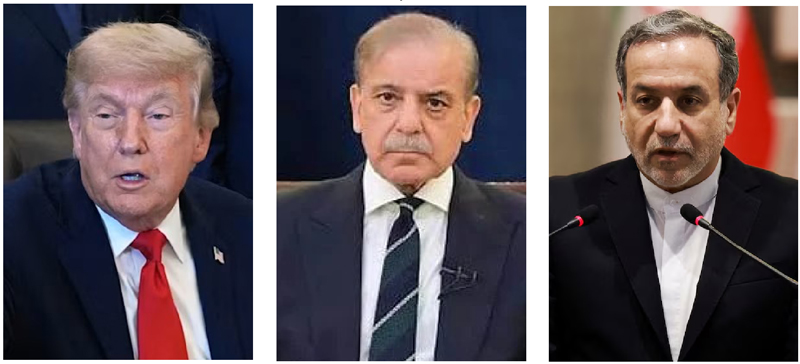
 US President Donald Trump and mediator Pakistan said on Saturday an initial deal to end the war in the Middle East would be signed on Sunday, although Iran denied the signing would take place so soon.
Pakistani Prime Minister Shehbaz Sharif said the two sides had agreed on a framework for a peace deal and that Islamabad was preparing for an electronic signing on Sunday, to be followed by technical-level talks next week.
Shehbaz Sharif said that Pakistan was close to a peace deal between Iran and the United States, as its finalization was likely within the next 24 hours.
Expressing confidence, the prime minister described the development as a historic milestone that would lay a strong foundation for lasting peace and stability across the region.
On his X handle, the prime minister posted, “We are closer to a peace deal than ever before. With finalisation likely expected in the next 24 hours, Pakistan is preparing for the electronic signing of the peace deal immediately after, followed by technical-level talks next week.”
He also thanked the United States of America and the Islamic Republic of Iran for their ongoing commitment during the negotiations, and extended sincere appreciation to their brothers in the region for their support.
“We are confident that this historic peace deal will form a strong foundation for lasting peace,” he added.
Trump also said in a social media post that the deal with Iran was scheduled to be signed on Sunday and that the Strait of Hormuz, a vital artery for global oil supplies which Iran has blocked, would be immediately “open to all” after it was signed.
Earlier on Saturday, Iranian Foreign Ministry spokesperson Esmaeil Baghaei cautioned against commenting on the timing the signing.
“We will have to wait and see about the exact date of the signing of the memorandum of understanding, although it will not be tomorrow,” state media quoted Baghaei as saying.
“The possibility of this happening in the coming days cannot be ruled out. However, due to the hesitation of the other side, we must be cautious in making any comments about this process.”
A US official who spoke to reporters later declined to be drawn on the timing but said: “It’s a great deal and a very strong deal.”
It is not the first time the two sides have appeared close to an initial agreement on ending the war that began on February 28 with joint US-Israeli strikes on Iran, but Sharif said on X: “We are closer to a peace deal than ever before.”
The war has sent global energy prices sharply higher and killed thousands of people, mostly in Iran and Lebanon, where the war has revived a conflict between Israel and Iran-aligned Hezbollah militants.
The United Arab Emirates (UAE) has denied media reports alleging that the government agreed to release up to $20 billion in frozen assets to Iran, with its foreign ministry saying claims that Iranian funds had been released were “entirely false and unfounded”.
The UAE foreign ministry issued a statement early on Saturday categorically denying reports of the transfer, “including allegations concerning $3 billion”.
The statement “affirmed that these allegations are entirely false and unfounded, stressing that no frozen Iranian funds have been released, transferred or facilitated through the UAE.
The statement did not provide any further specifics.
Iranian Foreign Minister Abbas Araghchi has said during an interview with Iran’s State TV, Tehran and Washington are on the verge of finalising a memorandum of understanding (MoU) aimed at formalising the ceasefire that ended the recent conflict between Iran, the United States and Israel.
According to IRNA, Araghchi described the proposed agreement as the outcome of two months of negotiations facilitated by Pakistan, which brokered the April 8 ceasefire and has continued to mediate efforts to secure a lasting settlement.
Both Iran and the United States have indicated in recent weeks that discussions are nearing completion. The proposed framework follows the conflict that erupted in late February and was halted after Islamabad helped secure a ceasefire between the parties.
Araghchi said the Iranian Foreign Ministry had pursued the negotiations to consolidate what he described as the Iranian people’s victory during the war.
“One of the missions entrusted to the Foreign Ministry was to follow a negotiating track that would preserve and consolidate the achievements of the Iranian nation,” he said, adding that the diplomatic effort had been carried out in full coordination with the country’s armed forces. The foreign minister stressed that Iran’s diplomatic and military institutions had worked in tandem throughout the process.