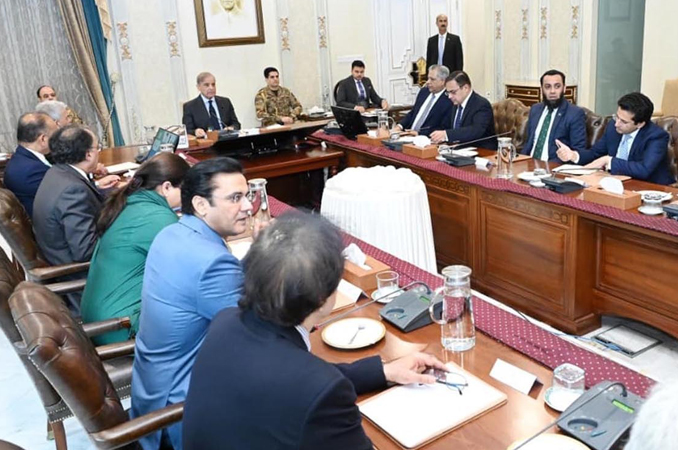
 Prime Minister Shehbaz Sharif on Thursday directed the launch of a pilot project for a proposed automated income tax collection system in Islamabad, the Prime Minister’s Office (PMO) said.
In a statement, the PMO said that Prime Minister Shehbaz chaired a review meeting on ongoing reforms in the Federal Board of Revenue (FBR), attended by Finance Minister Muhammad Aurangzeb, State Minister for Finance Bilal Azhar Kayani, and others.
“The meeting reviewed the ongoing measures aimed at modernising the tax system and increasing tax collection in detail,” it said, adding that a comprehensive plan was presented to make inland revenue collection more “effective, transparent and faceless”.
According to the PMO, the meeting was informed that the proposed new tax system would have the capability to identify under-declared income and assets through data relating to properties, vehicles and banks.
“Modern technology and artificial intelligence would be used to make the tax system automated, transparent and effective,” it added.
Addressing the meeting, the prime minister said that the “project for an automated, modern and efficient tax management system through the effective use of modern technology would prove to be a milestone in the government’s reform agenda,” the PMO stated.
The premier added that minimising human intervention and discretionary powers in the tax collection system was the need of the hour.
The prime minister further said that implementation of the project would not only increase revenues but also promote transparency, fairness and public trust in the tax system.
He added that the process of FBR reforms would continue for the documentation of the economy and expansion of the tax net.
During the meeting, the PM Shehbaz also paid tribute to the provincial governments for their effective action against illegal cigarettes, the PMO said.
“Through enforcement measures, additional tax collection of Rs40 billion from the cigarette sector is expected this year for the national exchequer,” it said.
Under the new system, it was also proposed to establish a National Faceless Audit Wing, a National Assessment Wing and a Field Operations Wing.
Meanwhile, the government has decided to reduce customs duties on specialised vehicles and machinery to promote the construction sector.
To provide facilities for the pharmaceutical sector, customs duty will be eliminated on raw materials, especially those used in cancer medicines.
The development came during a review meeting chaired by Prime Minister Shehbaz Sharif on the overall development of the national economy and implementation of the National Tariff Policy on Wednesday.
Addressing the meeting, the prime minister said that achieving export-based development goals is our top priority. The active and transparent performance of the National Tariff Commission (NTC) is essential for promoting the country’s industry, trade, and investment.
He said that the NTC should play its active role in the facilitation of investors and industrialists.
The PM further said that innovation should be brought to the NTC by adopting the best global practices and modern technology prevailing in the world, including information technology and artificial intelligence.
A briefing was given in the meeting regarding the implementation of the National Tariff Policy 2025-30.
The briefing stated that under the National Tariff Policy 2025-30, tariffs will be gradually reduced for various sectors, the objective of which is to achieve export-based economic growth targets.
For the development and promotion of the logistics sector, duties imposed on reefers, containers and semi-trailers will be eliminated.