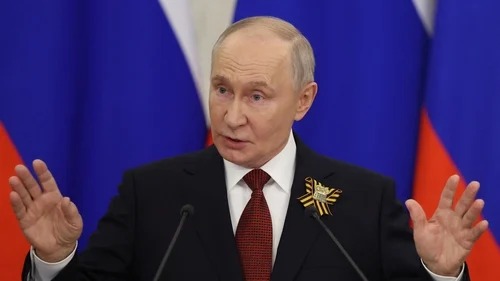
Russian President Vladimir Putin signaled that the war in Ukraine is moving toward an end, speaking to reporters in Moscow after scaled-down Victory Day celebrations marking World War Two victory. He described the conflict as nearing completion while continuing to defend Russia’s military campaign and blaming Western countries for escalating tensions through support for Ukraine. Putin also reiterated that Russia’s actions remain a “special military operation” and said recent battlefield developments suggest the conflict is approaching its final phase. His remarks came as fighting continues more than two years after the 2022 invasion, which has reshaped regional security and global diplomatic relations.
Read more : Putin claims Russia advancing in Ukraine May 9
The annual Victory Day parade in Moscow’s Red Square took place under tight security, with officials scaling back displays due to fears of Ukrainian drone attacks. Instead of traditional tanks and missile columns, authorities used large screens to show military hardware footage during the ceremony for safety reasons. A temporary ceasefire arrangement, reportedly supported through US-led mediation efforts, helped reduce immediate security risks during the commemorative event. Despite restrictions, the Kremlin used the occasion to reinforce national unity and highlight its narrative of strength during ongoing conflict conditions.
Putin said he would only meet Ukrainian President Volodymyr Zelenskyy after a final peace agreement is reached between the two sides. He added that any such meeting would likely take place in a third country and would focus only on signing a completed treaty. The Russian leader also expressed skepticism about Ukraine’s willingness for meaningful dialogue, suggesting earlier proposals had not been fully new. Despite this, he indicated that Russia remains open to structured negotiations under agreed security frameworks and clear conditions.
Read more : Putin focuses on escalating Middle East crisis –
During his address, Putin again blamed Western leaders, saying they misled Russia after the fall of the Berlin Wall in 1989. He argued that NATO expansion toward Eastern Europe, including Ukraine, played a central role in triggering the ongoing conflict. Putin said Russia is willing to discuss new European security arrangements, but prefers engagement with select former Western leaders. He specifically mentioned Gerhard Schröder as a potential interlocutor, reflecting strained ties with current European governments.
The war, which began with Russia’s 2022 invasion of Ukraine, has caused massive casualties and widespread destruction across cities and infrastructure. Russian forces currently control about one-fifth of Ukrainian territory, although they have not achieved their stated full military objectives. Recent US-led mediation efforts produced a temporary ceasefire and preliminary agreement on prisoner exchanges involving around 1,000 individuals. However, both Moscow and Kyiv continue to disagree on territorial control, security guarantees, and long-term peace arrangements.
European countries continue providing military and financial support to Ukraine, while accusing Russia of ongoing aggression in the conflict. Russia rejects these accusations and instead blames Western governments for prolonging the war through political and military involvement. Despite occasional diplomatic signals, both sides remain far apart on core issues, keeping prospects for a lasting settlement uncertain. As a result, international pressure continues to mount for renewed negotiations and clearer peace commitments from all parties involved.