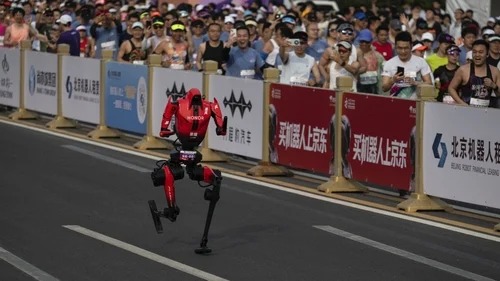
A humanoid robot shocked spectators after breaking the world record at the Beijing half marathon, completing the 21-kilometre course faster than elite human runners. The event in Yizhuang showcased rapid advances in robotics as machines and humans competed in separate lanes to ensure safety throughout the race.
The winning robot, designed with an autonomous navigation system for a Chinese smartphone company, finished the race in 50 minutes and 26 seconds. This performance surpassed the current human world record of 57 minutes and 20 seconds, highlighting the growing capabilities of artificial intelligence and robotics technology in endurance sports.
Read more : Beijing ready to ‘organically integrate’ Pakistan’s uplift plans, says …
Compared to last year, when robots struggled to complete the course, this year’s competition showed dramatic improvement in performance and stability. Organisers reported that more than 100 humanoid robots participated, a sharp increase from around 20 entries previously, reflecting rising investment and interest in the robotics sector.
Spectators expressed mixed reactions as they watched the machines run at impressive speeds alongside human athletes. While many praised the technological achievement, others voiced concerns about the long-term impact of automation on jobs and daily life as artificial intelligence continues to develop rapidly.
Read more : Beijing sanctions signal rising Taiwan tensions
Experts and attendees suggested that humanoid robots may soon become part of everyday society, performing tasks such as household work, caregiving, and even dangerous operations like firefighting. This growing potential reflects how robotics and artificial intelligence are increasingly moving beyond laboratories into real-world applications.
Investment in robotics and embodied AI has also surged significantly in recent years, reaching billions of dollars in China alone. As a result, analysts believe such innovations will continue to reshape industries, raise ethical questions, and redefine the balance between human ability and machine intelligence.