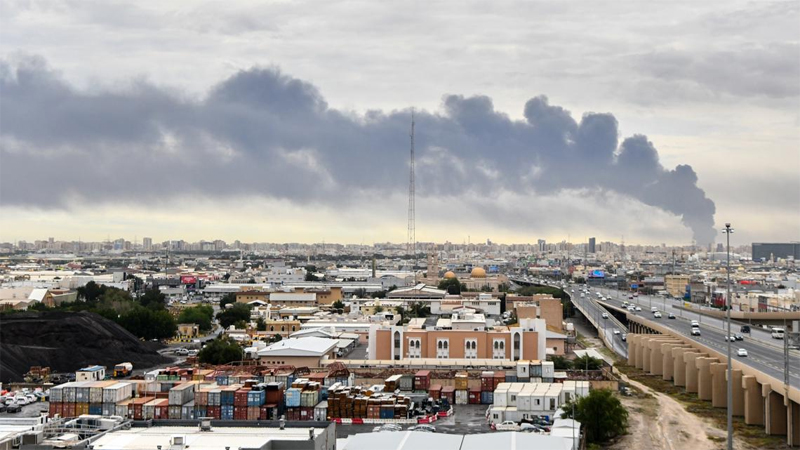
 Iran on Wednesday dismissed an American plan to pause the war in the Middle East and launched more attacks on Israel and Gulf Arab countries, including an assault that sparked a huge fire at Kuwait International Airport.
Iran’s defiance came as Israel launched airstrikes on Tehran and as the United States deployed paratroopers and more Marines to the region.
Iranian state television´s English-language broadcaster, Press TV, quoted an anonymous official as saying Iran rejected America´s ceasefire proposal. Press TV´s report came after Pakistan transmitted the proposal to Iran.
“Iran will end the war when it decides to do so and when its own conditions are met,” Press TV quoted the official as saying. The official added Tehran will continue its “heavy blows” across the Mideast.
Earlier, two officials from Pakistan described the 15-point US proposal broadly, saying it addressed sanctions relief, a rollback of Iran´s nuclear program, limits on missiles and reopening the Strait of Hormuz, through which a fifth of the world´s oil is shipped.
An Egyptian official involved in the mediation efforts said the proposal also includes restrictions on Iran´s support for armed groups. The officials spoke on condition of anonymity to discuss details not yet released.
Some of those points were nonstarters in negotiations before the war: Iran has insisted it won´t discuss its ballistic missile program or its support of regional militias, which it views as key to its security. And its ability to control passage through the Strait of Hormuz represents one of its biggest strategic advantages.
Iran´s attacks on regional energy infrastructure along with its restrictions on the strait have sent oil prices skyrocketing and sparked fears of a global energy crisis, in turn putting pressure on the US to find a way to end the chokehold and calm markets.
At least 1,000 troops from the 82nd Airborne Division will be sent to the Mideast in the coming days, three people with knowledge of the plans told The Associated Press. They spoke on condition of anonymity to discuss sensitive military plans.
The paratroopers are trained to jump into hostile or contested areas to secure key territory and airfields.
The Pentagon is also in the process of sending about 5,000 more Marines, trained in amphibious assaults, and thousands of sailors to the region.
Mediators are pushing for possible in-person talks between the Iranians and the Americans, perhaps as soon as Friday in Pakistan, the Egyptian and Pakistani officials said.
Meanwhile, the US and Iran are expected to hold negotiations covering issues “broader in scope” in Islamabad this weekend, International Atomic Energy Agency (IAEA) Director General Rafael Grossi said on Wednesday.
The nuclear watchdog chief said that the forthcoming discussions are expected to cover missiles, Iran-aligned militias and security guarantees for Tehran, Turkiye’s Anadolu Agency reported, citing Grossi’s interview with Italian newspaper Corriere della Sera.
He added: “This time, there will also be missiles, militias allied with the Islamic Republic, security guarantees for Iran on the table.”
Grossi suggested that a temporary resolution could be achievable, stressing that military options should be avoided.
“There are alternative diplomatic plans that would allow both a solution that says that at the moment there will be no more enrichment because the political, military, and trust situation does not allow it; and, in principle, to reassess the issue in five or ten years’ time,” he added.
Trump has said the US is “in negotiations right now” and that the participants included special envoy Steve Witkoff, his son-in-law Jared Kushner, Secretary of State Marco Rubio and Vice President JD Vance. He has not disclosed who from Iran they are in contact with, but said “the other side, I can tell you, they´d like to make a deal.”
Press TV cited an Iranian five-point plan for a ceasefire from the official who rejected the US proposal. That plan included a halt to killings of its officials, means to make sure no other war is waged against it, reparations for the war, the end of hostilities and Iran´s “exercise of sovereignty over the Strait of Hormuz.”
Those measures, particularly reparations and its continued chokehold over the Strait of Hormuz, likely will be unacceptable to the White House as energy supplies worldwide remain affected by the war.
While Iran and Oman both have territory in the Strait of Hormuz, its narrow shipping channels are viewed as international waters through which all ships can travel.
Israeli officials, who have been advocating for Trump to continue the war against Iran, were surprised by the submission of a ceasefire plan, according to a person who was briefed on the contours of the proposal and spoke on condition of anonymity because they were not authorized to speak publicly.
Any talks between the US and Iran would face monumental challenges. It´s not clear who in Iran´s government has the authority to negotiate – or would be willing to, as Israel has vowed to continue killing the country´s leaders.
Iran remains highly suspicious of the United States, which twice under the Trump administration has attacked during high-level diplomatic talks, including with the Feb. 28 strikes that started the current war.
“We have a very catastrophic experience with US diplomacy,” Iranian Foreign Ministry spokesperson Esmail Baghaei told India Today on Tuesday.
The Israeli military said Wednesday afternoon it had completed several waves of airstrikes in Tehran. The army also said that as part of its strikes a day earlier it targeted an Iranian submarine development center in Isfahan.
“There have been some days when the bombings are so intense you can´t do anything,” a 26-year-old graduate student in Tehran said, adding his friends mostly stayed at home. He spoke on condition of anonymity because of security fears.
Missile alert sirens sounded multiple times in Israel as Iran launched its own attacks.
Drone and rocket fire from the Iran-back Hezbollah militant group continued unabated. Since entering the fighting, the group has fired rockets into northern Israel around the clock each day, disrupting the lives of hundreds of thousands of people.
Iran also kept up the pressure on its Gulf Arab neighbors. Saudi Arabia´s Defense Ministry saying it had destroyed at least eight drones in the kingdom´s oil-rich Eastern Province, and missile alert sirens sounding in Bahrain.
Kuwait said it shot down multiple drones but the General Civil Aviation Authority said one hit a fuel tank at Kuwait International Airport, sparking a fire that sent a huge plume of smoke into the sky.