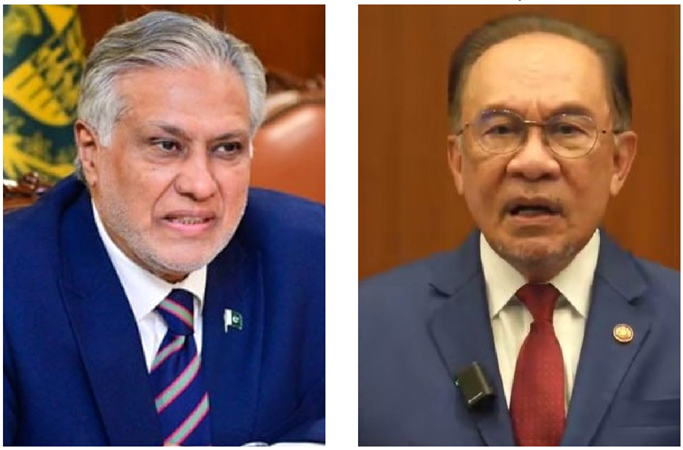
 Deputy Prime Minister and Foreign Minister Ishaq Dar stressed the need for de-escalation, dialogue, and diplomacy to address ongoing challenges during phone calls with Malaysia’s Foreign Minister Mohamad bin Haji Hasan and EU High Representative Kaja Kallas.
Since the outbreak of the conflict involving the US, Israel, and Iran, Pakistan’s leadership has intensified diplomatic efforts to help ease regional tensions.
Dar has held telephonic discussions with counterparts from several Gulf states and other countries, stressing the importance of de-escalation and advocating for dialogue and diplomacy in line with the principles of the United Nations Charter.
During his conversation with Malaysian FM Hasan, the two leaders reviewed recent developments in the region and the wider international context.
They underscored the critical need for dialogue and diplomacy to address ongoing challenges, according to the Ministry of Foreign Affairs.
Both leaders agreed that peaceful solutions must be prioritised to ensure regional stability.
Separately, Dar also spoke with EU High Representative Kaja Kallas, exchanging views on similar regional concerns.
The discussion reaffirmed the importance of dialogue and diplomacy, with the DPM highlighting the need for continued efforts to de-escalate tensions.
Both leaders agreed to remain in close contact regarding the evolving situation, reinforcing their shared commitment to peace and stability.
Earlier, Malaysia’s Prime Minister Anwar Ibrahim on Wednesday strongly endorsed Pakistan’s offer to mediate between the United States and Iran, calling it a “timely and constructive” initiative, and urged all sides to seize what he described as a narrowing window for diplomacy.
In his statement posted on X, Anwar praised Pakistan’s leadership, particularly Prime Minister Shehbaz Sharif, along with other international actors, for stepping forward “at a moment of acute regional danger.” He also acknowledged earlier facilitation efforts by Oman and other partners.
Highlighting Pakistan’s diplomatic reach and standing in the Muslim world, Anwar said Islamabad is well positioned to help create conditions for meaningful negotiations between Washington and Tehran. “Malaysia supports this initiative and encourages in particular the United States and Iran to respond in the spirit in which it was offered,” he wrote, stressing that “there remains some space for diplomacy” that must be treated with urgency and seriousness.
The Malaysian premier emphasized that any talks must pursue a genuine and lasting resolution rather than short-term pauses, warning against ceasefires that serve only tactical purposes. Reaffirming Malaysia’s commitment to international law, he noted Iran’s right to defend its sovereignty while urging restraint from all sides, particularly amid continued Israeli strikes in Iran and Lebanon. He cautioned that further escalation risks drawing in Gulf states and destabilizing the wider region.
Anwar also underscored that the credibility of the rules-based international order depends on consistency and equal accountability. He revealed ongoing engagements with leaders from the Gulf Cooperation Council, Türkiye, Egypt, Indonesia, Japan, Pakistan and others to push for de-escalation and peaceful resolution.
“Malaysia will continue to support every credible effort towards a just and lasting peace,” he concluded.