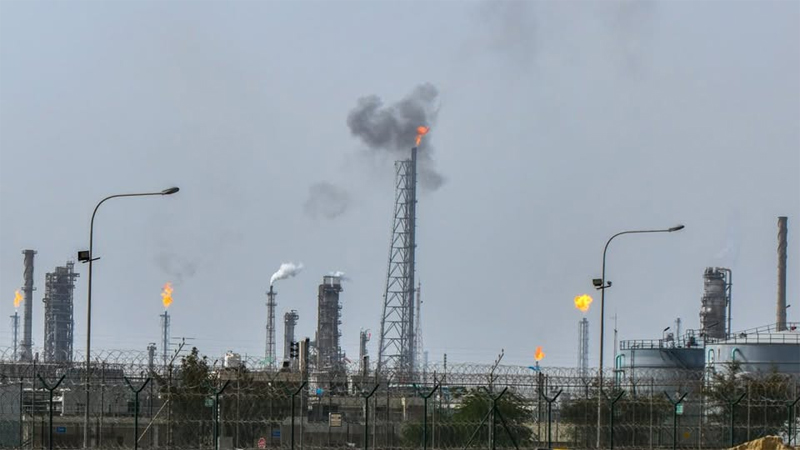
 Iran threatened on Sunday to attack key infrastructure across the Middle East if US President Donald Trump follows through on his vow to “obliterate” the Islamic republic’s power plants unless the Strait of Hormuz swiftly reopens.
Iran’s defiant response came after its missiles slipped through air defences and struck two towns in southern Israel including one housing a nuclear facility, underscoring Tehran’s continued ability to retaliate as the war entered its fourth week.
Trump ratcheted up pressure on Iran’s leadership, announcing a countdown over the Islamic republic’s de facto blockade on the crucial trade route.
Trump wrote on Truth Social that the US would “hit and obliterate” Iranian power plants “starting with the biggest one first” if Tehran did not fully reopen the strait within 48 hours, or 23:44 GMT on Monday according to the time of his post.
But Iran’s military operational command responded that if the country’s facilities were hit, “all energy, information technology and desalination infrastructure belonging to the US” in the region would be targeted.
Early Sunday morning, AFP journalists in Jerusalem heard blasts and air raid sirens as Iran launched a fresh barrage of missiles at Israel.
The alerts came hours after direct hits on the towns of Arad and Dimona wounded more than 100 people, in one of the most destructive attacks on Israel since the start of the war on February 28.
“There was a ‘boom, boom!’, my mother was screaming,” 17-year-old Arad resident Ido Franky told AFP near the impact site, where an AFP correspondent saw three damaged buildings and firefighters reported a blaze.
“This was terrifying… this town had never seen anything like this.”
Israel launched a fresh wave of strikes on Iranian capital Tehran on Sunday in response, while the Israeli military said it was investigating how air defence systems had failed to intercept the incoming missiles.
Iran’s attacks on Israel indicated that its arsenal still poses a threat across the region, even after Trump and Israeli Prime Minister Benjamin Netanyahu claimed to have decimated Tehran’s forces.
Dimona hosts what is widely believed to be the Middle East’s only nuclear arsenal, although Israel has never admitted to possessing nuclear weapons, insisting the site is for research.
The missile fell about five kilometres (three miles) from the nuclear facility, according to rescuers. Iran said the strike on Dimona, which tore open residential buildings and gouged craters into the ground, was in response to an earlier attack on its nuclear site at Natanz.
US Treasury Secretary Scott Bessent claims Washington can comfortably fund the war on Iran and will not need to increase taxes to do so, Al Jazeera reports.
Speaking on the NBC News programme ‘Meet the Press’, Bessent said, “We have plenty of money to fund this war,” adding that a supplemental budget request sought by the Pentagon – reported to be $200bn – would be for the military’s future capabilities.
Meanwhile Iran has kept up retaliatory attacks on Gulf nations it accuses of serving as a launchpad for US strikes. Saudi Arabia said Sunday it detected three ballistic missiles around the capital Riyadh. One was intercepted, and two fell in uninhabited areas, the defence ministry said.
The United Arab Emirates said it responded to new missile and drone attacks from Iran, after the Islamic republic warned its neighbour against allowing strikes from disputed islands near the Strait of Hormuz.
In Lebanon, the Iran-backed Hezbollah militant group said it attacked Israeli soldiers in northern Israel’s Misgav Am, where first responders said rocket fire from Lebanon killed one person. The death is the first Israeli fatality from fire from Lebanon since fighting started with Hezbollah on March 2.
The war has also spilled into Iraq. At least six overnight attacks targeted a US diplomatic and logistics centre at Baghdad’s International Airport, two Iraqi security officials told AFP on Sunday.
Separately, Türkiye’s Foreign Minister Hakan Fidan on Sunday discussed “steps to end” the war initiated by US and Israel on Iran over a phone call with his counterparts from Egypt and Iran, as well as with US and EU officials, according to Turkish diplomatic sources.
Fidan held separate calls with Iranian Foreign Minister Abbas Aragchi, Egyptian Foreign Minister Badr Abdelatty, EU’s foreign policy chief Kaja Kallas and officials from the US. No further information on the calls was provided.