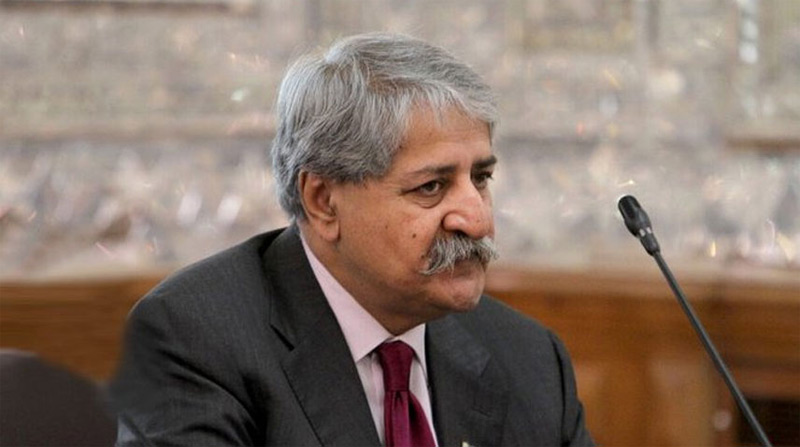
Senior PPP leader Syed Naveed Qamar on Monday urged the government not to shift the full impact of rising global oil prices onto the public.
Speaking in the National Assembly, he said international oil prices had recently increased due to the ongoing conflict involving Iran, Israel and the United States, which had disrupted oil supplies in the region.
Qamar said Iran had taken steps that affected the movement of oil tankers and cargo ships in the Strait of Hormuz, limiting the supply of oil to global markets, particularly to Asian countries. He added that some oil-producing countries in the Gulf had also started reducing production because shipping disruptions were making exports difficult.
He said the rise in global oil prices was understandable in the current circumstances.
The PPP leader pointed out the recent increase of Rs 55 per litre by the government, adding that the global oil prices were still around $90 per barrel.
Referring to Pakistan’s programme with the International Monetary Fund (IMF), he urged the authorities to engage with the IMF in order to minimize the impact of petrol prices on public.
Meanwhile, Minister for Parliamentary Affairs Tariq Fazal Chaudhry informed the National Assembly that more than 2,000 Pakistani students have started returning from Iran as the government continues to monitor the situation and facilitate their safe return.
Speaking during the Question Hour, the minister said the number of Pakistani students moving from Iran towards Pakistan had crossed 2,000.
Minister of State for Interior Talal Chaudhry informed the National Assembly that the capacity of a hospital mainly serving employees of the Capital Development Authority (CDA) and their families had been increased to 416 beds after 136 beds were added in 2022.
Responding to questions during the Question Hour, he said the hospital was primarily used by CDA employees and their families. With the addition made in 2022, the total bed capacity of the hospital reached 416.
The minister said there was no more space available to increase the number of beds. “It is not possible to add more beds at this time because the facility has reached its maximum capacity,” he told the House.
Talal Chaudhry said the bed occupancy rate usually remained between 60 and 70 percent, which showed that beds were generally available when more patients needed treatment.
He also highlighted improvements in the hospital’s staffing, saying that all departments are now fully functional with adequate staff.
“For the first time, the hospital has a complete staff structure and all departments are working,” he said.
He added that only 79 posts were still vacant, mostly for nurses and paramedical staff, while all other positions had been filled.
The minister said the addition of 136 beds two years ago had significantly increased the hospital’s capacity, but there was currently no room to expand the facility further.
Responding to another question, Talal Chaudhry said the Ministry of Interior had no direct role in deciding whether elections were held or postponed. He said the ministry only implemented decisions after legislation was passed and the Election Commission of Pakistan announced the polls.
He explained that the authority to conduct elections rested with the legislature and the Election Commission. “The Interior Ministry has no direct role in the holding or delay of elections,” he said.