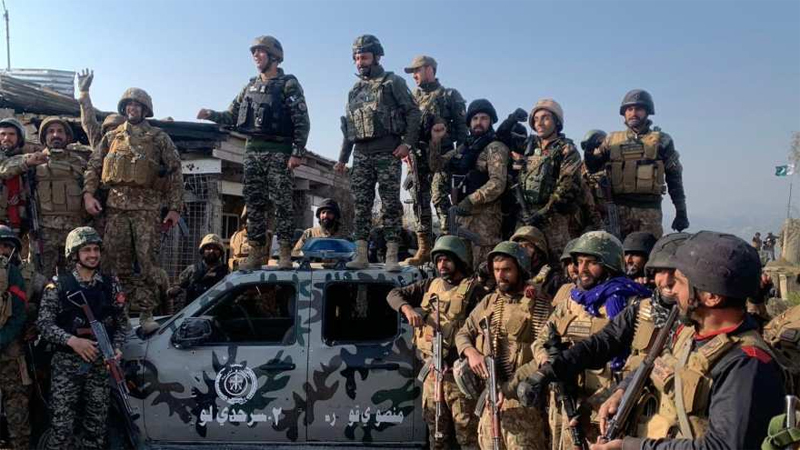
 Security sources on Thursday confirmed that several
mid-level leaders of TTP were eliminated during Pakistani military strikes conducted under Operation Ghazab-lil-Haq.
A senior security official said that the Afghan Taliban were well aware of Pakistan’s concerns and demands, adding that the regime needed to take “verifiable steps” if it wanted a ceasefire or a dialogue.
Briefing KP-based journalists at the ISPR headquarters, the senior security official said, “If they want dialogue or a ceasefire, they must take verifiable steps. Pakistan does not wish to attack anyone; our priority remains the country’s security.”
He further said that the Pak-Afghan border was the only international border that was “guarded on one side” by Pakistan, instead of maintaining bilateral surveillance.
“On the other side, terrorist elements are provided shelter in the border areas and facilitated,” the security official said.
In an apparent reference to the ongoing operation, he added that despite the prevailing situation, Pakistan was demonstrating “utmost responsibility” by minimising collateral damage.
“Civilian population has not been targeted in any operation carried out by Pakistan,” he said, adding that operations were “limited to terrorist camps and military targets”.
Recalling past attempts at dialogue in the aftermath of the October clashes with Afghanistan, the official said that three different countries played a role in working towards a resolution.
“These countries have accepted the evidence provided by Pakistan and have also convinced the Afghan Taliban that Pakistan’s concerns are absolutely valid,” he said. However, he noted that no change had been observed on the part of the Afghan Taliban.
“The reality is that there is a clear nexus between terrorism and crime in Afghanistan,” he said, adding that the Afghan Taliban were harbouring several terrorist organisations and acting as their “master proxy”.
He said that Pakistan initially carried out attacks on TTP camps. However, in response, the Afghan Taliban resorted to attacking Pakistan’s border posts set up to prevent terrorist infiltration, he said.
He said that operations aimed at dismantling militant networks and eliminating terrorists within Pakistan were also underway.
However, the official said that until the entire nation “develops a clear and unified narrative against terrorism, total eradication may not be possible”.
“The NAP was formulated with this objective in mind, so that along with terrorism, extremism and crime spreading in the society can also be curbed,” he said. “Vacuums in internal security systems and governance further strengthen terrorism,” the official added.
He further said that Pakistan held no “interventionist agenda” concerning Afghanistan, stating that the neighbouring country’s political landscape was a matter for the Afghan people.
He said that security forces had destroyed all 36 posts inside Afghanistan, which were being used to launch attacks against Pakistan.
Talking about KP, he said that the provincial government was serious about counterterror operations. “The provincial government is well aware of the threat,” he said.
He also talked about the targeting of the Bagram base in Afghanistan, saying that the purpose was to destroy weapons and ammunition used against Pakistan. He further said that there was no need for a full-scale operation in KP’s Tirah.
Meanwhile, Armed Forces intensified Operation Ghazab-ul-Haq, with the Pakistan Air Force reportedly destroying a brigade headquarters of the Afghan Taliban in Kandahar.
According to security sources, the air operation targeted the Taliban’s brigade headquarters of the 205 Corps in Kandahar, while the Pakistan Army simultaneously struck and destroyed several ammunition depots belonging to the group.
Moreover, three people were injured after a shell fired from Afghanistan struck a house in Mamad Kor area of KP’s Mohmand district, police sources said.