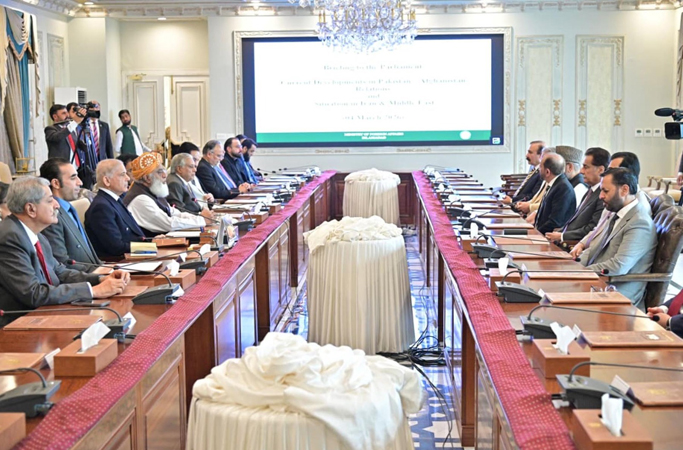
 Prime Minister Shehbaz Sharif on Wednesday emphasised the need for national unity and solidarity while chairing a meeting of parliamentary parties’ leaders and representatives of political parties to brief them on the regional security situation.
The participants were given an in-camera briefing on the Pakistan-Afghanistan situation, developments concerning Iran, conflict in the Middle East and the Gulf region and Pakistan’s diplomatic efforts.
Sources told media that the participants were also briefed on the country’s security situation, with political leadership taken into confidence over key developments.
They added that PM Shehbaz also informed participants of the huddle about his recent contacts with leadership in the Middle East and shared details of diplomatic engagements undertaken during the recent regional tensions.
During the meeting, the parliamentary leaders of the political parties expressed their views openly, the PM Office Media Wing said in a press release.
They appreciated the diplomatic efforts being made by Pakistan for the regional peace, and stressed the need to further intensify them, besides presenting their suggestions for the future course of action.
All participants reaffirmed their strong resolve to eliminate terrorism from the country.
They also appreciated the prime minister’s initiative of taking all the political leadership into confidence in the broader national interests and thanked him.
Federal Minister for Law and Justice Azam Nazeer Tarar told the media later that a proposal had been put forward to convene a joint sitting of parliament to deliberate on developments concerning Afghanistan and the Middle East.
He added that it had been suggested Prime Minister Shehbaz Sharif and Foreign Minister Ishaq Dar would jointly brief lawmakers from both the opposition and treasury benches on the prevailing international situation and Pakistan’s role within the evolving regional landscape.
Prominent figures, who attended the briefing include Deputy Prime Minister and Foreign Minister Dar, National Assembly Speaker Ayaz Sadiq, Deputy Speaker Ghulam Mustafa Shah, and Pakistan Peoples Party Chairman Bilawal Bhutto Zardari.
Jamiat Ulema-e-Islam-Fazl (JUI-F) chief Maulana Fazlur Rehman, along with federal ministers Ahsan Iqbal, Azam Nazeer Tarar and Attaullah Tarar, also attended the session.
Speaking to the media after the meeting, Sanaullah provided some insight into the briefing’s discussions.
He highlighted that Pakistan’s efforts on the diplomatic front were that “this war imposed on Iran ends in some kind of agreement or understanding”.
Asked whether Saudi Arabia and Iran were in direct contact with each other or Islamabad was acting as a mediator, Sanaullah stated, “Pakistan is doing this work of communication.”
He pointed out that the political and military leadership have made contacts regarding the ongoing hostilities, and it was also stated in the briefing that they were trying to convince Iran not to attack Gulf countries.
Sanaullah noted that if the attacks on Gulf countries stop and “those countries also add their weight that this war should end”, then there would be greater chances of an agreement to end the hostilities.
About whether the Middle Eastern countries could push US to halt its attacks, the senator said a “strategy” was being carved out, with various leaders, including former foreign minister Bilawal, giving their recommendations.
The minister further said that “engagement was underway to seek clarity” on Iran’s concerns of Gulf countries’ territory being possibly used for strikes against it.
Responding to a question, Sanaullah said the political and military leadership were engaged in communication to “resolve misunderstandings” and halt retaliatory attacks from Iran directed towards Gulf countries.
About arch-enemies Iran and Israel, the senator affirmed that Iran “definitely has the right to respond to aggression done against it”, adding that leaders voiced the same opinion in the meeting.
Speaking about the opposition’s decision to skip the important briefing, Sanaullah expressed disappointment at the opposition’s “attitude of isolation”, adding that the PTI did not believe in dialogue.
Separately, the US has urged its citizens in Pakistan to remain cautious, saying that there was a risk of terrorist violence, including terrorist attacks and other activity in the country.
The United States Department issued an advisory on Wednesday, saying that violent extremist groups continue to plot attacks in Pakistan, especially in Balochistan and Khyber Pakhtunkhwa, adding that they have also occurred in major cities such as Karachi and Islamabad.
“Terrorists may strike without warning. They target transportation hubs, hotels, markets, malls, military and security forces sites, airports, trains, schools, hospitals, places of worship, tourist spots, and government buildings,” it said.