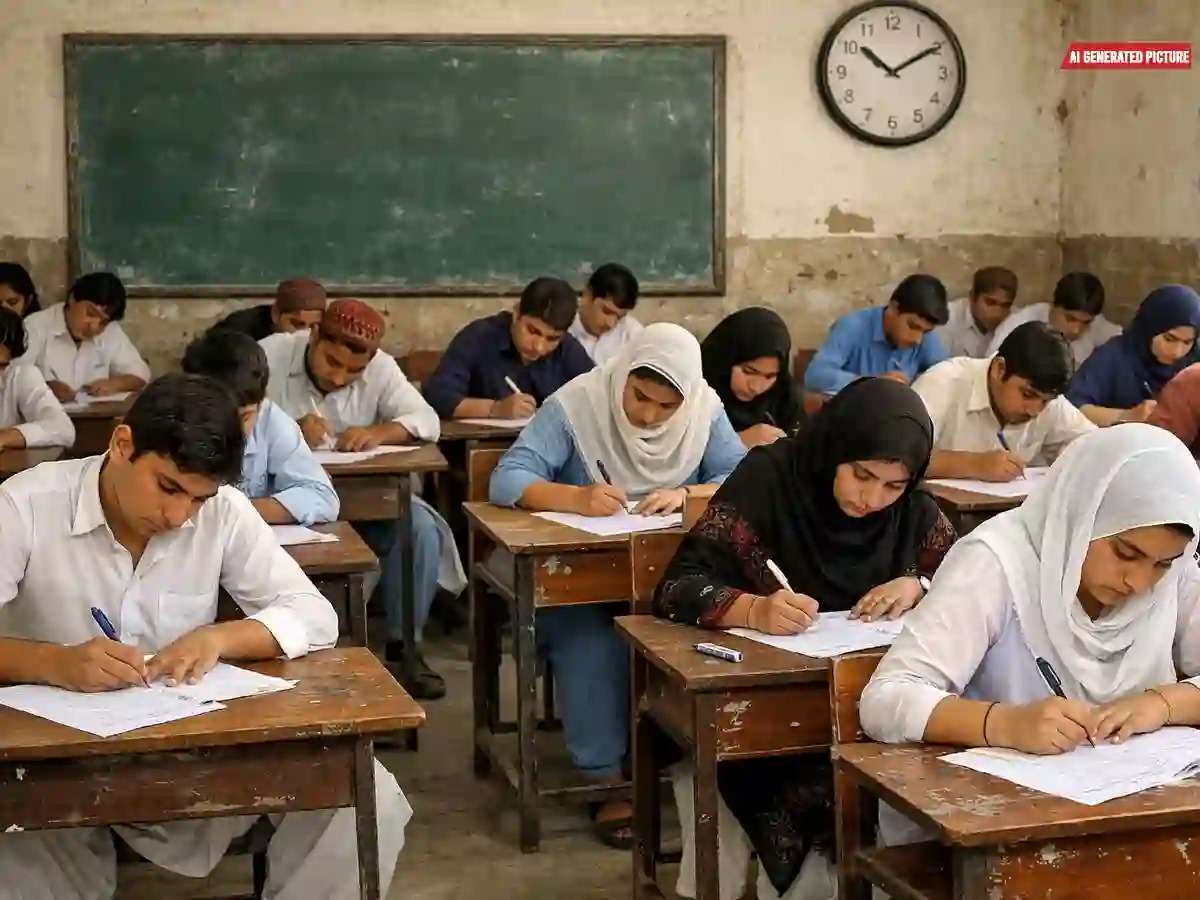
The Sindh government has approved a new grading system for matric and intermediate exams, replacing the traditional marks system. Students scoring below 40% will now be considered failed. The decision follows policy directives from the Inter Board Coordination Commission (IBCC).
Under the new system, student performance will be categorised as A++ (96-100%), A+ (91-95%), A (86-90%), B++ (81-85%), B+ (76-80%), B (71-75%), C+ (61-70%), C (51-60%), D (40-50%), and U (below 40%). Students receiving a ‘U’ grade can reappear in the same paper to improve.
Read more: Govt approves ‘grading system‘ in place of ‘marks’ in educational
The system will be introduced in phases, starting in 2026 for first-year matric (class 9) and intermediate (class 11) exams. In 2027, it will apply to final-year exams for classes 10 and 12. The phased approach ensures smooth implementation across all boards.
Sindh Minister for Universities and Boards Ismail Rahoo said the reform aims to create uniformity across all educational boards. Once fully implemented, the system will also support a Grade Point Average (GPA) system in the future.
Read more: Sindh ends marks system, adopts modern grading
Officials believe the new grading system will reduce exam stress and provide a clearer evaluation of students’ abilities. The reform aligns Sindh’s education system with international standards.