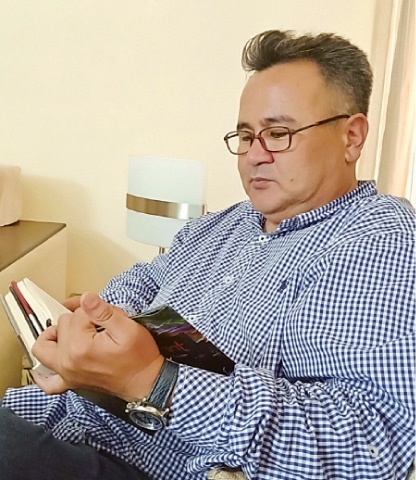
Ali Baba Taj, a Hazara poet, academic and quiet believer in Quetta’s shared cultural soul, passed away on November 9 in a hospital in Karachi. He was 48. His death marked a rare and painful moment for a city where too many lives have been claimed by violence rather than time.
Born in Quetta in 1977, Taj belonged to the Shia Hazara community, which has faced decades of relentless sectarian attacks in Balochistan’s capital. Yet he never surrendered his faith in a plural, humane Quetta — a city he believed could still belong to all its people despite the scars of bloodshed.
Read More: ‘Anarkali’ — exploring truth behind the legendary slave girl’s death
Taj wrote poetry in Urdu and Persian, exploring themes of life, loss and quiet resistance. His 2007 poetry collection Muthi Mein Kuch Saansain reflected both personal introspection and the broader anxieties of a city under siege. He earned a master’s degree in Persian language and literature from the University of Balochistan in 2003 and devoted his life to teaching, eventually becoming a professor of Persian at Musa Degree College in Marriabad just weeks before his passing.
Deeply embedded in Quetta’s literary circles, Taj grew up in an environment where writers from diverse ethnic and linguistic backgrounds — Baloch, Pashtun, Hazara, Punjabi and Sindhi — shared ideas and creativity. As violence tightened its grip on the city, that collective spirit faded, but Taj continued to embody it in his friendships and work.
Despite grave security threats, he resisted isolation and refused to let fear define his existence. At times, he disguised his identity to move across the city, determined to maintain connections beyond the boundaries imposed by violence.
Taj also represented Pakistan internationally, including at the World Poetry Festival in Kolkata in 2008, when cultural exchange between India and Pakistan was still possible.
Read More: Malika Pukhraj — a strong, unique and tuneful voice
For many who knew him, Ali Baba Taj’s passing is especially poignant. He died a natural death — something tragically uncommon among the many Hazara lives remembered in Quetta’s cemeteries. With his death, the city lost not only a poet and teacher, but a gentle reminder of the Quetta it once was — and could still be.